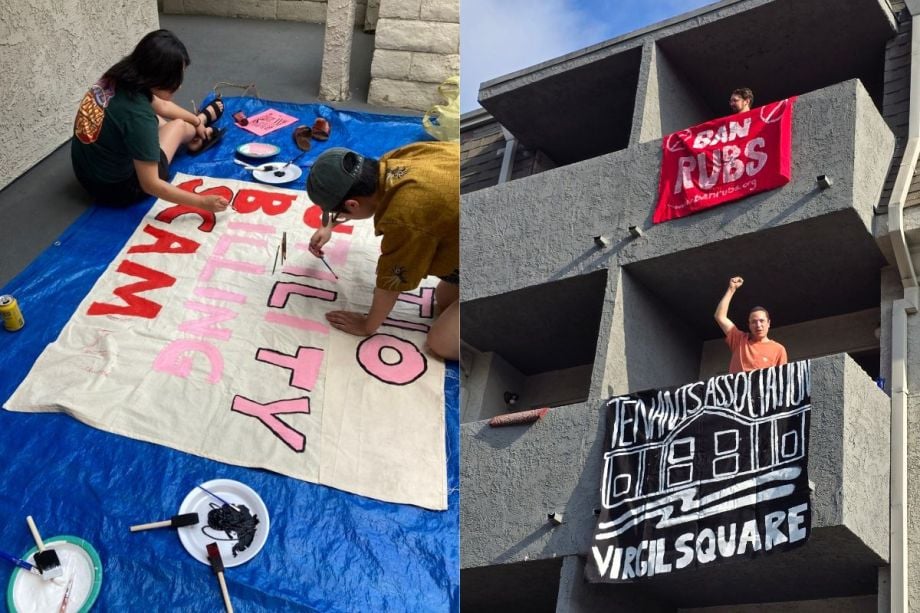
Above photo: Virgil Square Tenants Association.
Their Fight Isn’t Over.
Ratio utility billing systems can allow landlords to quietly shift building utility costs onto tenants. Tenants say it’s time to break open the black box.
When Joe Porter, a 29-year-old video editor, moved into his 400-square-foot studio apartment in Los Angeles four years ago, his bills for water, trash removal and pest control were bundled together into one monthly payment that came out to about $60. After the first few years, Porter said, his bill increased to about $200.
When he asked his landlord – the giant real estate investment trust Equity Residential — for an explanation, he was told billing was done by a third party and that Equity could not provide a more detailed breakdown. Like many landlords of multifamily buildings, Equity uses a billing method called ratio utility billing systems (RUBS). Landlords who use this system divvy up the costs of the building’s total utilities usage according to each unit’s square footage and number of tenants.
Porter had no luck getting more of an explanation from Equity. “Because I was on my own, management didn’t pay any attention to me,” Porter says.
But late last year, Porter and others who live in Virgil Square Apartments formed a tenant association and began organizing their neighbors. After launching a RUBS strike in June that involved dozens of tenants refusing to pay the bundled utility bills, they’ve secured some big wins.
Equity agreed in August to decrease tenants’ monthly RUBS bills, acknowledged that the tenants were being overcharged and issued a total of $25,000 in refunds. But tenants are still on strike, as their demands include Equity providing a breakdown of the underlying utility costs and the formula it uses to calculate bills. They are also pushing the city to mandate that landlords be more transparent in tenant utility bills.
Porter attributes the strike’s success thus far to collective action. “The only way we accomplished that was by organizing, by collectively making noise, collectively withholding payments and doing it together. Because individuals have tried stuff like this, and management has not responded at all,” Porter says.
How RUBS Works
RUBS is used by landlords in multifamily buildings around the country where individual units do not have their own meters to measure water use, also called submetering. It has been criticized for its opaque nature — tenants never see the underlying charges or the formula used to divide costs — and for allowing landlords to shoehorn in costs that should be borne by owners, like utility use in common rooms.
According to Alex Ferrer, a researcher at the L.A. tenants rights nonprofit SAJE, RUBS has become widespread in California apartments that don’t have submetering.
Ferrer and other tenant advocates say that because the RUBS formulas are a black box, it can be used as a backdoor way to raise rents on rent-regulated units. For that reason, Ferrer and others prefer that utilities be added to a unit’s base rent, where statewide California policies and local laws regulate against sharp increases.
Rose Lenehan, an organizer with The Debt Collective and LA Tenants Union who helped organize tenants at Virgil Square, believes that the Tenant Protection Act of 2019 (also known as Assembly Bill 1482) and other local laws expanded RUBS use.
And some property managers overtly promote RUBS as a way to charge more money than rent caps allow. For example, a post on Beachfront Property Management’s website titled “How a Ratio Utility Billing System (RUBS) Reduces Expenses,” explains that California Assembly Bill 1482 “does not put a cap on utility rates.” It says that landlords “proportionately sharing utility bills with residents means a significant reduction in expenses.” The website says that RUBS is cheaper than installing submeters and “does not require equipment, thus requiring less initial investment from the start.”
Landlords often argue that RUBS incentivizes tenants to conserve more water, Ferrer says. But tenants have no idea how much of their increased bill is a result of their neighbor’s usage or their landlord’s, nor do they have control over building-wide issues like leaks that can cause bills to spike.
“Tenants don’t have control over maintenance of building infrastructure or proper maintenance of pipes and walls,” Ferrer says.
Some research backs up the idea that RUBS actually leads to more water use. According to a 2004 national submetering study funded by the Environmental Protection Agency and 10 American cities, submetered properties saved on water usage compared to other properties, while RUBS properties did not.
While the most accurate utility bills would result from individual meters in each unit to track energy usage, Ferrer says that landlords don’t pay for these fixes because of the cost — potentially thousands per unit — and added administrative burden. But Ferrer says this cost is “extraordinarily cheap” when considering the conservation effect and the savings for tenants.
This is why tenants want LA’s city council to push the housing department to finish developing a set of recommendations for a utility bill ordinance, as required by a February 2023 law, that could regulate RUBS. The housing department was supposed to send a report to the council by April 2023 with recommendations for an ordinance that would “require greater transparency for tenant utility bills.” The ordinance is expected to regulate the billing of common area expenses and to require that landlords provide detailed information to tenants explaining how they calculate utility bills. The report to the council has still not been produced two years later.
When reached for comment, Sharon Sandow, a spokesperson for the LA Housing Department, said, “The RUBS report will be out by the end of the year.” Sandow did not provide an explanation for the delay. According to Porter, “We’ve been trying to put the pressure on them by contacting city council people to try to get movement on this again.”
While Ferrer believes that the city should ban RUBS altogether, encourage submetering or push forward on the report it never released, he argues that previous court decisions have found that tenants have the right to know if the amount they’re being charged reflects their landlords’ utility bills.
Organizing At Virgil Square
Angie Jahja, 25, a resident of Virgil Square who helped organize tenants, says the RUBS strike began gradually.
In April, tenants issued a petition to Equity with 88 resident signatures demanding transparency in their utility bills. They also demanded to be provided with Equity’s utility bills from the Los Angeles Department of Water and Power and the city’s sanitation department.
When Equity didn’t concede any demands, tenants escalated by posting their utility bills onto their doors, visible to prospective tenants who were touring vacant apartments.
“We wanted to make it very public,” Jahja says, adding that it scared some prospective tenants away. They also held press conferences, painted banners and hung them on balconies with messages that said “Ban RUBS” and “Don’t Rent Here.”
In response, Equity issued a lease violation notice to Jahja and others on June 6. A month later, a law firm representing Equity sent her a letter citing a lease addendum that says, “do not hang flags or other items from balconies or windows.” The letter warned her that the landlord would terminate Jahja’s rental agreement if the banner was not taken down in three days.
The RUBS strike began in June with 43 units — a significant percentage of the 140-unit building, of which 130 units are occupied. More tenants joined the effort in July and August.
In an Aug. 11 email to Virgil Square tenants viewed by Next City and Shelterforce, the building’s management said it would credit individual tenants for “a larger-than-expected RUBS water and RUBS sewer bill for the period between December 2023 and May 2025.” The email attributes this to “additional water usage by toilet flappers and fill valves that were recently discovered to be leaky, after a lengthy investigation to rule out other potential causes,” saying that the faulty parts have been replaced. The letter says that future bills will be lowered as well to provide “relief” on a “lookforward basis.”
Virgil Square management also says in the email that an exact estimate of how much tenants were overbilled is “difficult and impracticable” to calculate, because “water and sewage usage varies continuously and it’s difficult to determine the exact impact of any individual element that contributes.”
Lenehan of The Debt Collective and LA Tenants Union says Equity is still not answering basic questions that tenants asked in April.
“We have no idea where those numbers are coming from,” Lenehan says of Equity’s email.
Lenehan speculates Equity issued the refund because it was concerned about a lawsuit from tenants. “I think it’s a huge victory, but it’s also an admission of guilt,” Lenehan says. Next City/Shelterforce reached out to Equity for comment but did not receive a response.
Jahja and other tenants say the strike will continue until Equity responds to their demands for transparency.
“The refund is a big achievement for us, but that is not what we wanted,” says Jahja, who lives in a two-bedroom, two-bathroom unit with her partner. Together, they pay about $2,800 between base rent and “junk fees,” and their RUBS bill had put their monthly payments at about $3,000.
When the company issued a refund, Jahja got $700 back and her monthly bill was lowered from around $200 to around $130, although her most recent bill was $230.
Jahja shared her two most recent RUBS bills with Next City and Shelterforce. In September, the bill totaling $130.82 shows the following:
-
a $2 charge for pest control (all tenants and organizers interviewed say this charge is likely illegal and should be covered by the city’s warrant of habitability.)
-
a $26.31 charge for sewer services
-
a $55.60 charge for trash
-
a $4.87 trash admin fee (the bill says this is the cost for a third-party company, Conservice, to prepare the bill)
-
a $42.84 water charge.
An October bill comes out to $230.48, with most of that increase coming from a $111.39 water charge.
Jahja believes that RUBS disincentivizes Equity from repairing leaks that could be causing water bills to spike. She says the building has leaks in the pool and garage.
Lenehan says the success of the strike at Virgil Square can be replicated at other buildings.
“In any building where tenants build a solid organization, the company would find it prudent to do the same thing,” she says. She guessed that returning funds was a way for Equity to “make the ledgers look a little better” in case tenants sue them in the future.
As for further demands, Lenehan says, “We want RUBS to be totally illegal.” She says without RUBS, “the landlord would have an incentive to make those systems more efficient.”