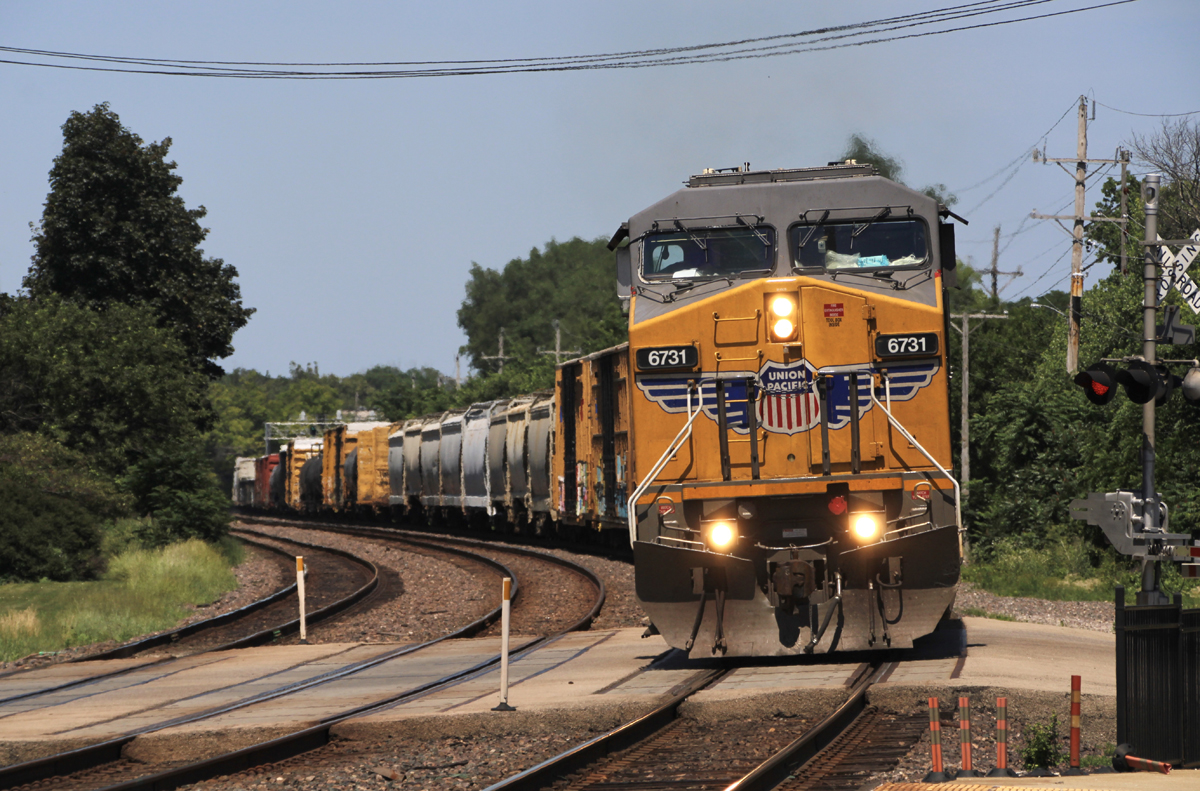
Above photo: A westbound Union Pacific manifest freight crosses Hill Avenue in Wheaton, Ill., on June 28, 2025. David Lassen.
UP says the merger will have a minimal impact on the number of trains operated.
The Stop the Rail Merger Coalition has posted an interactive map that combines projected merger-related increases in rail traffic and blocked-crossing and safety data.
The Stop the Rail Merger Coalition is looking to stir up local opposition to the Union Pacific-Norfolk Southern merger in trackside communities that would see an increase in train and truck traffic if regulators approve the proposed transcontinental combination.
The coalition — which includes BNSF Railway, CPKC, shipper organizations, and three rail labor unions — on Thursday released an online interactive map tool that combines projected merger-related increases in train traffic and freight volume with existing blocked-crossing and safety data.
The group urged local communities to participate in the Surface Transportation Board’s merger review process. The deadline to file a notice of intent to participate is Sept. 30.
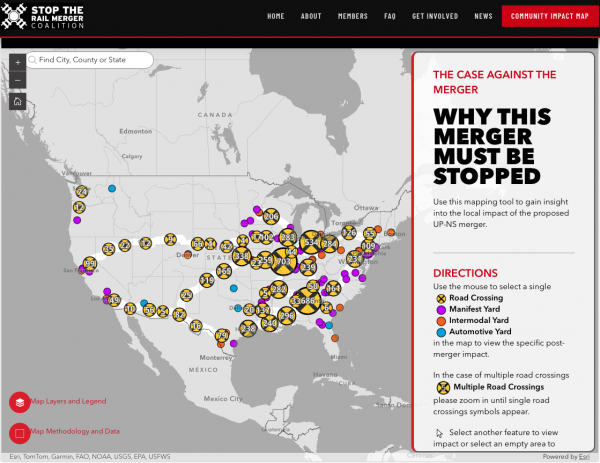
“This map provides a clear picture, for the first time, of how many communities will see negative impacts from this proposed UP-NS railroad merger,” Stop the Rail Merger Coalition said in a statement. “The STB must hear from state, county, and local officials, from first responders, and from the residents who will be living with the consequences of this merger.”
The Surface Transportation Board, however, has an online map on its website that depicts line segments and rail facilities that exceed its environmental review thresholds.
The STB’s environmental review will evaluate the local impacts of the merger on lines where traffic increases by eight or more trains per day or tonnage is projected to increase by 100% or more. The environmental impact statement will recommend mitigation measures, which the board can then make conditions of a merger approval.
Union Pacific, in a statement to Trains, said the merger will bring minimal changes to the number of trains the railroad operates, and that taking 2.1 million trucks off the highway will improve safety. A Trains review of the merger application found that the bulk of the projected merger-related growth will be handled on two dozen new trains, split evenly between intermodal and merchandise trains.
“We expect to launch less than 1% more trains per day, including local trains that are moving within communities to make deliveries, and less than 3% more cross-country train starts. That’s cargo that will come off highways, easing congestion and saving more than 1,700 lives from highway-related injuries and fatalities from large-truck incidents each year,” railroad spokeswoman Kristen South said in an email. “Our opposition is simply afraid to compete against a single-line railroad that can deliver customers’ goods safer, faster, and more reliably coast to coast.”
The coalition said that communities along more than 2,200 miles of UP-NS main line will see a 40% or more increase in the number of daily trains. Gross ton-miles are projected to increase by 40% or more on more than 5,000 miles of main line due to the operation of heavier or longer trains, the coalition said.
The combined railroad would operate a network totalling 52,215 route miles, according to regulatory filings.
Rail traffic will double at some grade crossings, the coalition said. And more than 50 intermodal and transload facilities are projected to see truck traffic increase by more than 20%, including the Inland Empire, Calif.; Centreville, Ill.; Toledo, Ohio; and the Twin Cities, Minn. “All are projected to see increases above 225%, with Inland Empire exceeding 400% and Centreville reaching 400%,” the coalition said.
According to the FRA’s blocked-crossing data, UP accounts for more blocked-crossing reports than all other U.S.-based Class I railroads combined, which the coalition said raises questions about the potential community impacts of additional traffic resulting from the proposed merger.
In Houston, the railroads project an almost 140% increase in intermodal truck traffic and a 15% increase in auto-carrier truck traffic within five years, the coalition said. Houston has long been a blocked grade-crossing hot spot. Since 2020, the FRA has received more than 20,000 blocked-crossing reports from the Houston area.
But the FRA’s database is not a scientific representation of block crossings. Rather, it relies on motorists who contact the agency — and if six motorists call about a single incident, it is counted six times.
Opposition to merger-related increases and shifts in train traffic is nothing new, particularly in Chicago.
Chicago suburbs banded together to oppose Canadian National’s 2009 acquisition of the Elgin, Joliet & Eastern, which turned the sleepy railroad into a busy corridor linking CN’s lines to Western Canada, Eastern Canada, and the Gulf Coast. The STB mandated grade-crossing improvements such as overpasses and underpasses, quiet zones, and fencing and noise barriers.
More recently, Chicago suburbs opposed Canadian Pacific’s 2023 acquisition of Kansas City Southern, citing projections for increased train traffic.