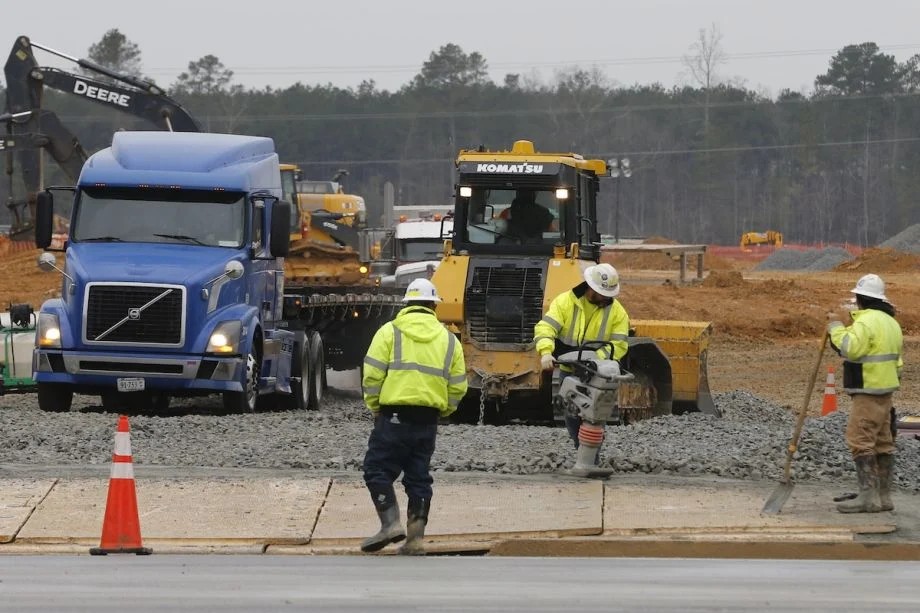
Above photo: Workers prepare a construction entrance to the Facebook data center that is being built in Sandston, Va., Wednesday, Feb. 7, 2018. Steve Helber / AP.
Local governments need a new framework for evaluating construction‑phase transportation.
To avoid saddling communities with undisclosed impacts.
Across the country, communities are pushing back against the rapid expansion of data centers. In Northern Virginia, Phoenix, Austin, Atlanta, and other localities, public opposition has grown loud enough to stall rezonings, trigger moratoriums, and reshape local elections.
The political pressure is mounting because the scale of the boom is staggering. The United States now hosts more than 5,300 data centers, according to industry tallies, with hundreds more planned or under construction. Northern Virginia alone contains the world’s largest cluster, and states from Ohio to Texas are racing to approve new campuses. But they have become a major political liability for elected officials as residents see their utility bills explode.
Still, the transportation footprint that begins years before a data center even opens has been left out of the equation so far. Understanding that impact is essential to remedying the regulatory environment in which they get built.
The myth of low traffic
Data centers are routinely sold to communities as low-traffic land uses. On paper, that claim seems true. Their operational trip generation is legitimately small, a point developers are quick to emphasize.
The Institute of Transportation Engineers’ Trip Generation Manual, used by public‑sector planners to evaluate development proposals and rezonings, gives data centers some of the lowest daily trip rates of any industrial use — often just a few dozen vehicle trips a day. Data centers have no customer traffic and only a handful of employees. Industry reports, like Cushman & Wakefield’s Americas Data Center Update, also focus almost entirely on power capacity, fiber access, and vacancy rates.
Once construction begins, it’s another story.
Building a hyperscale data center is a multi-year freight operation, not a normal office build out. Structural steel, concrete, generators, transformers, cooling equipment, and oversized loads arrive day after day, often for years. The volume of freight is similar to major infrastructure projects, pushing heavy trucks onto local roads that were never designed for sustained cargo movement.
In fast-growing data center corridors, residents have grown familiar with the consequences: long backups behind slow moving trucks, lane closures for oversized loads, and pavement that deteriorates far faster than expected.
Almost none of this shows up in the official review process. Traffic impact analyses focus almost exclusively on post-construction operational trips; local governments lack the tools to evaluate multi-year freight surges; and developers are rarely required to disclose detailed construction logistics. The result is a permitting environment that underestimates transportation impacts, leaving communities to absorb congestion, road wear, and safety risks that were never part of the public conversation.
Northern Virginia as a case study
Northern Virginia offers the clearest view of what happens when data center growth outpaces regulations. In Loudoun County, where data centers now dominate entire corridors, the approval process has never required a full accounting of construction related transportation impacts. As a result, the region has watched its suburban road network absorb industrial scale freight without any corresponding changes in planning, maintenance, or mitigation.
The effects are all too obvious. Multi-year construction schedules have turned once-ordinary arterials into continuous truck routes, with heavy vehicles circulating for months at a time. Pavement is wearing out faster than county budgets anticipated, forcing accelerated resurfacing cycles for communities nearby. Residents in Loudoun and neighboring Prince William County have shown up at public hearings describing backups behind slow moving trucks, surprise lane closures, and roads that seem to crumble long before their expected lifespan.
Northern Virginia’s approach is no longer local, either. Other cities nationwide are now copying its review framework, evaluating data centers almost entirely on their post‑construction footprint and replicating a regulatory blind spot.
What can local governments do?
Traditional traffic analysis tools aren’t built for projects where the biggest surge in traffic happens before the facility opens. So how can localities assess potential impacts more accurately? Kittelson & Associates, a prominent transportation engineering and planning firm, offers a five-step framework for how local planning and zoning authorities can adapt:
- Understand that traffic impact analyses must be scoped differently from the start, recognizing that construction traffic is significant, temporary, and often occurs outside commuter peaks. A standard daily trip model will miss the mark unless paired with a strong construction management plan.
- Build an accurate construction traffic profile, something the Trip Generation Manual can’t provide. Work directly with developers and contractors to understand workforce schedules, delivery patterns, and where workers are traveling , especially since many sites are in rural areas far from the labor pool.
- Identify real system constraints by overlaying construction traffic on existing conditions. Rural roads, unpaved segments, gated entries, and privacy-driven circulation limits can all create unexpected choke points.
- Prevent overbuilding. Temporary signals, flaggers, staggered shifts, off-site parking, and shuttle systems can manage short-term surges without saddling communities with long-term maintenance costs. In some cases, temporary roads can later be repurposed for community use.
- Assume that traffic will continue after construction ends. Equipment refresh cycles and ongoing deliveries for maintenance mean periodic traffic spikes around data centers.
The effects of data center growth isn’t just about land use or utility cost spikes for local communities. Unless local governments overhaul how they evaluate construction traffic, communities will keep absorbing impacts of a freight traffic surge that was never disclosed or planned for.