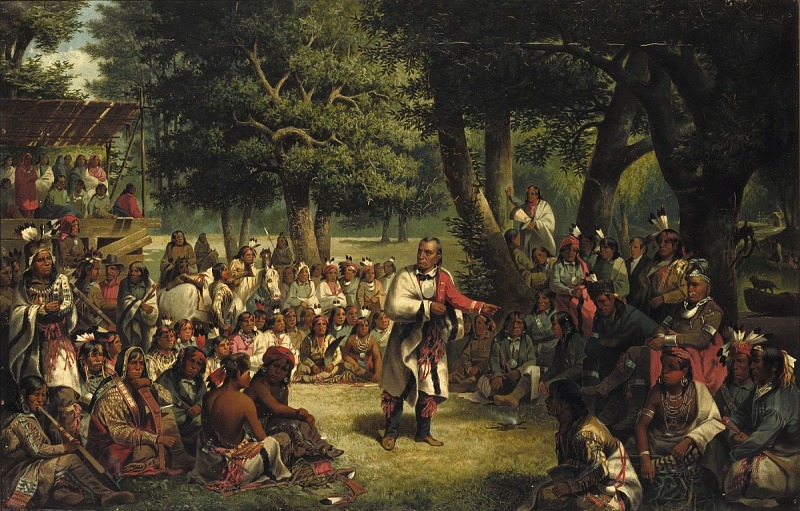
Above photo: John Mix Stanley, The Trial of Red Jacket, Smithsonian Institute.
One native source of our current democratic system goes back far longer than 250 years.
Pegged to last week’s semiquincentennial, two of today’s articles focus on overlooked sources of American democracy: Black churches and cooperatives. Right on, all true. But having recently returned from a trip to New York’s Finger Lakes, I want to highlight another: the Haudenosaunee (aka Iroquois).
Many centuries ago, the Mohawk, Oneida, Onondaga, Cayuga, and Seneca, formed a confederacy under the Great Law of Peace that covered much of what is now New York state and beyond. The governance structure of the resulting Haudenosaunee Confederacy, with its balance of centralization and decentralization, influenced Benjamin Franklin’s early Albany Plan proposal for a united government of states, which presaged the U.S. Constitution— even though the Declaration of Independence had meanwhile criticized King George III’s backing of “merciless Indian Savages” to conduct war against the colonists.
As a 1987 U.S. Senate resolution notes, “[T]he confederation of the original Thirteen Colonies into one republic was explicitly modeled upon the Iroquois Confederacy, as were many of the democratic principles which were incorporated into the Constitution itself.”
The U.S. Constitution was not initially influenced by the role of women in Haudenosaunee politics and clan identity, which are matriarchal and matrilineal. A bit of that came later, starting with the Seneca Falls Convention of 1848, the birthplace of the U.S. women’s rights movement. Several leaders of the Seneca Falls Convention spent time living with the Haudenosaunee and had admired the political authority that Haudenosaunee women had. One of the convention leaders, Matilda Joslyn Gage, even became a citizen of the Mohawk nation. Inspired in part by the Haudenosaunee, the women’s suffrage movement finally made its way into the U.S. Constitution generations later, with the 19th Amendment, in 1920.
At the Women’s Rights museum in Seneca Falls I also saw how Haudenosaunee women’s clothing inspired the bloomers, loose pants under a short skirt, that the early suffragists wore in the 1850s. This controversial dress style rejected the era’s mainstream women’s dress, corsets and long, layered skirts, which were restrictive and crippling. Meanwhile, the clothing worn by women in the Oneida Community, a Christianity-based utopian free-love commune located nearby, resembled Haudenosaunee women’s traditional clothing even more closely.
This all reminded me of The Dawn of Everything (2023), which argues that indigenous Americans’ criticism of European avarice, hierarchy, and lack of personal freedom— expressed, for example by Chief Kondiaronk visiting Paris in 1699— influenced the Enlightenment views of politics that later animated the American and French Revolutions. (Note: Kondiaronk wasn’t Haudenosaunee; he was rival Wendat, from the other side of Lake Ontario.)
(While in the area, I was also interested to learn about the current dispute over the fate of the beautiful Wells College campus, between the indigenous education-oriented Hiawatha Institute, the Federally-recognized, casino- and dispensary-owning Cayuga Nation, and the Wells alumnae-led Minerva Institute.)
Another article today, from CounterPunch, is profoundly decent. It argues that the left/right political spectrum may today correlate with education, gender, or the urban/rural divide, but these leanings inevitably shift. The more important dichotomy is between centralized and decentralized power. In finance, banking, healthcare, agriculture, media, and every other major industry, we are experiencing a crisis of concentration and centralization that the political charades of the “Washington corporate uniparty” can never address, because they’re also in on it. As a rule, when institutions get too big, they render people powerless, as E.F. Schumacher described in Small is Beautiful (1973). That’s why we need to revive small-scale community, local attachment, and technologies that foster independence and autonomy.
Other articles below report on nature-based resilience restoration, local governments developing clean energy, ultra-efficient manufactured homes, and political power for community land ownership. I hope you enjoy them, or at least my summaries of them.
America at 250
- How Black Churches Built the Civic Infrastructure That Kept the Nation Alive, Nonprofit Quarterly (July 8)
- Since emancipation, Black churches have defended democracy by centering political education, action, and talent, and by fostering community development and well-being. People see them as religious orgs, but they’re also civic orgs; they’ve long done what CDFIs and nonprofits now try to do, and should likewise be supported by philanthropy.
- At 250 and Beyond: Cooperatives’ Role in America’s Story, National Cooperative Business Association (June 23)
- Cooperatives are inherently democratic and deeply American. In 1752, Benjamin Franklin co-founded an insurance co-op. Freed Black farmers created agricultural co-ops to counter economic exclusion. Co-ops financed rural electrification, and credit unions created opportunity. New challenges that co-ops can answer include housing, caregiving, and data governance, and AI ownership.
- In It for the Long Haul, Reasons to Be Cheerful (July 3)
- In a photo essay, readers across the country show and tell how their communities come together, transcending politics, through potlucks, tea parties, talent shows, local free newspapers, discussion groups, fitness classes, parties, exhibitions, and community choirs.
- The Promise of Democracy 250th Summit, The Philadelphia Citizen (July 7)
- The Committee of Seventy, Philadelphia’s storied, nonpartisan good-government group, is holding a Promise of Democracy Summit with a high-powered roster at the University of Pennsylvania, July 15-16.
Decentralism
- Small is Still Beautiful: The True Political Realignment, Counterpunch (June 9)
- The left/right political spectrum is a distraction; the important dichotomy is between centralization and decentralization (discussed above).
Resilience
- Rebuilding Resilience Along the Wolastoq, Corporate Knights (July 7)
- Farms, housing, and industry along New Brunswick’s Wolastoq, aka St. John River, has degraded its water absorption capacity, which has threatened wildlife and led to costly damage from floods. Wawanesa Insurance is funding WWFCanada’s restoring the river by planting diverse native tree species that grow well an root quickly along its banks.
- Ireland’s Midlands: A Model of Resilience, Renewal, and Regional Collaboration, ICMA (June 29)
- The main source of income for Ireland’s Midlands was peat harvesting until 2021, when Ireland banned peat-fired electricity generation. Now the region has pivoted to restoring its peat bogs and developing tourism as “Ireland’s Hidden Heartlands,” emphasizing its unique human and natural history, and current rewetting efforts that aim to restore the bogs as carbon sinks.
Energy
- US Local Governments Are Redefining the Clean Energy Blueprint, World Resources Institute (July 1)
- Local governments nationwide are buffering residents against rising electricity costs by installing solar on city properties, using tax credits to build battery storage and geothermal, streamlining clean energy zoning and permitting, supporting community clean energy programs, and banding together to lobby regulators.
Housing
- Vermont Is Boosting New Homes That Can Cut Energy Use in Half, Canary Media (June 30)
- Two companies are making manufactured homes that far exceed federal efficiency requirements, thanks to subsidies from Vermont. The homes are all-electric, with heat pumps. With windows closed, a heat-exchanging ventilator provides continuous fresh air to the insulated, sealed interior. New federal legislation and energy prices may encourage similar homes nationwide.
- How State Coalitions Are Advancing Community Ownership of Housing, Shelterforce (June 19)
- As Community Land Trusts (CLTs) expand in number, they’re also expanding their lobbying power through regional and statewide coalitions that promote the interests of CLTs, housing co-ops, co-op developers, community investment trusts, and others to inform city councils and state legislatures.