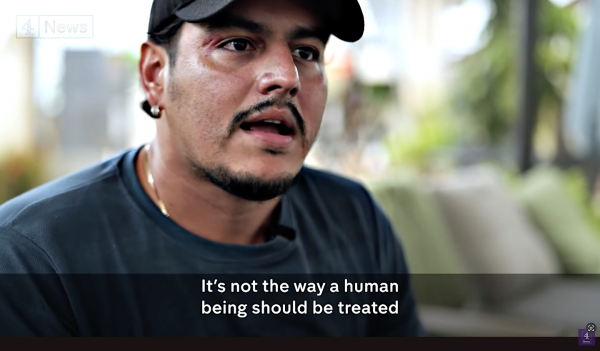
Above photo: A screenshot from Channel 4 News’ recent report about the Trump administration’s third country deportation program, featuring Carlos, a Venezuelan migrant sent from the US to Liberia.
Two days ago, on Channel 4 News in the UK, reporter Jamal Osman traveled to Liberia, in west Africa, to meet some of the 14 US migrants who were recently deported there from the US, as part of the Trump administration’s grotesque mass deportation program.
The program is overseen and tightly controlled by Stephen Miller, Trump’s Homeland Security Advisor, who, it is fair to say, is nothing less than a modern-day Nazi, obsessed with, and driving with fanatical enthusiasm his plans for the mass ethnic cleansing of the United States. I wrote about Miller’s profoundly baleful, racist influence on the US in an article in February, entitled, An Ever-Expanding Gulag of Concentration Camps for Immigrants: The US Under Stephen Miller.
More than half a million migrants have been deported to their home countries since Trump’s second term began, but those sent to Liberia are amongst another group — the estimated 25,000 migrants to date who have been sent to third countries, 28 in total, with which they have no connection whatsoever.
Details of the US’s shady deals with all these countries can be found on the excellent Third Country Deportation Watch website, established by Refugees International and Human Rights First, which has been assiduously chronicling the mixture of bullying and bribery required to get third countries to take in non-citizens that the US, for reasons of naked racism, wants to get rid of.
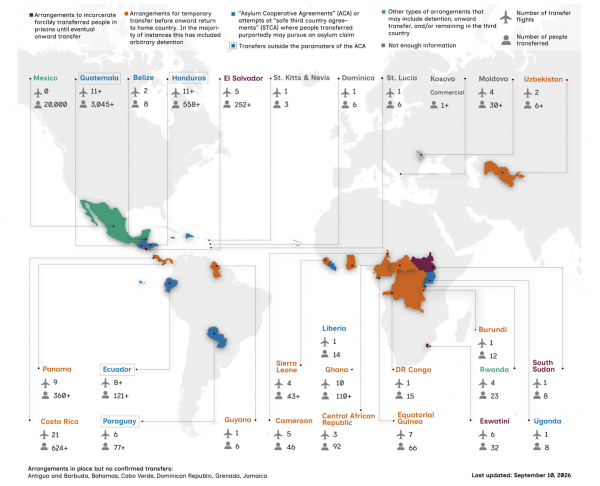
The map above, also on the website, reveals that around 80% of these third country deportations have been to Mexico, by land, but over 120 flights, at least, have carried the other 5,000 or so to 27 other countries, in Europe, Asia, Africa, and Central and South America.
All are deeply troubling.
The economic costs of this policy are obviously obscene and unjustifiable. In his first few months in office, in 2025, when Trump seized upon Guantánamo as a resonant location to send migrants, it was revealed that flights in the first few months, carrying no more than a few hundred migrants in total, had cost $21 million. How much is it costing for Miller to charter planes and send them halfway around the world, often with no more than half a dozen individuals on board?
Beyond the economic cost, however, there is also an alarming legal and moral cost to this story.
Ignoring the human rights implications of third country deportations
When I first wrote about third country deportations last summer, in an article entitled, Profound Alarm at Trump’s Deportation of Migrants to Third Countries Without Protections Against Torture or Even Death, the administration was seeking to deflect attention from the profound human rights concerns arising from third country deportations by targeting migrants with criminal convictions, who were sent in small numbers to countries including South Sudan and Eswatini.
The administration sought assiduously to avoid questions about whether or not these deportations involve an arrogantly dismissive contempt for the principle of non-refoulement — the obligation on nation states to not deport anyone to any country in which their “life or freedom would be threatened” — which is enshrined in the 1951 Refugee Convention and the 1984 Torture Convention, and is also enshrined in US law.
Those concerns have still not been adequately addressed, and in the meantime the third country deportation program has expanded massively, as its targets have also shifted, moving from convicted criminals to migrants with no criminal records, who are being targeted by Miller not because of any threat they could allegedly pose, but simply and cynically because US judges have ruled that it is unsafe for them to be repatriated.
Unwilling to allow them to stay in the US as a result — which ought to be their right as legitimate refugees supported by court rulings — Miller and his administrators and negotiators have worked out that dumping them abroad is preferable to having them imprisoned, possibly indefinitely, in the vast “black site” prison warehouses that they envisaged building in vast numbers across the US, but which have run into problems.
Last year, flush with an unconscionable gift of $45 billion from Congress to be spent on immigration detention, ICE began buying up empty warehouses to be repurposed as prisons, but, as the Marshall Project reported last month, after embarking on a $1 billion shopping spree, “Sustained public pushback and lawsuits from local governments and communities helped stymie those efforts, alongside the logistical challenges of retrofitting buildings that were not designed for long-term confinement.”
As a result, the Trump administration “recently moved to offload most of these properties, and has pivoted to a more traditional approach of trying to expand existing facilities and soliciting bids from private prison contractors to reopen shuttered lockups”.
Choosing expensive and diplomatically unwieldy third country deportations over an acceptance of legal restrictions on his putrid ambitions is an unforgivably cynical move on Miller’s part, and it seems clear, from Channel 4 News’ coverage, that he is also targeting not just those with “final deportation orders”, but others with permission to stay in the US, who were living and working legally, and who have been torn away from their families and hurled into an alarming existential limbo just to satisfy his lawless, giddy and apparently insatiable hunger for mass deportation at all costs.
Lost in Liberia
The first flight to Liberia, carrying 20 migrants from Brazil, Cameroon, Colombia, Cuba, Eritrea, Guatemala, Honduras and Venezuela, arrived a month ago. Six of the 20 (a Brazilian, a Cameroonian and four Cubans) refused to disembark, and were sent on to Equatorial Guinea, joining 60 others sent there since November 2025.
Two days before the arrival of these 14 migrants, Liberia’s Ministry of Information announced that the country plans to accept up to 1,200 third-country nationals in total, although no indication was provided about how they would be catered for.
Liberia — a country that, ironically, was established in the early 19th century for freed US slaves — is one of the world’s poorest countries, and the first 14 arrivals are being housed in a rundown hotel outside the capital, Monrovia, with no indication of how another 1,186 migrants might be accommodated.
For his Channel 4 News report (see the video above), Jamal Osman spoke to three of the recent arrivals, none of whom had received any notification about their deportation. Paula, from Brazil, who had been in the US for five years, had never even heard of Liberia, Elvis from Honduras, who had spent eight years in Texas, working in construction, revealed that he is now separated from his wife and four children, while Carlos from Venezuela, who had also spent five years in the US, explained to Osman that he had no criminal record, and that a US judge had granted him “withholding of removal”, meaning he couldn’t be deported to Venezuela, which he had fled because of persecution. As he explained, “‘Withholding’ allowed me to have a work permit, a driver’s licence, and a Social Security number.”
“I complied with everything to the letter of the law”, he added. “I am not a criminal, I am a good person, a person who contributes to society, a person who dedicated myself in the United States to working.” By day, he was a car salesman, and at night a food delivery driver, but he was seized at a routine immigration check-in, and held for eight months before the unexpected and unannounced flight to Liberia.
Asked about the journey, he recalled having his “hands and feet shackled for more than 15 hours”, a “nightmare” he never imagined, which reminded me of the nearly 800 individuals, largely seized arbitrarily in Afghanistan and Pakistan — or bought for bounty payments — who were flown to Guantánamo, mostly in 2002 and 2003, in a program of grotesque and lawless brutality that has, nevertheless, proved to be an inspiration for Stephen Miller and the Trump administration, who are treating migrants, in vast numbers, as they treated those regarded as “terrorists” after 9/11.
Carlos also told Osman that his wife and his five-month old son are still in Dallas, but that he wasn’t even given a chance to say goodbye to them. “It’s not the way a human being should be treated”, he said.
He’s right, or course, and as he and so many other migrants, sent to third countries, grapple with the profoundly existential limbo in which they find themselves, I’m reminded of another unforgivable analogy with Guantánamo, whereby prisoners approved for release who could not be repatriated because it was unsafe for them to be returned, or because the government regarded their home countries as a security risk, were also taken in by third countries, on the basis of secretive “diplomatic assurances” purporting to guarantee their humane treatment, which, all too often, evaporated on contact with reality.
Guantánamo’s former “enemy combatants” remain, essentially, the non-persons without rights that they were made into when the US stripped them of all protections after they were first seized. Now, shockingly, Trump and Miller seem to have created another group of non-persons — immigrants to the US, never convicted of any crimes whatsoever, but who, because they too cannot be repatriated, are being scattered to the four corners of the earth with no guarantees whatsoever that they will either be safe, or that any tolerable future at all awaits them.
This is, shamefully, an example of extraordinary human rights violations on a massive international scale, dwarfing previous efforts by countries like Britain and Australia to deal with unwanted migrants through offshoring or third country deportations, and with no sign, as yet, of how such monstrous contempt for the very lives of these unfairly targeted individuals can be brought to an end.
Ongoing efforts to restrain the Trump administration in court
Last Friday, September 18, the 1st Circuit Court of Appeals in Boston upheld a lower court ruling, in February this year, by District Judge Brian Murphy, that the third country deportation policy was unlawful. Judge Murphy has been a tenacious opponent of the administration’s sickening disregard for the law with regard to its deportation policies since Trump’s second term began, first issuing a temporary restraining order in March last year that was designed to prevent the administration from deporting anyone to a third country without them first having the opportunity to contest their deportation in immigration court, as I discussed here.
In a deliberate snub, the administration responded by sending seven Venezuelans — held, at the time, in Guantánamo — to El Salvador.
In April, Judge Murphy responded with a formal injunction, requiring the Trump administration to give non-citizens the chance to raise concerns about their safety before they are removed to third countries, as I noted in an article at the time.
As he stated in his order, thoroughly condemning the administration, “Defendants argue that the United States may send a deportable alien to a country not of their origin, not where an immigration judge has ordered, where they may be immediately tortured and killed, without providing that person any opportunity to tell the deporting authorities that they face grave danger or death because of such a deportation.” He added, “All nine sitting justices of the Supreme Court of the United States, the Assistant Solicitor General of the United States, Congress, common sense, basic decency, and this Court all disagree.”
In his ruling in February this year, Judge Murphy reiterated that migrants could not be sent to an “unfamiliar and potentially dangerous country” without any legal recourse, adding, as Al Jazeera described it, that “due process — the right to receive fair legal proceedings — is an essential component of the US Constitution.”
“These are our laws”, he write in his ruling, “and it is with profound gratitude for the unbelievable luck of being born in the United States of America that this Court affirms these and our nation’s bedrock principle: that no ‘person’ in this country may be ‘deprived of life, liberty, or property, without due process of law.’”
As the Guardian described it, the appeals court “unanimously agreed” that the administration’s policy “violated due process by failing to give people enough notice of the decision to deport them, or the chance to legally contest it.” Human rights lawyers immediately responding by calling for third-country deportation flights to be grounded immediately, but, as the Guardian added, “the government has 90 days to appeal against the court’s decision, and is expected to do so.”
The struggle for justice continues, but in the meantime Carlos, Elvis and Paula — as well as thousands of other migrants sent to third countries without any form of due process — continue to suffer from the unconscionable effects of what, at its heart, is a kind of “extraordinary rendition” policy engineered by the US government under Stephen Miller, whose horrors are so monstrously racist and indiscriminate that they almost defy comprehension.
Note: The Guardian’s article was an outcome of their involvement, with 23 other media organizations, in The Deportation Project, a joint investigation coordinated by Forbidden Stories, based in Paris. Journalists from these media outlets “interviewed more than 100 people affected by, or involved in, the US drive to extinguish unauthorized immigration, and reviewed documents outlining details of the agreements made by US officials with governments around the world.”