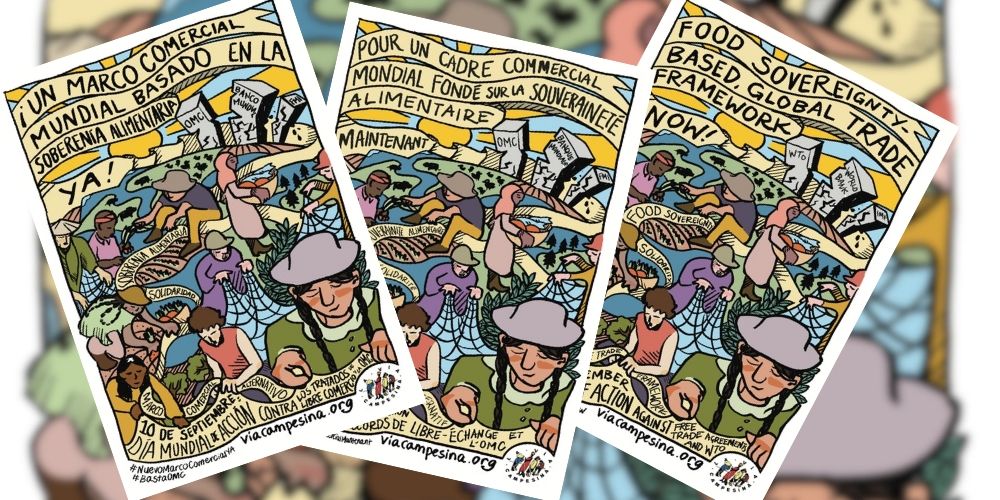
On September 10, we mark the International Day of Action Against Free Trade Agreements and the WTO.
Every year, during this month La Via Campesina reminds the world of the sacrifice of Korean farmer Lee Kyung Hae, who took his life in Cancun in 2003 outside the gates of the WTO Ministerial Conference venue. His action that day was among the loudest expressions of peasant despair, frustration, and resistance against a neoliberal global order; an order that since then has devastated rural food systems, captured our territories and seeds, and impoverished peasant families.
The neoliberal system: understanding the beast
To state plainly, neoliberalism is about protecting capitalism from the peoples. It is a transnational project of the twentieth century that sought to re-engineer the state and global institutions so that they could protect “markets” from the reach of national and democratic decision-making, as well as from demands for social justice.
One defining aspect of its evolution was the establishment of international institutions such as the World Bank, the IMF, and the WTO. These global institutions provided the legal scaffolding for a catastrophic globalization of capital.
Free Trade Agreements, conditional aid, loans and structural adjustment programs (along with other mechanisms) became instruments through which countries were pressured to open their markets and follow the ‘rules’ of international economic competition. It forced the Global South to extract and export raw materials to the imperial powers of the Global North, where they were processed and then exported back to the world as finished goods. This made wealthier countries and their corporations even wealthier, while workers and peasants, everywhere, were impoverished.
From Argentina to Srilanka, Kenya to Ecuador and Burkino Faso to Bolivia – we have seen how States have been coerced to switch to an export-orineted model of trade, roll back on their public welfare policies, privatize public services and open their markets to ‘integrate’ themselves into a globalized economy.
Its impact on people’s food sovereignty
In the case of agriculture, this has predictably led to massive land, forest and water grabs, and territorial dispossession for the purposes of large-scale monoculture and industrial livestock farming. It enabled the global expansion of fossil-fuel-based production, processing, and transportation of food. Brazil, Indonesia, Costa Rica, Australia, most Western European countries are all among the examples of this rapid expansion of industrial agriculture, and land concentration – coming at the expense of small-scale food producers.
Through Free Trade Agreements and other modes of economic coercion governments were forced to deregulate and privatize agricultural markets, dismantle public stocks, and remove farm income support; measures that increased precarity among small-scale food producers and food system workers, widened global inequality, and created huge import dependencies in many countries.
It has also made rural families and urban workers more vulnerable to global shocks.
The State of Agricultural Commodity Markets 2026 report points out that low- and middle-income countries are increasingly exposed to various shocks, such as extreme weather events, conflicts, pandemics, macroeconomic pressures, and financial crises. These disruptions often result in an increased cost of living, higher cost of food production, a drop in purchasing power, and increasing food insecurity among the peasant and working classes of society.
All of these have a profound influence on the world’s small-scale food producers – especially women and youth. National policies as well as international trade agreements are often stacked against the interests of peasant women, who firsthand face immense hardships in many countries to enter farm trade, be recognized as farmers, and are disproportionately affected by agrotoxics and labour abuse in industrial farming systems. It dismisses and marginalizes solidarity economies and feminist economies, and imposes on us a ‘free market economy’ that excludes more than it includes.
For the peasant youth, all of this combined with the prohibitive price of farmland due to speculation, and policies that impose digitalization in farming, often act as barriers to continuing farming – creating an exodus of young people from rural areas around the world, with profound implications for the food sovereignty of our communities.
The massive farmers’ protests witnessed in India, Japan, South Korea, and much of Europe over the last few years are testament to the public anger and farmers’ frustrations at a system that has constantly shortchanged them.
The changing nature of neoliberalism
Fast forward to 2026, and it is clear that this neoliberal system is rapidly adapting in the twenty-first century, in an era of accelerated digitalization and exceptionally powerful transnational corporations.
The emphasis is not only on grand multilateral trade deals and economic partnerships – such as EU-Mercosur or RCEP. It is also on the exponential proliferation of what is often described as zones of exception – places such as special economic zones, tax havens, data centres, AI-governed townships and digital platforms operating beyond (or exempt from) public oversight.
These are not just ordinary business parks. They are “legal spaces” carved out of national territory ( by flattening farm lands, forests and coastal zones) but governed by different rules, offering foreign investors low taxes, lighter regulation, and exemptions from standard labour and environmental laws.
Prospera in Honduras is among the most striking examples of it, and there are plenty more coming up worldwide. These zones effectively create holes in the nation-state, allowing capitalism to operate beyond democratic accountability.
Mobilize against this neoliberal system! Build alternatives
It is therefore clear, that we are not only up against the global institutions of the WTO, the World Bank, and the IMF. We are also up against this broader ongoing project of neoliberalism, and the dubious nexus between states, transnational corporations, and national elites that enables it.
And we cannot transform this “neoliberal system” by fighting alone in our territories. It requires a global response and the globalization of our struggle to push back against this globalization of corporate power.
At the same time, we must show them what a reimagined world could look like. We are not only resisting; we are also proposing concrete pathways. Our struggle for Food Sovereignty is a vision of the world we want to build; for ourselves and for future generations.
It is in this spirit that, on the sidelines of the 13th WTO Ministerial Conference in Cameroon, La Via Campesina released its alternative global trade framework, re-imagining a trading system along the principles of food sovereignty. This document represents our rallying cry to reorganize global trade in favor of small-scale food producers everywhere in the world.
This September we call upon all our member organizations and allies to mobilize against the WTO, the World Bank, and the IMF, and against the unfolding dystopian visions of tech overlords, while presenting our alternative visions to our communities everywhere.
- Actively campaign against ongoing free trade negotiations in your countries and to create public events – press conferences, campaigns, and other actions – that expose their ill effects on food sovereignty, while also calling for an alternative system. Add your events to this global map, here.
- Testify about how Free Trade Agreements, conditional loans from the World Bank and IMF, and the external debt crisis are affecting your governments’ abilities to carry out public policies in favour of peasants and rural families. Send us short videos from your territories, and we will amplify them throughout September and October. Email us: communications@viacampesina.org
- La Via Campesina will hold a Global Webinar in September to deepen our analysis of neoliberalism and how it is adapting to contemporary times, so that we can respond effectively and collectively. If you are interested, sign up here.