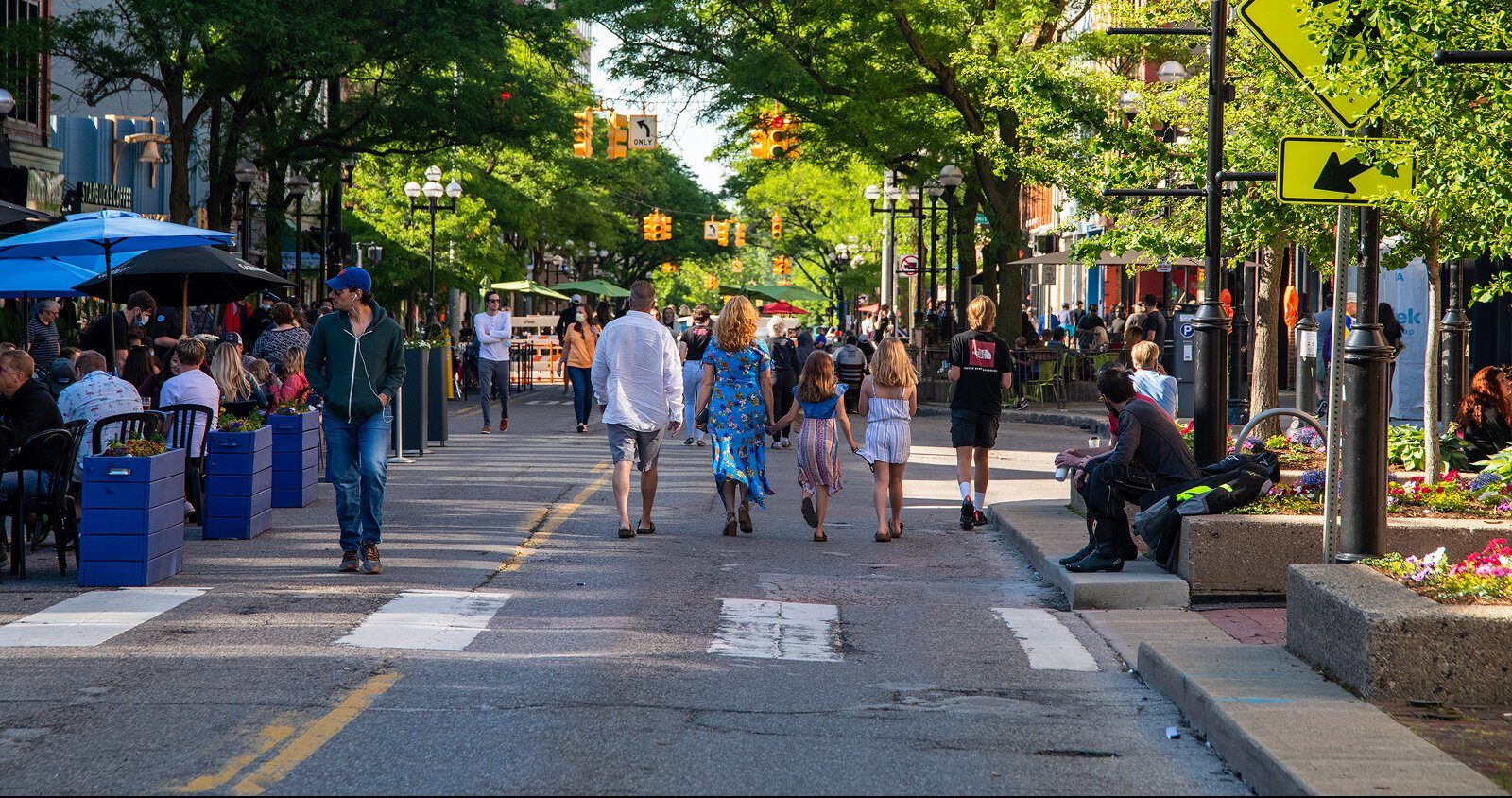
Above photo: People walk down Main Street in Ann Arbor.
Imagine your city has an online site where you can easily log in and then direct your investment dollars to your favorite issues. Here are this week’s hypothetical options: (1) Main Street Retailers, (2) Affordable Housing, (3) Renewable Energy, (4) Craft Manufacturing, (5) Brownfield Rehabilitation, (6) Land Acquisition for Local Parks, and (7) School Improvements. Once you select a topic button, you’re given several further options: (a) lend money at 5%, (b) put in equity investment at 7%, (c) co-sign a mortgage note for first-time home buyers, or (d) donate. You’re also given the option to link your self-directed IRA or 401k with some of these investments.
Further, imagine that you can return to the site anytime for updates on your investments. But more importantly, you can sleep well at night knowing that these funds are being professionally managed in a diversified account. And some of these accounts might also be guaranteed with the full faith and credit of your local government.
When Stephanie Gripne talks about creating an “Investor Easy” button in every community, this is how I visualize it. How would it look for your own community? This week’s interview with Stephanie, who founded a number of impact investing institutions starting in Colorado, will hopefully stimulate your own response to this question.
Stephanie imagines Main Street Capital Authorities everywhere, and as you’ll read, is prototyping them in several states and also thinking about state and national legislation that could accelerate their deployment.
Interview:
MS: Stephanie, thanks for talking with us today. You’ve been promoting impact investing for more than a decade with a bunch of interesting projects. Let’s start with CO Impact Days. What exactly did this project do, and what kinds of opportunities benefited?
SG: We created CO Impact Days in 2016 as the first statewide marketplace for impact investing in Colorado, and the first phase of what we envisioned as a National Impact Investing Marketplace. Our initial goal was to catalyze $100 million for social ventures over three years.
We were testing three hypotheses. First, did Colorado have high-quality investment opportunities? Second, could individuals and organizations be taught how to invest in them? And third, if we connected projects, nonprofits, small businesses, startups, funds, intermediaries, hybrid organizations, and emerging fund managers with accredited and nonaccredited investors, would more money flow than it had through two earlier attempts to create local funds in Colorado?
We built a marketplace through investor education. We then identified opportunities, prepared ventures, and brought investors and ventures together. Since its inception, the effort has delivered more than 200 courses, identified more than 600 social ventures, showcased 150, activated more than 155 investors, and catalyzed over 260 direct impact investments totaling more than $300 million.
We then expanded the model to AK Impact Days and MA Impact Days. We are now working to scale the National Impact Investing Marketplace so communities can build on what we learned.
MS: So if 155 investors generated $300 million, I assume most of them are accredited. Why focus on 155 deep-pocket investors rather than a larger number of grassroots investors?
SG: We actually provided practical investor education to anyone who wanted to learn how to invest for impact, including accredited and nonaccredited individuals, foundations, family offices, corporations, and other institutions. We featured investment opportunities starting at just $25.
Our focus was helping any individual or organization interested in moving some of its money out of Wall Street and into Main Street understand how to do so. The 155 investors were simply the people who raised their hands, took action, and allowed us to document their investments. They were not the full audience we educated or the only investors we sought to engage.
Colorado has enormous untapped investment capacity, but almost nowhere in high school, college, or adult life can people receive practical investment education from an organization that is not trying to sell them a financial product or service. We asked what would happen if we offered nonconflicted investor education to everyone, followed the people who raised their hands rather than limiting ourselves to the usual institutions, and connected them directly with community investment opportunities.
The answer is that it works. Sometimes a foundation makes a large investment or provides a guarantee. Sometimes an individual invests $25 in a local business for the first time. Both matter. Our goal was and remains to grow the number and diversity of people who see themselves as investors and help more of their capital reach their communities.
MS: So what’s next?
SG: We need to make participation easier. Most people do not want to spend months finding, evaluating, and completing each direct investment. They want an “Investor Easy” button that gives them access to credible opportunities, along with a safety net that provides due diligence, diversification, guarantees, and other forms of risk reduction.
At the same time, we do not want to lose the connection and joy that come from investing directly in a Black-owned business in Denver, a small business in Indian Country, or another social venture creating visible change in a community. The goal is to make community investing accessible to everyone while preserving that human connection between investors and the people their capital supports.
MS: You’ve written about publicly funded Main Street Capital Authorities as one way to connect these activities. Tell us more about this idea.
SG: Increasingly, mayors, city managers, chambers of commerce, place-based foundations, and higher education institutions are asking for local investment accelerators. These would have the things we just talked about: investor education, an “Investor Easy” button, and a safety net.
One model we are exploring is a locally branded nonprofit capital aggregator, drawing on the example of MCE Social Capital. A Main Street Capital Authority is a way to organize and sustain that work. I do not think every community needs a publicly funded authority. The question is what kind of structure can bring the right partners and resources, and keep doing the work over time.
MS: Isn’t one way to ensure these institutions do the work over time is to make them for-profit businesses?
SG: I agree we should build all kinds of local economy institutions, including ones that are for-profit. The question is how to design them so they can survive, remain accountable to their communities, and manage capital professionally over the long term.
We can learn from the land trust movement. A few decades ago, many small local land trusts were created because communities wanted trusted organizations that understood local landowners, local priorities, and local relationships. But many of those organizations never developed enough revenue to support strong legal counsel, professional administration, compliance, or the permanent stewardship of conservation easements.
Over time, some small land trusts closed or consolidated with larger organizations. The larger organizations sometimes inherited conservation easements that had not been structured properly or funded adequately for permanent stewardship. The lesson is that local trust and passion are essential, but they are not substitutes for durable legal, financial, and operational infrastructure.
I am thinking about this while sitting in Crested Butte, where I worked for The Nature Conservancy about 20 years ago. Gunnison Ranchland Conservation Legacy provides a trusted local presence for ranch families interested in conservation. Landowners can work with someone who understands the people, land, agricultural economy, and culture of the Gunnison Valley. The organization can then partner with larger statewide institutions, such as Colorado Cattlemen’s Agricultural Land Trust, The Nature Conservancy, or Colorado Open Lands, to provide specialized legal expertise, transaction capacity, funding, and permanent stewardship. Gunnison Ranchland Conservation Legacy continues to help ranch families protect their land through conservation easements while working with larger partners on individual transactions.
That’s the kind of model we should apply to local investment institutions. Communities need a local storefront run by people they know and trust. Behind that storefront, they need professionally managed shared infrastructure for a long list of tasks: legal work, compliance, underwriting, due diligence, custody, technology, reporting, diversification, and risk reduction.
We need the best of both worlds. The local institution provides relationships, context, accountability, and access to community investment opportunities. A larger system—perhaps regional, perhaps national—provides scale, professional management, diversification, and the safety net. The legal structure might be nonprofit, for-profit, cooperative, public benefit corporation, or a partnership among several entities.
The goal should not be to make every community create an entire financial institution from scratch. It should be to give every community a trusted local entry point supported by durable regional or national infrastructure.
MS: One of the ways we have seen this movement unfolding is through community investment funds. A decade ago, you could find only a dozen funds focused on local businesses or projects that allowed grassroots investors to participate. Together, by some counts, there are hundreds. How does this trend fit with your vision?
SG: Community investment funds are essential, but they are only one piece of the infrastructure we need. We need to think larger. Remember, the ultimate objective is that “Investor Easy” button that allows people to move all kinds of capital—their retirement savings, money-market funds, charitable dollars, and even the assets they can use as guarantees—into their communities.
A community foundation, municipality, chamber of commerce, university, health-conversion foundation, or other place-based institution can convene a strategic alliance and aggregate the necessary capital in one place. That capital stack might include grants or other dollars requiring no financial return, low-interest debt priced at 1% to 4%, equity targeting returns of 5% to 8%, and guarantees that reduce risk for other investors. And among the options for investors can be the local investment funds.
The alliance like this could then approach an experienced intermediary such as Apis & Heritage and say: “We have identified ten potential employee-ownership conversions, assembled the capital, and created resources to cover transaction expenses. Can you help originate, structure, and service these transactions?”
That is the larger vision: investment infrastructure designed around a community’s goals and investor demand, with funds and intermediaries serving as expert implementation partners.
MS: How are you trying to implement this idea?
SG: We are developing a trust company. And we are also interested in developing the Diligence League: a shared due diligence platform for emerging fund managers, community development financial institutions, and other intermediaries.
The current system simply has too much friction. I experienced this in my own donor-advised fund. I received the assets on January 8 and did not complete my first investment until August 24. It took eight months and approximately 50 separate steps. (The full case study is at gripne.com.) That is far too difficult for an average person with resources who wants to invest them in their community.
MS: Where else are you trying to prototype this approach?
SG: Besides Colorado, where we began, we are focusing on Alaska, where we first expanded. We are also deeply engaged in Pennsylvania through our partnership with the Pennsylvania Community Foundation Association, where we have trained seven community foundations, and in Massachusetts, where we conducted a cohort with seven community foundations in partnership with the Barr Foundation.
We are also working with extraordinary place-based leaders across the country. These include the Boreal Waters Community Foundation in northern Minnesota and Wisconsin; the Natrona Collective Health Trust in Casper, Wyoming, which is Wyoming’s first health conversion foundation; the Salinas Valley Chamber of Commerce in California; and leaders in Fairbanks, Alaska, including the mayor’s office.
We are also seeing growing interest from communities across the Southeast. Our future geographic expansion will depend, in part, on where we establish and receive regulatory approval for our independent trust company. That decision will help determine where we can build the strongest infrastructure and deepen our impact next.
MS: How can our readers get involved?
SG: Start by asking five questions: How much money do I have? What do I need to be safe and to thrive? Where is my money invested now? What work do I want it to do? Who do I want to join me on this journey?
These questions apply to everyone. You might be a high school student, a college student, a recent graduate, in your twenties or thirties, approaching retirement, or already retired. Your age and the amount of money you have do not matter. Everyone has resources, choices, relationships, and opportunities to begin.
Consider finding a qualified fiduciary financial advisor who works on a fee-only or project basis. Ask that person to help you determine your number. How much do you need to feel secure? How much do you need to thrive? Once you understand what is enough for you, you may discover that you have greater capacity to invest, lend, donate, or guarantee resources in support of your community.
You can also host a Money Over Dinner, a movement we are piloting based on the Death Over Dinner model. Invite people you trust to have an honest conversation about money, what each person needs, where your money is invested, and what you would like it to accomplish. Community investing does not need to be a solitary journey.
Then take one concrete action. Move some of your deposits to a community development financial institution, community bank, or credit union. Help a family member or friend refinance expensive debt. Consider whether you can safely use your assets to co-sign or guarantee a loan for someone you know and trust.
You do not need to transform your entire portfolio at once. Begin with honest questions, invite others into the conversation, and take one meaningful action.
Readers can also connect with our Impact Finance Center, share examples of successful local models, and convene the investors, community leaders, institutions, and intermediaries who need to be in the same room. I am particularly interested in communities that want to build lasting investment infrastructure that can continue beyond a single event, transaction, or grant.
I would also be happy to offer readers a complimentary one-year subscription to our Impact Investing Institute, which includes dozens of educational modules designed to help people understand their options and begin putting their resources to work in their communities. Email Jen if you’re interested.
MS: That’s very generous—thanks! Okay, final question: How do you invest your own savings locally?
My goal is to invest up to 99 percent of my assets in nearby communities and then use another 80 to 90 percent of those assets to co-sign or guarantee additional community investments. Because the same assets can remain invested while also supporting guarantees, I could hypothetically have the equivalent of 175 percent or more of my assets working in communities at the same time.
This includes both my personal assets and my charitable assets. Each pool of capital has a different purpose, risk profile, return expectation, and time horizon. My personal investments include real estate where I provide housing at below-market rent, helping family members and friends refinance expensive debt, and certificates of deposit through Clean Energy Credit Union.
Through my donor-advised fund, I invest in organizations and funds supporting communities, including the Alaska Conservation Foundation, Palestine Investment Initiative, LearnLaunch, Chloe Capital, Kachuwa Impact Fund, and Opportunity Main Street.
The goal is to fully use my personal assets to co-sign or guarantee community investments while still protecting what I will need for retirement. I do not want to give those assets away or put my future security at unnecessary risk. I want them to remain invested while also supporting carefully structured guarantees.
The central question for me is not simply how much money I can invest just once. It is how many times I can responsibly recycle the same assets throughout my lifetime. As loans are repaid and guarantees are released, that capacity can support another person, business, or community investment. My goal is to keep my assets working repeatedly while preserving the financial security I will need in retirement.