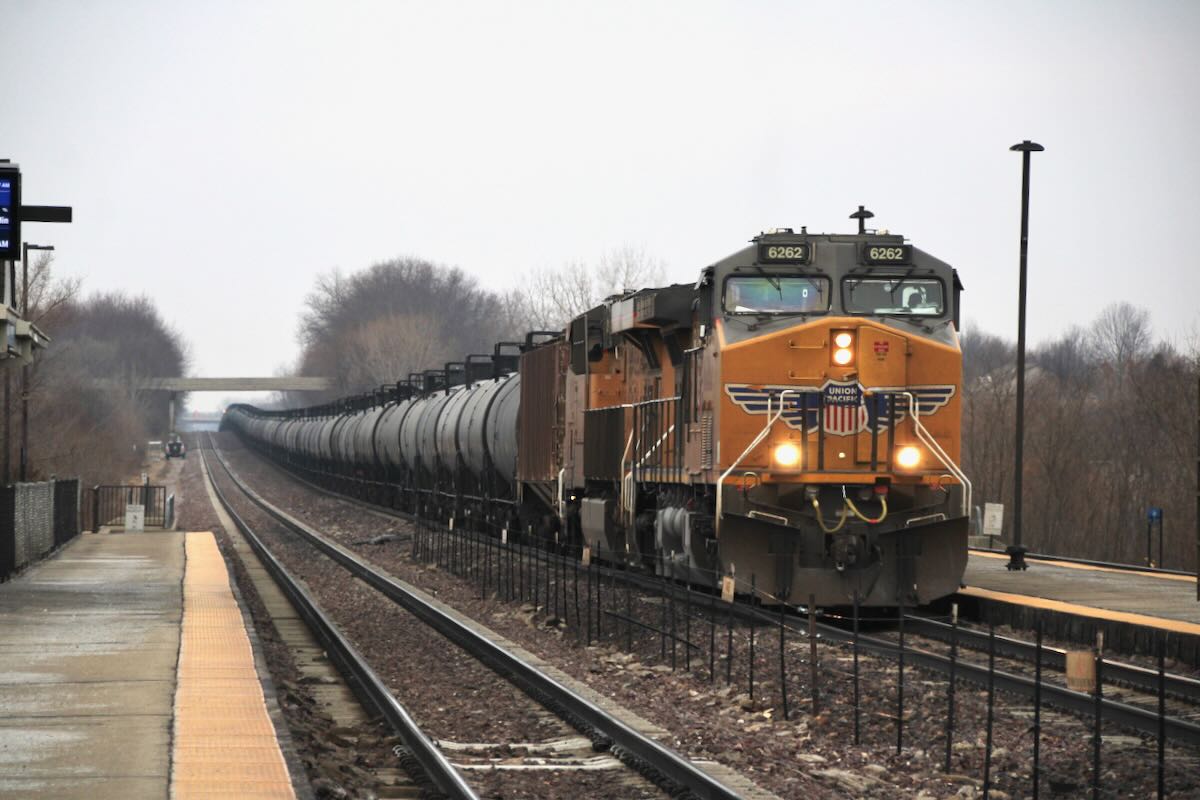
Above photo: An eastbound Union Pacific unit train of ethanol rolls through the Metra station at La Fox, Ill., on Feb. 14, 2026. BNSF, CSX, and a group of shipper organizations, mostly connected with the fuel and chemical industries, have asked the STB to immediately reject the Union Pacific-Norfolk Southern merger application. David Lassen.
Motions say applications fail to address key requirements of 2001 merger rules.
BNSF, CSX, and five major shipper organizations have asked the Surface Transportation Board to immediately reject the Union Pacific-Norfolk Southern merger application, saying it fails to address key aspects of the STB requirements for major mergers established in 2001.
The two railroads each filed motions for summary denial of the merger, while the five shippers’ groups filed their motion jointly. A CPKC filing made similar claims that the application does not meet the prima facie, or first-impression, standard to support the merger, but that filing is presented as comments rather than a motion.
The shipper groups argue that the merger will increase the degree to which shippers are captive to a single railroad, eliminate competitive options, and leave them at risk of service deterioration.
“The benefits are negligible and the harms are substantial,” contends the 59-page motion from the Alliance for Chemical Distribution (ACD), American Chemistry Council (ACC), American Fuel & Petrochemical Manufacturers (AFPM), National Industrial Transportation League (NITL), and The Fertilizer Institute (TFI). The groups call the merger application “a document built on smoke and mirrors” that includes “unsubstantiated and overstated benefit claims, conclusions presented as facts, analyses that ignore reality, meaningless promises, and inherent contradictions. Conversely, it is bereft of competitive enhancements, meaningful service assurance standards, and effective conditions.”
The railroad motions make similar arguments. The CSX filing says that “Applicants continue to adhere to positions on key issues that prevent the Board from rationally assessing the harms and benefits of their Proposed Transaction and ultimately the public interest as the law requires.” BNSF’s filing contends, “The record affirmatively demonstrates that the merger will harm the public interest.” [Emphasis here and elsewhere is in the original.]
In a press release accompanying the shipper groups’ filings, Chris Jahn, CEO of the ACC, said, “After reviewing everything the railroads have submitted, we believe they have failed to make their case, and the STB should deny their application.” Said Chet Thompson, CEO of the AFPM, “After three attempts, the applicants still have not demonstrated that this merger would enhance competition or serve the public interest.”
Union Pacific called the filings “a coordinated effort by opponents who are afraid to compete and instead continue to share the same baseless claims. The fact is the STB accepted our merger application, which is based on the most complete traffic analysis ever submitted in a rail merger case. Data shows this transaction will move more than 2.1 million truckloads from highway to rail, save customers $3.5 billion annually, and support more than 1,200 new jobs. Those are real, measurable benefits that mean lower transportation costs, stronger supply chains, reduced highway congestion, and more affordable goods for American consumers.”
The filing from the shippers’ groups contends that even with the two supplemental filings by the railroads in July, the merger application fails to support the public-interest criteria of the merger rules in six areas:
- It “categorically rejects the very notion underlying the 2001 Merger Rules that an end-to-end, vertical merger in the rail industry can cause competitive harm,” a stance that the shippers say contradicts STB precedent “and the Applicants’ own position in rail merger proceedings for over two decades.”
- It does not contain “any enhancements to competition. … Although this transaction is the largest possible end-to-end merger in scope and the 2001 Merger Rules expressed particular concerns over such mergers, the Applicants blithely contend not only that is there no reason for concern, but also that this merger actually is pro-competitive” by arguing it will improve competition with trucks and lead to competitive actions by other railroads.
- It does not “meaningfully address” the possibility the UP-NS deal will trigger further mergers, which “deprives the Board of the information it needs to make the special findings necessary to apply its legal criteria.”
- The merger rules require applicants to identify benefits obtainable only through a merger. UP and NS acknowledge that some of their benefits can be achieved by alternative means, the groups argue, but “nevertheless credit the entirety of those benefits as merger specific.”
- While the merger rules require applicants to ensure their claims of benefits are “well-documented and reasonable,” the groups argue that a majority of the UP-NS claims “depend on truck-to-rail conversions that are poorly documented and rely upon unrealistic or demonstrably wrong assumptions rather than critical analysis. Those failures unquestionably mean that the public benefit claims in the Application are exaggerated.”
- The merger rules prefer that all damage claims relating to service disruptions during the transitional period be submitted to arbitration, the groups say, but the UP-NS proposal “excludes exempt and contract traffic. Those restrictions effectively disclaim liability for most transitional service claims because far more traffic is exempt or covered by contracts than tariffs.”
Railroads address Gateway Pricing, rail-to-rail competition
The railroads address many of the same points. BNSF also focuses considerable attention on the UP-NS Committed Gateway Pricing plan, which a prior STB decision called “the sole competitive enhancement” by the applicants.
“But CGP does not offer any post-merger combinations to shippers that do not already exist today,” BNSF argues. “It is a convoluted — and pro-UP/NS — mechanism to halfheartedly address preservation of current competition at select gateways. That is not enhanced competition. … rather than giving BNSF- or CSX-served shippers a genuine, new competitive option, CGP would maintain access to an existing route at a new (most likely higher) rate that UP/NS calculate, from UP/NS’s data, using an arbitrary (high) percentile selected by UP/NS, for a bottleneck segment that UP/NS controls.”
It says that the program would only involve movements through the Chicago, St. Louis, Memphis, or New Orleans gateways between a UP-NS-served facility to one served by BNSF or CSX, and notes exceptions to the bulk unit train movements added in the UP-NS supplemental filing of July 27.
CSX’s motion argues that the UP-NS claim that the merger would inherently enhance competition through improved efficiency and the benefits of single-line service “cannot constitute enhanced competition within the meaning of the 2001 Rules, because they would be ‘inherent’ in any end-to-end Class I merger. To deem them “enhanced competition” would nullify the central requirement of the 2001 Rules and mean that any future transcontinental mergers would automatically meet the public interest test.”
That motion similarly contends that UP-NS projections that the merger will bring more effective competition against trucking does not constitute “enhanced competition” because it would be a feature of any transcontinental merger.
“The undeniable focus of the 2001 rules is rail-to-rail competition,” CSX argues. “… Yet applicants say nothing about enhanced rail competition. They can’t, because the whole rationale for their merger is to weaken other Class I railroads, via diversion, short-hauling, and other exercises of their transcon-driven market power, all the while depriving shippers of any rate reductions associated with those rail-diverted share gains.”
CPKC’s filing, along with addressing many of the same points, contends the downstream consequences of the merger are not in the public interest.
“There are only two plausible future states of the downstream rail world: (a) stasis, which would yield an unbalanced competitive landscape sharply dominated by UP, with each of the other Class I carriers reduced to a much smaller regional carrier, or (b) a full transition to a North American Class I duopoly,” CPKC argues. “Another year of evidence-gathering is not needed for the Board to conclude that neither of these outcomes would be in the public interest.”
The shippers’ filing concluded by saying its six areas of focus are not the groups’ only concerns: “They are just the ones that they believe constitute a failure to present a prima facie case and, therefore, warrant the immediate denial of the Amended Application.”
UP CEO Jim Vena, in his July 28 appearance at the TrainsPro Future of Rail Symposium, downplayed the significance of such shipper groups compared to individual shippers.
“I don’t like the person that’s just walking by the street that has an opinion,” Vena said. “I like the person that came into my store and wants to spend x amount of money. I want to know how they’re doing. Am I delivering for them?
“That’s why I like to deal with the companies, not the NIT League or somebody else … sometimes they’re trying to fulfill what every one of their people or companies have to say instead of the targeted people we want.”
More than 500 shippers have signed letters of support for the UP-NS merger.