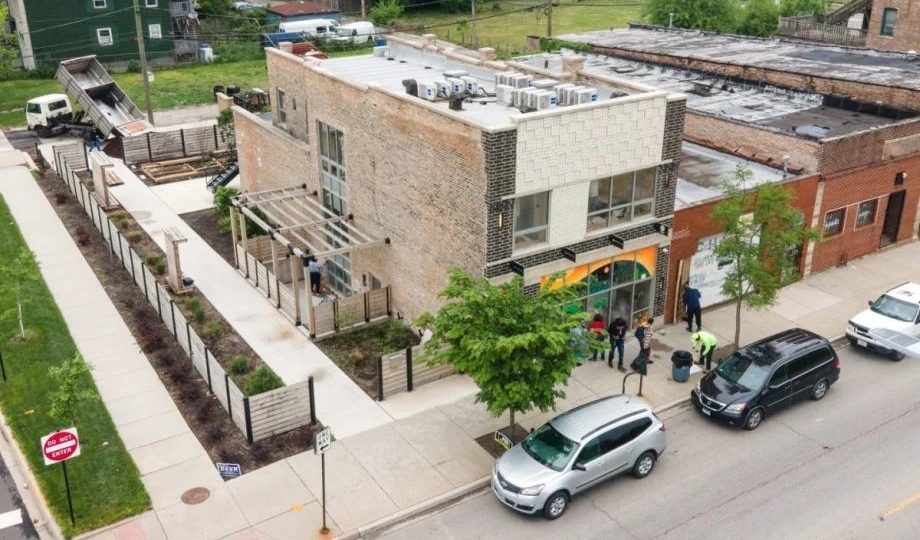
Above photo:
As transit investment reaches Chicago’s disinvested neighborhoods, who captures the value?
These Black entrepreneurs have spent years buying up property on 63rd Street so that Englewood residents get to answer that themselves.
Collective ownership of real estate has made Sunni Powell a rich man. Not in the conventional sense, but in all the ways that matter most.
“I don’t have all the money physically now but I don’t even need it,” Powell says. “I have a building, I have a business, I have a car, I have a motorcycle, I have a craft that’s legit. I’m a barber, and I’m also a licensed barber teacher in the state of Illinois, and I could do a lot with that. I can make money to take care of myself but I can also affect change in my neighborhood and in barbering, and that’s priceless.”
Powell’s barbershop sits on Chicago’s 63rd Street, the historic but long-disinvested commercial corridor in the South Side neighborhood of Englewood, kitty-corner from where his barbershop used to be before it closed in 2016. The difference now is the deed: Powell is a founding member of E.G. Woode, the collective of local Black business owners that bought and renovated the building where the barbershop is today — walking distance from where he lives in a building he inherited from his late mother.
E.G. Woode formed as a collective social enterprise back in 2017 when a group of local entrepreneurs came together to support each other — starting with collectively acquiring and developing the real estate where they could operate their businesses. No absentee landlords nor profit-driven developers needed. The collective has applied for grants and loans together, and raised seed capital from friends and family.
With those funds, the collective started acquiring commercial properties along a one-mile stretch of 63rd Street. E.G. Woode has completed renovations on one property, and will soon complete renovations on its second. This year it acquired two more properties and just won a city-led request for proposals to develop the Ashland Greenway, a mixed-use, multi-parcel, transit-oriented project on a set of vacant lots next to a CTA Green Line terminus.
All $11 million in public and private grants, loans, and private investor capital that E.G. Woode has raised so far have gone into materials, labor, and other costs to acquire and renovate its growing portfolio. It has yet to put anyone on its own payroll. Until now, all of E.G. Woode’s work has been fueled by sweat equity, social capital, and the shared vision to do development differently where traditional models have fallen short.
Meanwhile, Chicago has spent years trying to concentrate new housing and commercial space around its transit stations, and Englewood, with its abundance of vacant lots near transit, is an obvious place to do it. Now, E.G. Woode is using its collective approach to test whether the buildout around a station like 63rd and Ashland can be led by the people who already live there, rather than by whichever deep-pocketed investor gets there first.
The collective is now looking to raise at least $18 million to fund the first phase of the Ashland Greenway project. And maybe, just maybe, it will also raise some funding for payroll.
It will probably be a project manager. Or some kind of fundraiser. Or maybe someone who can do both. It probably wouldn’t go to co-founder and president Deon Lucas himself. For him, it’s worth the wait.
“I’m probably a little crazy,” says Lucas. He leads the architecture firm Beehyyve, which is also part of E.G. Woode. “But I would rather suffer through and get it done the way it should be with the community than to watch someone else just do the same old thing again.”
Why Englewood’s Black businesses built E.G. Woode
The conventional ways had already failed neighborhoods like Englewood. Small business owners or local developers first built these storefront buildings along 63rd Street, going back as far as a century ago. Eventually those owners and developers retired, or moved onto bigger things, expecting some other local business owner or investor nearby would be in position to take these properties off their hands. They often were for at least a generation or two, especially back when Englewood’s population was much higher.
In 1930, nearly 90,000 called Englewood home, and 63rd Street was a thriving commercial corridor. Back then, even Black Chicagoans were becoming known for the wealth they’d accumulated from their business ventures.
Many of Chicago’s previously successful Black-owned businesses, which largely employed Black workers, have long since shuttered. Many of those Black business owners funded Black-owned banks, which in turn funded other Black businesses and real estate – but those Black-owned banks are pretty much gone, too. Meanwhile, white-owned banks refused to do business with Black people or in Black neighborhoods. Federal policies incentivized white banks to invest in white neighborhoods while denying the same support to Black banks working in Black neighborhoods. This racialized lending pattern became known as redlining.
Without jobs or access to capital to create new ones, residents started leaving. Englewood’s population today is down to around 24,000. Newer Black-owned businesses, while they continue to form, have struggled to access capital and space to grow and reverse the tide of Black population loss in Chicago.
The commercial corridors left behind, like 63rd Street, declined and decayed. Redlining became a self-fulfilling prophecy. In neighborhoods like Englewood, increasingly distant property owners couldn’t access capital to maintain their buildings, while residents and local business owners couldn’t access capital to acquire and rehab those buildings themselves. The city ended up demolishing thousands of vacant homes and dilapidated commercial or mixed-use buildings. Vast stretches of 63rd Street today are lined with nothing but grass, including the entire block across from E.G. Woode’s first building.
The result of all that history is a kind of Catch-22 that is familiar to anyone trying to revitalize commercial corridors in Black neighborhoods. It’s called the appraisal gap. Conventional lenders only loan out a certain percentage of the underlying property’s market value. Decline and decay results in property values that are so low, loan amounts from conventional lenders aren’t enough to pay for the necessary rehab or new construction.
Even when the City of Chicago has offered to step in with resources to fund the revitalization of corridors like 63rd Street, actually getting those resources out and into projects has been a frustrating process, E.G. Woode co-founder Lucas says. Only a fraction of grant applications ever get approved. Those that do get approved run into barriers in the pre-development stage, resulting in many approved grants getting clawed back.
E.G. Woode was born directly out of those frustrations.
Evolving acquisition pathways
Winning a city-led request for proposals marks a key step in the growth and evolution of E.G. Woode.
The collective’s first two acquisitions came with the help of the Cook County Land Bank Authority, a county government body created to acquire vacant and tax-delinquent properties and put them back into use and paying property taxes again. The land bank acquires tax liens on delinquent properties and gradually moves them through the state of Illinois’ onerous foreclosure process, which typically takes years for each property.
But just the threat of foreclosure can prompt a speculative property owner to sell — which is what happened in the case of E.G. Woode’s first building. The previous owner wasn’t interested in selling to E.G. Woode until the land bank was close to foreclosing. The collective acquired its second building from the land bank itself.
It took four years for E.G. Woode to complete renovations on its first property and another nearly four years to complete renovations on its second. But the collective’s persistent presence along the corridor has allowed it to build relationships with other private owners nearby, owners who wouldn’t return earlier calls or dismissed earlier offers as unserious.
Just two doors down from its first building is a long vacant storefront that once housed the Keynote Lounge, a local bar and music venue. The collective repeatedly made offers to buy the building, but the previous owner didn’t relent until earlier this year.
Not long after that, E.G. Woode finally got another yes from the owner of a building with four occupied apartments over two vacant storefronts — just two doors down from the former Keynote Lounge.
Meanwhile, through tax foreclosures and other avenues, the City of Chicago owns around 10,000 parcels of land, largely concentrated on the South and West sides of the city. Many city-owned lots are located near transit stations; out of all 77 neighborhoods in Chicago, Englewood is number one for vacant lots near transit.
But the city’s process for selling those lots or otherwise releasing them to developers has long been criticized for being opaque, slow, riddled with red tape and more favorable to developers with deep pockets and experience over more community-rooted applicants. Only recently has that started to change.
Surrounding the CTA Green Line terminus at 63rd & Ashland, the city-owned lots that E.G. Woode recently won the right to develop have been on Lucas’ radar for years, even before E.G. Woode formed, says Lucas. The request for proposals from the city for those lots went up in October 2025, with a deadline of January 5, 2026.
Three months to put together a full proposal may be plenty of time for a conventional for-profit developer with much deeper pockets or even a nonprofit with years of experience and a balance sheet with some cash cushion to get the ball rolling. For E.G. Woode, it’s a tighter timeline without any full-time or part-time staff and members are also busy running their own businesses. But it’s still a small enough group that, for now, the members have enough trust to delegate the real estate acquisition and development work to Lucas and E.G. Woode Operations Manager Justin Essig — who also works with Lucas at Beehyyve.
“Process is a tricky part,” Essig says. “Sometimes you have the entrepreneurs driving the need for specific spaces, but sometimes it’s an impulse or an opportunity. This is a chance to take empty lots and build something really special, and as architects and developers and people who have been working together in this community now for a decade, we couldn’t let the opportunity go by.”
Prior to submitting anything, Lucas touched base with E.G. Woode’s members, advisory board members, and other key community organizations in Englewood — the Greater Englewood Chamber of Commerce, the Residents Association of Greater Englewood, Teamwork Englewood, Grow Greater Englewood, Inner City Muslim Action Network, Englewood Arts Collective. All have close personal or professional ties to E.G. Woode and its collective members.
“Everybody that I knew in the group chat, they got it,” Lucas says. “Then other artists that I work with, because they’re gonna be a part of it. Art drives growth. And I think if we can turn this project into a canvas for them in some way, I don’t know what that looks like just yet, but art is what brings people because people want to see that culture. They want to see a reflection of them in the projects that we do architecturally.”
Evolving financing sources
The Ashland Greenway, E.G. Woode’s big new transit-oriented development at 63rd & Ashland, will require the collective to take a big step up in terms of raising capital.
E.G. Woode is incorporated in the state of Illinois as a Low-Profit Limited Liability Company, or L3C. Under Illinois’ L3C law, the primary purpose of an L3C has to be some kind of charitable purpose that fits within the federal tax code’s definition of charitable purpose. The L3C’s articles of incorporation must also state that “no significant purpose of the company is the production of income or the appreciation of property.” Other than that, L3Cs can do pretty much everything conventional LLCs can do — including selling shares to private investors.
As an L3C, E.G. Woode raised $760,000 in startup capital by selling ownership shares to friends and family. Under the terms of the investments, the collective members keep control over E.G. Woode, so the investors can’t start kicking members out of the collective or evicting them from its buildings.
That relatively modest cash cushion has been crucial, giving the collective some flexibility to get the ball rolling on acquisitions or paying construction contractors while waiting for grant administrators or lenders to cough up the funds they’ve already committed to a project.
Someday, the collective plans to return its seed investors’ capital, with a modest return. But there’s no fixed timeline.
“I definitely warned them all, I don’t know when I’ll be able to get their money back,” Lucas says. “We thought it would be three years, and now it’s eight years later. But I think what’s glorious about that is they see their money at work, and I always remind them we could not have done this without their seed capital. I would love to pay them back now, but that would mean taking away from growth.”
E.G. Woode’s first building was a $1.2 million project. About $300,000 of that came from the collective’s seed capital. The rest came from a $250,000 grant for its first building from the Retail Thrive Zones program, created in 2017 under then-Mayor Rahm Emanuel using funding from Chicago’s tax-increment financing districts; a $400,000 mortgage from the Chicago office of the Local Initiatives Support Corporation, a community development financial institution, or CDFI; and $250,000 in the form of a below-market rate loan from Benefit Chicago, a local partnership created to pool philanthropic dollars for investments in community development.
After completing renovations in 2022, E.G. Woode’s first building is now home to Beehyyve, Powell’s Barbershop, and boutique consignment shop Marie Wesley.
For its second building, E.G. Woode raised another $5 million through tax-increment financing. For this project, E.G. Woode raised its first state dollars, obtaining a $1.1 million grant from the Illinois Department of Commerce & Economic Opportunity. E.G. Woode is nearly done with renovations to house two restaurants on the building’s first floor and a commercial kitchen incubator with shared office space on the second floor.
The funding for E.G. Woode to acquire and renovate the former Keynote Lounge came as a grant from the city-funded “Wealth Our Way” program, administered by Community Desk Chicago — an entity incubated at the Chicago Community Trust that spun off as an independent nonprofit in 2023. Once renovations are done, the building will become E.G. Woode’s “Pop Up Hub,” a retail and events space for multiple businesses that may not quite be ready for their own full time space.
To acquire its fourth building, its first to include residential units, E.G. Woode borrowed $285,000 from the Community Investment Corporation, a CDFI that specializes in financing residential projects in the Chicago metropolitan area. It’s expecting to raise at least another $500,000 in additional grants or debt for renovations and badly-needed rehab work on the residential units.
Persistence and patience have once again paid off. Since forming in 2017, E.G. Woode has become one of a growing number of community-led commercial or mixed-use real estate entities across the country that are all starting to access capital sources that they’ve previously had more difficulty accessing, from philanthropy and CDFIs to public sources.
“I don’t think we’ve changed too much in how we’re creating our narrative,” says Essig. “It was more that these organizations are starting to catch up on the power of community-led real estate developments. I think over time they’ve become more comfortable with it. I’m not sure if things changed with board members or anything like that, but people became a little bit more experimental, a little bit more willing to take a chance on this to see how it can pay off.”
The Ashland Greenway project will test E.G. Woode’s relationships with funding sources. All of the funding E.G. Woode has raised so far only adds up to around $11 million. Now it’s looking at raising $18 million for the first phase of Ashland Greenway. The collective is looking to the city, state, and philanthropy to cover as much as possible to keep down the rents for the housing and commercial spaces.
E.G. Woode’s proposal estimates $36 million in total costs to develop phase II of Ashland Greenway, replacing a parking lot with a mixed-use, mixed-income development. To raise that amount, the collective is already planning to seek out federal low-income housing tax credits — meaning it will have to compete against larger, more experienced developers for a slice of those credits.
The Trump administration’s newly-proposed regulations for the Community Reinvestment Act threaten to undermine low-income housing tax credits as a funding source, potentially stacking the deck even further against E.G. Woode.
What collective ownership has meant
Born and raised in Englewood, Sunni Powell first opened a barbershop on 63rd Street back in 2010. It quickly gained a reputation as a “third place” for the community, a gathering spot for conversations with community leaders and local elected officials.
But then came a 2016 shooting inside the barbershop. Powell’s business wasn’t the target, but one client was killed and another wounded. He re-opened the next day, but many former clients never returned. He soon closed that location but stayed committed to Englewood and to barbering. He launched the Brotherhood of Barbers, an annual community event in Englewood with free food, music, and free haircuts.
That was also right around when Powell also became a founding member of E.G. Woode. The collective’s first acquisition happened to be a building kitty-corner from Powell’s original location. Since re-opening his barbershop on the first floor of the building, Powell’s has thrived. He has four barbers or hair stylists on staff, along with a few more chairs rented out to fellow alums of Larry’s Barber College in Chicago. He still organizes the Brotherhood of Barbers event every year, right outside the shop.
Powell has also been active in helping reform his local industry, too. For years, he has been concerned about the number of unlicensed barbers around Chicago. Barbering school teaches aspiring barbers how to prevent transferring infections or diseases from one client to another, and licensing is meant to enforce these proper practices. But the time and cost of barbering school can be prohibitive, which is why Powell worked with members of the state licensing board to get legislation passed this year, creating a new apprenticeship pathway for barbers or hair stylists in Illinois.
His goal is to set an example to other Chicago barbers through his own business. That means taking pride in every detail.
“I keep the bathrooms really clean, cleaner than anybody’s home because it makes people appreciate the space a whole lot more,” Powell says. “When people come to my shop, or barbers go to my shop, they go back to their shop and they change everything.”
Powell is hopeful about the changes slowly building positive momentum along Englewood’s 63rd Street corridor. He and the barbers at his barbershop have become regulars at the Go Green Community Fresh Market, which opened in March 2022 just two blocks away on 63rd Street — created by the Inner-City Muslim Action Network and designed by Beehyyve. The long-vacant lot to the west of E.G. Woode’s first building was just converted into a sculpture garden with a new mural, featuring art by some of the same artists with works on display inside Powell’s Barbershop.
And Powell can hardly wait for E.G. Woode’s second building and its two restaurants to open. Both chefs are also founding members of E.G. Woode.
“That building when we were kids was the Apple restaurant,” Powell says. “My granddaddy used to eat there. It was a Church’s Chicken, a Chinese place too. We all used to eat in there. So for us to have something to do with that, it’s iconic. It’s a major historical building in our neighborhood. I feel like I’m a millionaire already because I’m a part of all of these things.”