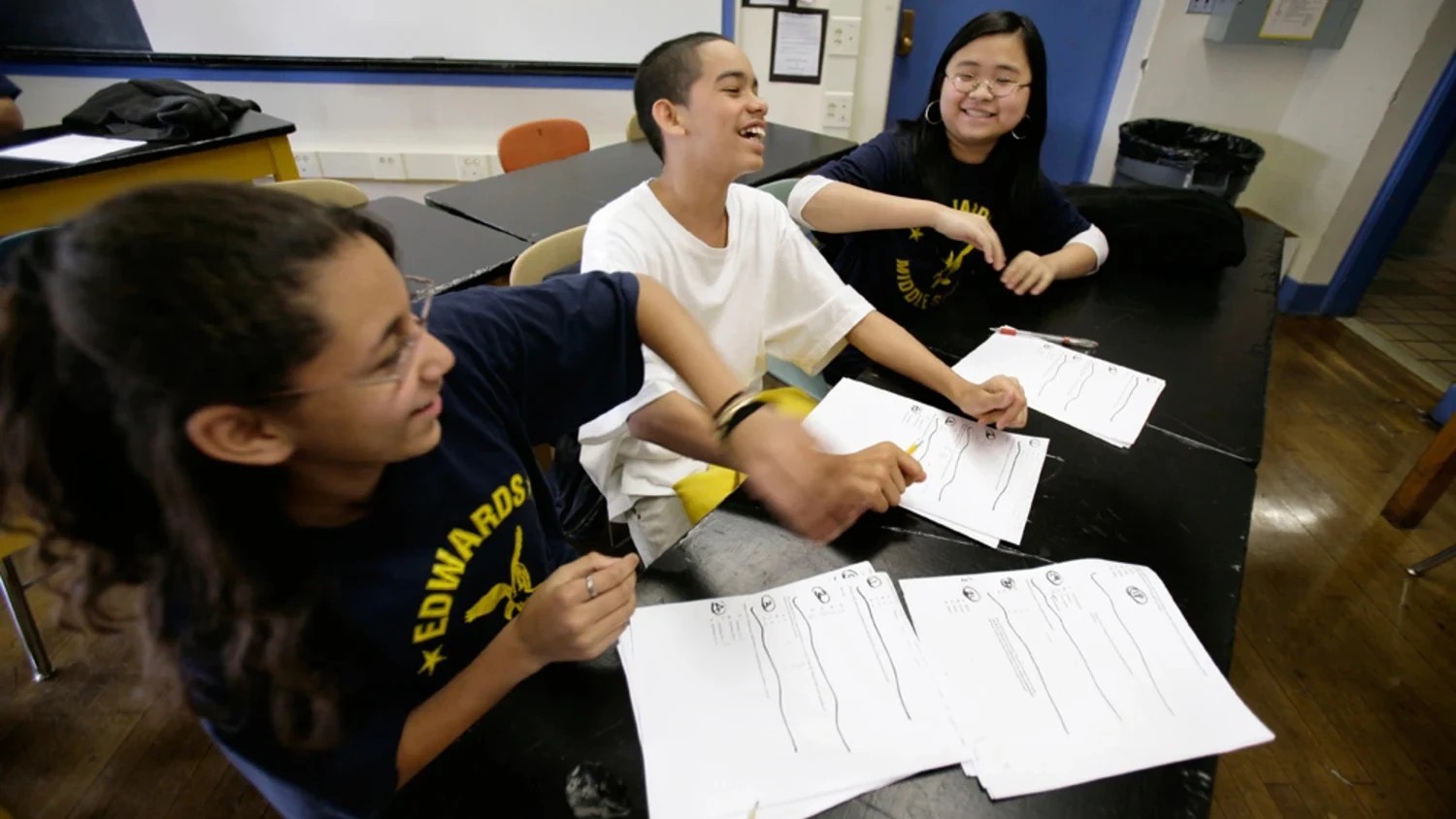
Above photo: Michael Dwyer / AP.
The 2025 PISA study by the OECD shows student performance in the western democratic countries collapsing in the areas of math and reading.
Student performance across western developed countries has continued to decline, reaching the lowest average ever recorded in science, reading, and mathematics, according to testing data released by the Organization for Economic Co-operation and Development (OECD) on 8 September.
The conclusions come from the 2025 PISA study, a global test administered by the OECD every three years to 760,000 15-year-olds across 91 OECD and non-OECD countries.
The OECD currently has 38 member countries, mostly higher-income democracies, including the US, Canada, the UK, Europe, Japan, South Korea, and Australia.
Across the OECD, 20 percent of 15-year-old students are now low performers in science, mathematics, and reading, up from 16 percent when the previous test was administered in 2022.
Reading scores fell by 28 points across OECD countries between 2015 and 2025, equal to about one and a half years of learning, the PISA results showed.
Math scores fell by 22 points over the past 10 years – about one year of learning.
Student performance has also declined in non-OECD countries, with reading scores down 16 points and math scores down eight points over the same period.
If you really want to understand where the world is at and where it’s going, you probably cannot get anything more meaningful than the OECD’s PISA study – a global test given every 3 years to an insane 760,000 15-year-olds across 91 countries.
No report globally, by any… pic.twitter.com/QljTWcGdp5
— Arnaud Bertrand (@RnaudBertrand) September 9, 2026
“PISA 2025 shows that reversing declines in student performance is urgent. The most successful education systems focus on fewer areas in greater depth, invest in teachers, engage parents, and provide targeted support for the students and schools that need it the most,” said OECD Secretary-General Mathias Cormann.
In contrast, student performance has improved and/or remains high in several countries, most notably in China.
Students in China, Estonia, Japan, Korea, Singapore, Chinese Taipei and the UK ranked among the highest-performing in science, mathematics, and reading.
In math, the average Chinese student performed at a level that is considered elite in the rest of the world.
Science performance rose in Lithuania, the Slovak Republic, Turkiye, the Dominican Republic, Georgia, Macao (China), Montenegro, Qatar, Thailand, the UAE, and Uruguay.
The 2025 PISA testing results also show that when AI and digital tools are used, they should be used with “care, for clearly defined purposes, and in moderation.”
Students tended to perform worse when the use of such tools “became excessive or when devices were used for leisure at school.”
More than one in four students participating in the PISA test said that classmates were distracted by digital devices in most or every science lesson.
Students who said they did not use AI to draft text for writing assignments performed better than those who said they did.
“Technology and AI can strengthen learning and help prepare young people for the future, but only when used purposefully and not as a substitute for attention, effort and understanding,” the OECD secretary-general stated.
Founded in Paris in 1961, the OECD is a global policy forum that aims to promote policies to preserve individual liberty and improve the economic and social well-being of people around the world.