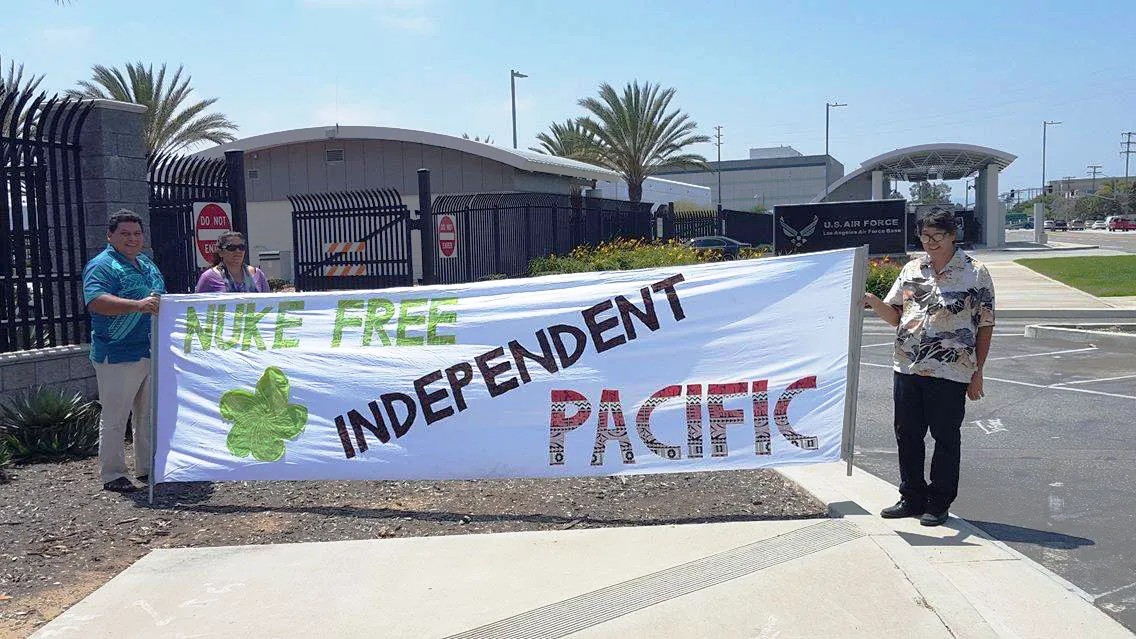
Above photo: Standing outside the gate of Lockheed Martin in Los Angeles, 2016.
Realigning peace in the Asia-Pacific.
It’s time to conclude the war and restore the U.N.
This is the first of two related articles on the western Pacific. The Unconcluded War examines the treaty record from Cairo in 1943 to San Francisco in 1951. It argues that the American alliance system in East Asia replaced a wartime settlement that was never concluded, and that Chinese policy on Taiwan and Japanese rearmament seeks the completion of that settlement. The second article, Island Chains or Corridors, turns to the Pacific Islands. The 1951 settlement placed the former Japanese mandates under American strategic administration. Current proposals for American retrenchment would concentrate the remaining military posture there. The second article asks what Pacific Island countries can build in its place through regional institutions and South-South corridors.
Arnaud Bertrand’s recent Substack essay, “Top Washington strategist says U.S. bases in Asia are ‘all risk and little reward,’” reads Jennifer Kavanagh’s report, “A Second Island Chain Strategy for Asia,” as evidence of a Chinese strategic victory. In his account, China spent decades making the first island chain indefensible, and Washington’s leading strategists now conclude, in their own interest, that the United States should withdraw. Bertrand closes with Sun Tzu’s maxim about “breaking the enemy’s resistance without fighting.” The reference could just as readily be turned toward Washington’s history of containment, regime change, military intervention, and strategic encirclement. Since 1949, the PRC has framed its own international position through anti-imperialism, territorial defense, and opposition to the military alliances surrounding it.
Both Kavanagh and Bertrand assign China the role of an adversary executing a campaign, a role that fits the historical record only when that record is read from the Western canon. Bertrand treats the American position in the western Pacific as the baseline and Chinese capability as the force that eroded it. That sequence should have been reversed long ago, before President Obama’s 2011 Rebalance to Asia reinforced it.
As I argued in a 2025 article, “Peace is a Haunting Specter of War,” the 1951 Japanese Peace Treaty should be understood as the foundation of a U.S.-Japan postwar alliance. It departed from the territorial framework the Allies established during the war and produced no regional settlement comparable to the one established for Germany at Potsdam. Read against the documents of that peace process, Kavanagh’s report describes the cost of maintaining an unconcluded war. Bertrand presents its conclusion as a strategic withdrawal, closer to a modern-day Dunkirk, in which an untenable forward position is abandoned while the military perimeter is preserved farther east. It should instead be read as a relocation of the unconcluded war, transferring its military perimeter and strategic risks from the first island chain to the Pacific states and territories of the second.
The Argument Under Review
Kavanagh, director of military analysis at Defense Priorities, defines American interests in Asia as two: defense of the homeland and access to regional markets and trade routes. Measured against those interests, she rightly recommends terminating the mutual defense treaty with South Korea, adopting a policy of non-intervention in any military confrontation over Taiwan, renegotiating the Philippine treaty to exclude South China Sea claims, removing the mutual defense clause from the Australian relationship, and substantially reducing the American presence in Japan by 2035. She also proposes relocating forces to Guam, Palau, the Marshall Islands, the Federated States of Micronesia, and Australia. That relocation leaves the postwar security architecture in place and moves its military perimeter farther east.
Most of these sites lie within the former U.S.-administered Trust Territory of the Pacific Islands, which included what are now the Marshall Islands, the Federated States of Micronesia, Palau, and the Northern Mariana Islands. Much of the strategic geography established under the postwar trusteeship system remains embedded in U.S. defense arrangements regardless of the present status of these Pacific Island countries and territories. For them, the Second Island Chain redistributes the strategic risks, infrastructure, and obligations of an unconcluded war to island nations continuing to struggle against the twin fists of colonization and militarization. The Nuclear Free and Independent Pacific movement recognized this relationship decades ago, arguing that “self-determination for Pacific peoples was the key to creating a demilitarized and nuclear-free Pacific” (Naidu 185). The Second Island Chain raises the same question in a different strategic form: whether Pacific security can be determined by Pacific peoples while their islands remain incorporated into the military perimeter of outside powers.
Bertrand accepts Kavanagh’s military reasoning, adding that the first island chain became indefensible because China built the missiles, the navy, and the industrial base that now hold American bases at risk. I am more than happy to read Washington’s retreat as Chinese success, and I accept his reading of Kavanagh’s proposal as “essentially Beijing’s own wish list for the region,” citing Xi Jinping’s 2014 statement that “it is for the people of Asia to run the affairs of Asia.” His reading stops short of asking what “postwar international order” is actually being defended. Bertrand treats Beijing’s objection to a nuclear-armed Japan as a potential cost of American retrenchment, and Taiwan as a strategic asset whose value can be weighed against the cost of defending it. Both arguments begin with the present security architecture and pass over the settlement that produced it. Before deciding whether Kavanagh’s withdrawal would dismantle the postwar order, we have to establish what that order actually settled and what it left unresolved.
The Open Door
American policy toward China rests on a foundation older than the alliance system of 1951. John Hay’s Open Door policy of 1900 declared the American aim to “preserve Chinese territorial and administrative entity” and to “safeguard for the world the principle of equal and impartial trade with all parts of the Chinese Empire” (Hay). The Nine-Power Treaty of 1922 converted the policy into treaty law. Its first article bound the signatories to respect China’s territorial integrity and to maintain “the principle of equal opportunity for the commerce and industry of all nations throughout the territory of China” (Treaty between the Nine Powers). The language of integrity guaranteed foreign access. China’s territory was to remain whole so that its market, tariffs, and finance would remain available to the nine powers on equal terms (Tomimas; Bau).
The Chinese signatory was the foreign-backed Beiyang government in Beijing, a regime dependent upon foreign loans and a foreign-administered customs service. The Nationalist government under Chiang Kai-shek inherited the treaty system and carried it forward without a popular mandate. In the terms of Chinese political thought, the bullying and concessions of his government had lost the Mandate of Heaven (Tianming). Mencius stated the principle in the fourth century BCE: “The people are the most important; the altars of state come next; the ruler is the least” (Mencius 7B:14). The revolution of 1949 applied that judgment. The People’s Republic rejected the treaty system and the foreign management of China that the Open Door had codified. Washington answered with a comprehensive blockade and trade embargo in December 1950.
The Republic of China on Taiwan then became the government of continuity for the Nine-Power system. It retained China’s seat in the United Nations and on the Security Council until the passage of U.N. General Assembly Resolution 2758 in 1971. Taiwan remained the “China” open to American and Japanese capital, and from the 1960s its export-processing zones integrated it more deeply into their supply chains. The alignment of the original signatories suggests a broader institutional continuity. Seven of the eight parties other than China became founding members of NATO in 1949. The eighth, Japan, entered a bilateral security alliance with the United States in 1951, while the Mutual Security Act extended American economic and military assistance within the emerging Cold War security system. Recognition of the ROC as the government representing China allowed this system to preserve Western leverage over the China question after 1949. Kavanagh’s semiconductor argument restates the same interest in its present form. Taiwan matters to Washington as a node of commercial access.
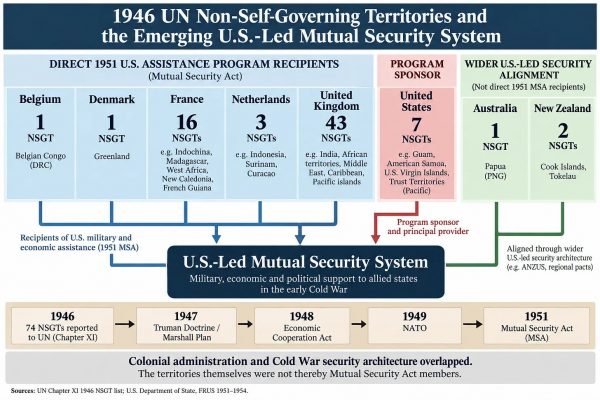
The China Lobby gave this arrangement its domestic political force. The textile importer Alfred Kohlberg, the publisher Henry Luce, Representative Walter Judd, Senator William Knowland, and Senator Pat McCarran organized around the charge that the State Department had “lost” China. The Committee of One Million, founded in 1953, held a congressional veto over recognition of the People’s Republic for two decades. The lobby fixed Taiwan’s status as a loyalty test in American politics and helps explain why the island was detached from the wartime settlement.
Cairo, Potsdam and San Francisco
Washington’s undermining of the peace process begins with the Allied commitment among the United States, the United Kingdom, China, and the Soviet Union that no separate peace would be made with the Axis powers. The January 1, 1942 Declaration by United Nations bound its signatories to “make no separate armistice or peace with the enemies.” China participated as one of the principal Allied powers in determining the terms of Japan’s territorial surrender. The Cairo Declaration stated that “all the territories Japan has stolen from the Chinese, such as Manchuria, Formosa, and the Pescadores, shall be restored to the Republic of China.” Annex II of the Potsdam Conference provided that “the terms of the Cairo Declaration shall be carried out” and limited Japanese sovereignty to Honshu, Hokkaido, Kyushu, Shikoku, and such minor islands as the Allies determined. Okinawa and the Ryukyus were never among the minor islands to be handed over to Japanese administration.
Japanese forces in Taiwan surrendered to representatives of the Republic of China in Taipei in October 1945, after which the ROC assumed administration over Taiwan. The People’s Republic would not be established until 1949, so the wartime negotiations involved the ROC, which was internationally recognized as the government of China and held China’s seat in the newly established United Nations and Security Council. The later division over which government represented China did not exist when Cairo and Potsdam established the Allied terms for Japan’s surrender. The distinction is no more complicated than France recognizing the United States in 1778, five years before Britain formally recognized American independence in the Treaty of Paris of 1783. The revolution of 1949 changed which government exercised authority over China. The Chinese state that participated in the Allied settlement of 1943 to 1945 remained the same party to it.
In January 1950, President Truman recalled Cairo and Potsdam and affirmed that “the United States and the other Allied Powers have accepted the exercise of Chinese authority over the Island,” adding that the United States had no intention of using its armed forces to interfere. Five months later, following the outbreak of the Korean War, Truman ordered the Seventh Fleet into the Taiwan Strait and declared that “the determination of the future status of Formosa must await the restoration of security in the Pacific, a peace settlement with Japan, or consideration by the United Nations.” The doctrine of Taiwan’s undetermined status emerged from this reversal of American policy.
The Treaty of Peace with Japan, signed at San Francisco a year later, incorporated that reversal into the postwar settlement. Neither Chinese government participated. Korea was excluded. The Soviet Union, Poland, and Czechoslovakia attended but refused to sign, while India and Burma declined to attend (United States Department of State, Record of Proceedings). Measured against Cairo and Potsdam, the San Francisco treaty produced these results:
- Korea (Article 2(a)): Japan renounced its claims to Korea, while Korea itself was excluded from the conference.
- Taiwan and the Pescadores (Article 2(b)): Japan renounced “all right, title and claim to Formosa and the Pescadores” without naming a recipient, despite the Cairo conference having already named it as part of China.
- The Kurils and southern Sakhalin (Article 2(c)): both were renounced without a recipient, leaving Russia’s claim unresolved.
- The South China Sea (Article 2(f)): China’s Xisha and Nansha Islands (the Paracel and Spratly Islands) were renounced despite China’s historical jurisdiction over the South China Sea unresolved, including the Dongsha and Zhongsha Islands (the Pratas Islands, and Macclesfield Bank and Scarborough Shoal).
- The Ryukyus (Article 3): Okinawa and the Ryukyus were placed under American administration. Potsdam had never designated them among the minor islands left to Japan and undermined their former independent status.
- The Pacific Islands: Japan’s former Pacific Island territories passed into American strategic trusteeship. That has led to decades of decolonial struggle across the region.
Zhou Enlai clearly rejected the treaty, prepared without the participation of the People’s Republic, as illegal and invalid. He carried the mandate for China’s liberation, writing, “When faced with aggression by the Japanese imperialists, one party in China was for resisting while the other party was for making concessions” (Zhou 62).
The contradiction with the 1942 commitment was substantial. China had entered the Allied war under an agreement prohibiting a separate peace, participated in establishing Japan’s surrender terms, and received the Japanese surrender in Taiwan. Six years later, a peace treaty with Japan was concluded without China at the negotiating table, reopening territorial questions the wartime declarations had already addressed.
The present security architecture was assembled around that settlement. The United States signed a mutual defense treaty with the Philippines in August 1951, the ANZUS Treaty in September, and the Security Treaty with Japan a week later, on the same day as the peace treaty. Under pressure from the United States Senate, Prime Minister Yoshida Shigeru committed Japan to conclude a treaty with the Republic of China, and the Treaty of Taipei was signed in April 1952, the same day the San Francisco treaty entered into force. Article 7 committed the parties to place “their trading, maritime, and other commercial relations on a stable and friendly basis.” The settlement reproduced the Open Door under new terms. It withheld a territorial settlement from the government in Beijing, established commercial normalization with the government in Taipei, and secured an American military position across the region.
Japan’s remaining relations were addressed through separate and incomplete arrangements. Japan normalized relations with the Republic of China in 1952, South Korea in 1965, and the People’s Republic of China in 1972, while its relationship with the Philippines was addressed through separate reparations and peace arrangements. No peace treaty was concluded with the Soviet Union, and none exists today between Japan and North Korea. Largely absent from these arrangements is any reckoning with Japan’s atrocities in China, Taiwan, South Korea, and the Philippines. The Philippines presents an added complication. It participated at San Francisco only five years after gaining independence in 1946 from the United States, which had ruled it since 1898, interrupted by Japanese occupation from 1942 to 1945. The genocide and mass atrocities committed during both U.S. and Japanese occupation of what remained legally a U.S. territory are largely absent from conventional accounts of U.S.-Philippine relations. President Bongbong Marcos’s present security arrangements with the United States should at least reopen the question of American responsibility for the protection of a people then under U.S. sovereignty. Pacific Island governments need to ask the same questions regarding the security of their people, who already face existential threats from climate change. Written clearly on the world stage, there are powers that really don’t give a shit about marginalizing populations for their own benefit.
Japan and the Surrender Terms
Territory was only one part of the surrender settlement. The Potsdam Proclamation also imposed conditions on Japan’s future military power. Article 6 required that “the authority and influence of those who have deceived and misled the people of Japan into embarking on world conquest” be eliminated for all time. Article 7 provided for occupation until “Japan’s war-making power is destroyed.” The U.N. Charter subsequently included Articles 53 and 107, the enemy-state clauses, preserving language concerning action against states that had been enemies of the Charter’s signatories during the Second World War.
The Marshall Plan, enacted through the 1948 Economic Cooperation Act, moved the United States and the Marshall Aid countries away from the original spirit of the Charter. In Japan, the National Police Reserve was established in 1950, the Self-Defense Forces followed in 1954, and the U.S.-Japan security relationship incorporated Japan into American regional strategy. The contradiction was apparent by the end of the Cold War. In 1990, Marine Maj. Gen. Henry Stackpole described American forces in Japan as “a cap in the bottle,” preventing the emergence of a “re-armed, resurgent Japan.” A 1991 Chicago Tribune analysis asked whether the Japanese were effectively “paying us to contain them.” Kavanagh carries this process further by proposing a Japan capable of providing for its own defense by 2035 and accepting the possibility that Tokyo might acquire nuclear weapons (Kavanagh). Responsibility for the same military perimeter would pass to a more heavily armed Japan operating under an unresolved framework of peace.
Recent Chinese statements address this history. In October 2025, China held its first Commemoration Day of Taiwan’s Restoration, established to “safeguard the outcomes of the victory of the World Anti-Fascist War and the post-war international order.” The following month, Prime Minister Sanae Takaichi told the Diet that a Taiwan contingency could constitute a “survival-threatening situation” for Japan. China’s permanent representative Fu Cong wrote to the Secretary-General that this was the first time since 1945 that a Japanese leader had made such a link in an official setting, and stated that China would exercise its right of self-defense under the Charter if Japan intervened militarily. The Chinese Embassy in Tokyo also invoked the enemy-state clauses. When Takaichi called at the General Assembly for the removal of those clauses, Foreign Ministry spokesperson Guo Jiakun correctly responded that they were established to prevent fascism and militarism from again threatening international peace and security, and that their underlying purpose remained relevant.
Bertrand quotes the Foreign Ministry’s description of Japanese nuclear advocacy as “a blatant challenge to the postwar international order” and reads it primarily as a problem that American retrenchment would leave behind. The statement has a more specific historical reference. Beijing is invoking the surrender framework established at Cairo and Potsdam against the rearmament of Japan, while Japan seeks to move beyond restrictions derived from that framework. Chinese arguments concerning Taiwan and Japanese rearmament therefore return to the same unresolved question: whether the postwar order is defined by the surrender terms established between 1943 and 1945 or by the American security architecture constructed around San Francisco after 1950.
Containment and Capability
Bertrand holds that China made the first island chain indefensible. The chronology reveals a different sequence. The Seventh Fleet entered the Taiwan Strait on 27 June 1950. The embargo followed in December 1950, the San Francisco System in 1951, and the Mutual Defense Treaty with the Republic of China on 2 December 1954. During the Strait crises of 1954 to 1955 and 1958, the Eisenhower administration considered the use of nuclear weapons against the mainland. For its first three decades, the People’s Republic faced an American fleet in waters that the wartime instruments had placed within Chinese sovereignty, an American nuclear posture directed at its coast, and an alliance perimeter built on the very islands Japan had renounced. The U.S.-backed Philippine position in the South China Sea dispute should be understood in the same context.
Chinese missile, naval, and industrial capacity developed inside that perimeter and in response to Washington’s containment. China has built the means to hold the terms of a settlement it was party to, in a strait the United States entered by unilateral executive order. Bertrand writes that “the surest sign a strategy has worked is when your rival concludes, in its own interest, that it should do what you wanted all along.” The outcome Beijing has sought since 1949 is the outcome Washington signed at Cairo in 1943.
Xi Jinping made his 2014 statement at the Conference on Interaction and Confidence-Building Measures in Asia shortly after Obama announced the Pacific Rebalance, and just before the founding BRICS documents were signed in Fortaleza on the sidelines of the World Cup. His view that the people of Asia should run the affairs of Asia belongs to a longer line of Chinese policy running through the Five Principles of Peaceful Coexistence of 1954 and the Bandung Conference of 1955 (Ministry of Foreign Affairs of the People’s Republic of China). Its demand is regional security without an external garrison. That demand converges with Kavanagh’s recommendations because both respond to the same fact: the American posture in East Asia rests on a suspended settlement whose costs now exceed its returns.
Concluding the War
The colonial Open Door system of 1900 and 1922 secured foreign access to China through the language of territorial integrity, and it failed when the Chinese revolution of 1949 rejected it. The San Francisco settlement of 1951 attempted to restore that system by withholding Taiwan from Beijing and binding Japan to American strategy. It is failing now because Beijing has the capacity to uphold the terms of the earlier Allied settlement. Kavanagh’s report records this second failure in the language of cost and benefit, and Bertrand’s essay records it in the language of stratagem.
A genuine conclusion would return to the instruments the United States signed in 1942. It would honor Cairo and Potsdam on Taiwan, maintain the surrender terms on Japanese rearmament, settle the Korean question with the Korean people present, resolve the renunciations of 1951 with recipients named, and open the second island chain to the self-determination that the Trust Territory deferred. Describing that policy as aggression requires treating 1951 as the origin of the postwar order. Measured against the instruments of 1942 to 1945, the war in the western Pacific remains unconcluded. The companion article, Island Chains or Corridors, follows the consequences of that unconcluded war into the Pacific Islands.
Works Cited
Bau, Mingchien Joshua. The Foreign Relations of China: A History and a Survey. Fleming H. Revell, 1921.
“Joint Communiqué of the Government of Japan and the Government of the People’s Republic of China.” 29 Sept. 1972. Ministry of Foreign Affairs of Japan.
Mencius. The Works of Mencius. Translated by James Legge, Dover, 1970.
Naidu, Vijay. “The Fiji Anti-Nuclear Movement: Problems and Prospects.” The Pacific: Peace, Security and the Nuclear Issue, edited by Ranginui Walker and William Sutherland, United Nations University and Zed Books, 1988, pp. 185–195.
“Potsdam Proclamation (Proclamation Defining Terms for Japanese Surrender).” 26 July 1945. Foreign Relations of the United States: The Conference of Berlin (Potsdam), 1945, vol. 2, U.S. Government Printing Office, 1960.
Tomimas, Shutaro. The Open-Door Policy and the Territorial Integrity of China. A. G. Seiler, 1919.
“Treaty of Peace with Japan.” 8 Sept. 1951. United Nations Treaty Series, vol. 136.
United Nations General Assembly. Resolution 2758 (XXVI), “Restoration of the Lawful Rights of the People’s Republic of China in the United Nations.” 25 Oct. 1971.
United States Relations with China. Department of State Publication 3573. Office of Public Affairs, U.S. Government Printing Office, August 1949.
United States Department of State. Record of Proceedings: Conference for the Conclusion and Signature of the Treaty of Peace with Japan, San Francisco, California, September 4–8, 1951. U.S. Government Printing Office, 1951.
Zhou Enlai. “Statement on the U.S.-British Draft Peace Treaty with Japan and the San Francisco Conference.” 15 Aug. 1951. Ministry of Foreign Affairs of the People’s Republic of China.
Zhou, Enlai. Selected Works of Zhou Enlai. Vol. 2, Foreign Languages Press, 1989.