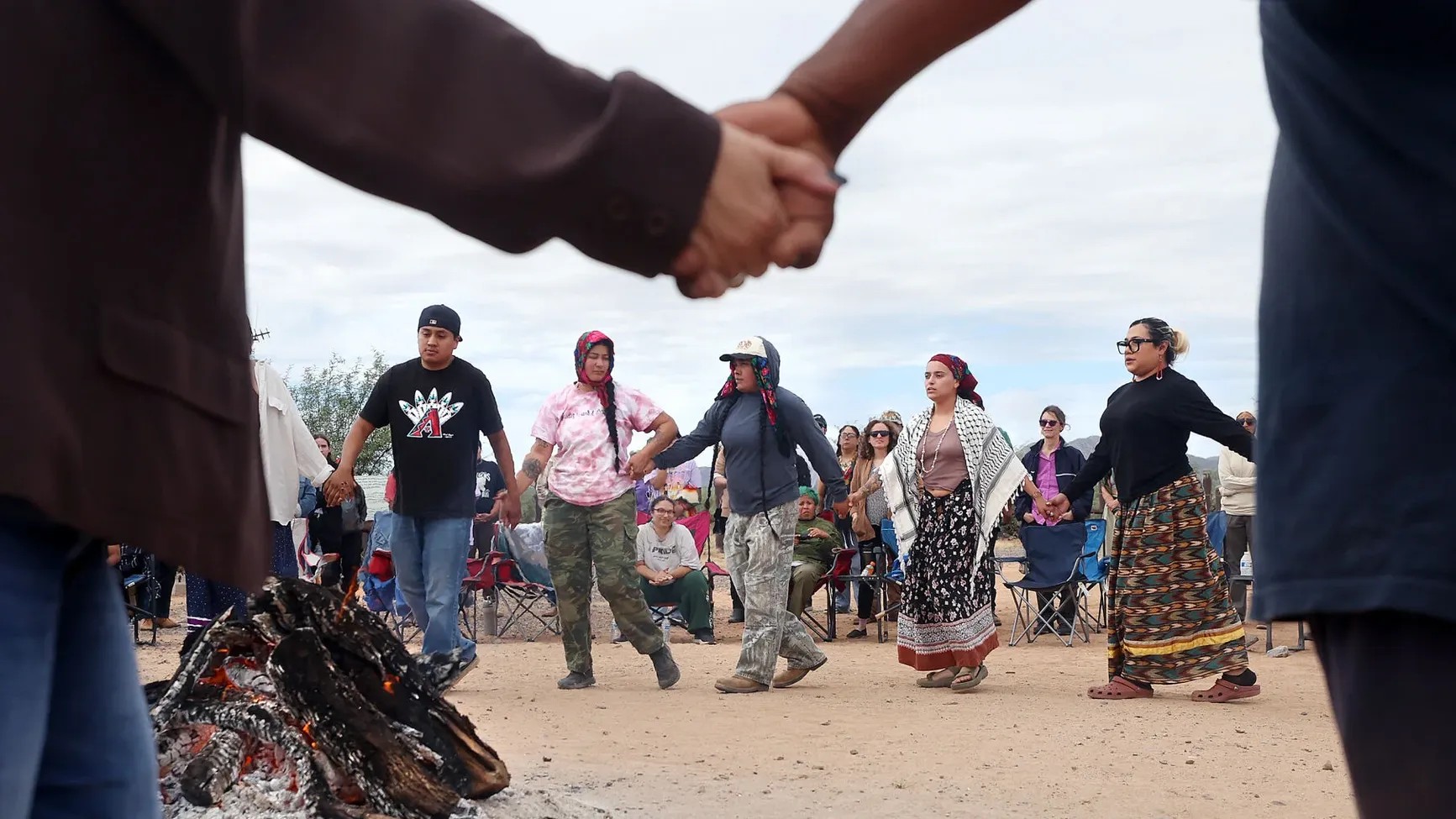
Above photo: Arizona Central.
Tohono O’odham Nation – The Tohono O’odham Nation is preparing for potential confrontations between tribal members defending their land and federal contractors who will soon be uprooting thousands of cacti, including sacred saguaros, to make way for border-wall construction that’s fiercely opposed by the tribe.
The Nation’s emergency management office has set up a medical station at the San Miguel Community Center — much closer to the border than the hospital in Sells — with emergency services, a mobile health center and dozens of tribal police and fire personnel ready to attend anyone who needs assistance, whether due to use-of-force incidents, such as pepper spray, or simple dehydration, said Anthony Manuel, administrator of the emergency management office.
“This will be our Day 1,” Manuel said Monday, noting his personnel are trained in triage. “If we do have an influx of people that are hurt or injured, that’s something we can accommodate.”
Tribal Chairman Verlon Jose said that while he respects tribal members’ right to protest, he is urging peaceful resistance to avoid any injury or violence.
Jose said the situation facing the Nation is heart-breaking and the stakes are high. He spoke Monday before a tribal elder gave a blessing to the land, about eight miles east of the San Miguel Gate.
The tribe says thousands of saguaros, sacred to the Tohono O’odham, are marked with tags for removal in the desert landscape.
“To us, it’s total destruction,” Jose said. “It’s as if they’re going to take one of our relatives and destroy them.”
Tensions are rising on the Tohono O’odham Nation as the U.S. government has ignored the tribe’s opposition and pushed ahead with plans for two border walls along the Nation’s border with Mexico.
In August, U.S. Customs and Border Protection agents provided an armed escort to protect contractors engaged in pre-construction activities on the Nation’s land. The agency’s armed escort was a response to tribal police turning away contractors, enforcing a “no trespassing” order for non-tribal members in the area.
CBP has not shared details with tribal leadership on the agency’s plans to build two border walls on the Nation’s border with Mexico, which will divide the O’odham ancestral lands in two, Jose said.
But last week, CBP told tribal leaders they would begin removing vegetation — including thousands of saguaros — on Oct. 12, which is Indigenous People’s Day.
No contractors were on site Monday, but tribal officials were braced for their arrival any day.
“We’re just in the dark, like you guys,” Manuel said. “It’s just the unknown that’s going to probably have us on our toes.”
Thousands of saguaros and other plants stand in the path of the border walls that CBP has planned across 62 miles of the Nation’s southern boundary. CBP has already tagged many cacti, including saguaros and ocotillos, that will be transplanted elsewhere.
Jose said he has little hope most will survive transfer: About 100 saguaros were relocated in 2019 to make room for border-wall construction, and more than half of those transplanted died.
The removal of saguaros, known as ha:sañ, is an “atrocity,” tribal leadership said in an Oct. 9 statement. The tribal council recognized saguaros as people in a 2021 resolution.
“Trespassing on our land to remove the sacred saguaros is like having masked men break into your house and take away your children,” Jose said in the statement. “The ha:sañ are our family, as much a part of us as any blood relative. To destroy them by the thousands carves a wound in our hearts that will not heal.”
On Monday, U.S. Rep. Adelita Grijalva, D-Arizona, and Pima County Board of Supervisors Chair Jen Allen joined tribal leaders and attorneys involved in the tribe’s federal lawsuit in visiting the Nation’s southern border.
Grijalva said the wall construction, and what she called the disrespectful manner in which it’s being carried out, is a “black eye” on the U.S. and “an abuse of the people of the Nation.”
“The federal government has not been forthcoming with information,” neither with the tribe nor with Grijalva herself, she said.
“It is a complete violation of sovereignty and (tribal) consultation, and respecting the land and the people here,” she said.
The U.S. government’s actions are re-opening old wounds and having a deep “psychological impact” on community members, said Vivian Juan-Saunders, Chukut Kuk District representative, speaking to journalists and other visitors to the San Miguel area Monday.
“We’re trying to heal from the last 250 years,” Juan-Saunders said. The border wall will come very close to a cemetery, horrifying families who have loved ones buried there, she said.
“We have a family that wants to unearth their child’s body (and move it) because they don’t want their child’s body to be blown up” during construction, she said. “That’s the trauma we’re feeling.”
The lack of clear information from the federal government on where exactly the wall will go is also weighing on tribal members, she said.
“Whatever path they’re taking, they’re not telling us,” she said.
Local subcontractors
Tohono O’odham Nation Chairman Verlon Jose speaks Monday after a prayer ceremony on the Tohono O’odham Nation, near where the U.S. plans to build a second border wall opposed by the tribe.
Mamta Popat, Arizona Daily Star
In June, CBP awarded Texas-based SLSCO LTD the contract to install primary border wall on the Nation’s southern boundary. The construction company hired four subcontractors to handle the upcoming vegetation removal and related activities on the Nation’s land, tribal officials said.
Those sub-contractors include Tucson-based Southlands Engineering and Marana-based KP Cactus and Tree, according to a Monday press release from tribal leadership.
“These companies must understand they are participating in an atrocity against our people,” Jose said in the statement. “… By taking this contract, these companies are choosing to be complicit in a lawless desecration of our land, our culture and our identity.”
The office manager at Southlands Engineering declined to comment Monday afternoon, when the Star called to confirm the company’s involvement. A man who answered the phone at KP Cactus and Tree said, “We have nothing to do with that,” but he would not clearly identify himself , nor connect the Star with management.
The Tohono O’odham Nation, which sued the Department of Homeland Security in June over its border-wall plans, filed an emergency injunction last week with the Washington, D.C., Circuit Court of Appeals to try to stop the destruction of vegetation, at least while its appeal in the case is still pending.
It was the tribe’s second attempt to halt construction, after unsuccessfully seeking a preliminary injunction in August.
U.S. District Judge Richard J. Leon denied the tribe’s request for an injunction again Thursday.
In denying the injunction, Leon wrote, “The Government has identified serious national security and public safety concerns at the international border. … I see no compelling reason to revisit my conclusion that the balance of equities and public interest favor the Government at this juncture.”
Leon’s decision opened the door for CBP to move forward with what tribal leaders called “lawless behavior that has already caused irreparable damage to our environment and cultural heritage.”
Though no contractors were on site Monday, a growing number of tribal members and supporters are gathering at a prayer camp and fire circle at the San Miguel Gate, one of three traditional crossings in the current low-lying vehicle barrier that now demarcates the international boundary.
The “fire keepers” aim to share and center tribal traditions, while keeping tabs on CBP and contractors’ activity, tribal member Amy Juan said last month.
On Monday, dozens danced and prayed together, seeking a means of demonstrating their opposition to CBP’s wall plans, and to counter those plans by defiantly celebrating their traditions.
“It’s nice being out there building a community, building a family that has the same hopes and priorities,” said Sialig Hu’u, who is 28 and has a 2-year-old daughter. “Trying to get people to remember that we have a purpose here, to protect the land. … I have a daughter, so it’s to be able to share with her that we were there. And she can be proud to know we were there and didn’t just let it happen.”