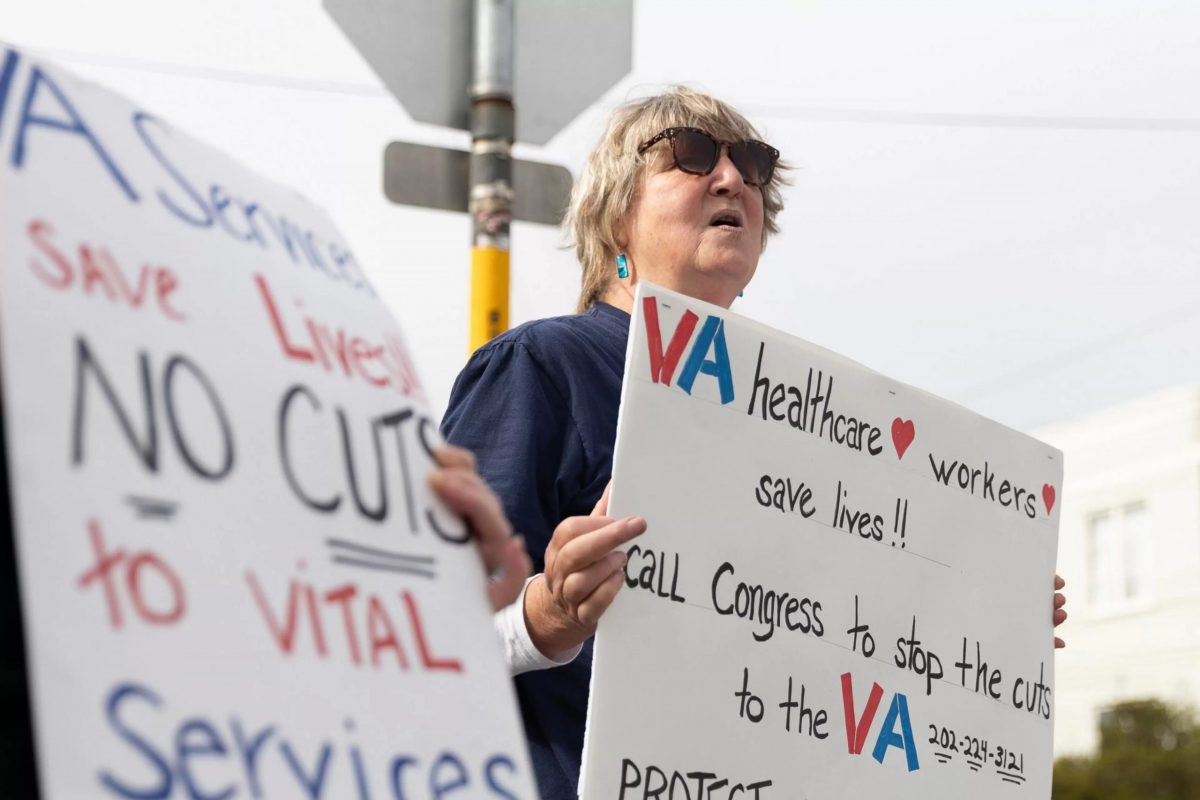
Above photo: Kim Valadez, a retired VA social worker, protests Monday against DOGE outside the San Francisco Veterans Affairs Medical Center. Magali Gauthier for The Standard.
It’s all about fulfilling Lincoln’s real pledge, which wasn’t just to veterans.
The other day, I did a presentation with Oscar Arbulu, a Marine veteran and executive director of the organization I co-founded, the Veterans Healthcare Policy Institute (VHPI). We spoke about the threats to the VA at a Bay Area Rotary Club and then later at night, we addressed the same topic at the Evergreen Cafe in Berkeley.
The Rotary Club members we addressed have a long history of helping veterans. A few veterans were members of the club and some of them used the VA for their healthcare. Other members in the audience included the children of veterans. One woman’s father had, in fact, worked as a physician for the VA. Members of the club thus understood that the VA healthcare system provided clinical care to the nation’s veterans.
When we expanded our discussion beyond how the VA served not only veterans but all Americans, things got very interesting. We asked the non-veteran, non-VA users how many thought the VA had ever benefited them personally or the nation more broadly.
You could see the confusion in their eyes as they considered the question. Me? Benefit from the VA? How, I’m not a veteran? (The response was hardly surprising. Before I began writing about VA care, I had the very same response.)
We asked folks if they knew that their primary care doctor, orthopedist, or oncologist might have trained at a VA medical center. Nope, they had no idea. Had anyone ever been to a therapist for mental healthcare? A few brave hands went up. Well, we said, your mental health provider might have done an internship at the VA. Really, the group responded. Yes indeed, we said, since the VA trains 70% of American physicians as well as myriad other healthcare professionals. (Click here for more info). They had no idea.
The Rotarians were even more astounded to learn about the VA’s critical role in the nation’s medical/healthcare research infrastructure (click here to see more). How many folks in the room, we asked, received the first shingles vaccine? Almost every hand went up. The VA developed it.
How many ever used the nicotine patch or knew someone who had a pacemaker? More hands were raised. Thank you VA.
Were you ever admitted to a hospital, we asked? Even more hands shot up. We told the group that patients’ barcoded wrist bands – the ones nurses check before administering medication – were invented by a VA nurse. Barcoding was tested and implemented throughout the VA healthcare system before being adopted in global healthcare. Billions of patients worldwide have the VA to thank for a major innovation in patient safety.
Finally, we asked the Rotarians if anyone knew about the VA’s Fourth Mission to serve as back up to the civilian healthcare sector during national, regional and local emergencies. Not a soul in the room had a clue. We asked folks if anyone from their local healthcare provider – Sutter, UCSF, Stanford – had ever called them during one of California’s many wildfires to ask them if they had their meds, medical equipment, or needed help getting to an appointment. Of course, no one ever had ever received such a call. Unlike the VA, private sector healthcare providers do not routinely set up command posts during regional emergencies so they can contact every patient who lives in a wildfire zone.
The VA does all this, we explained, because it is an integrated, comprehensive, national health system that delivers more than episodic medical care. It has established a model of what healthcare in the U.S, should look like, not just for veterans but for all of us. Even though it has many problems (what human system doesn’t), as many scientific and healthcare research articles point out, it can serve as a model of what American healthcare could look like if its patient care/ patient safety imperatives and financing models were aligned (which, in case you didn’t know it, are not).
When we left the Rotary Club that afternoon, people thanked us for the presentation and for providing a very different perspective on both VA and American healthcare.
Later that night, Oscar and I attended another event where we talked about the VA at the Evergreen café in Berkeley at the launch of its Writers on Wednesday series. My husband Steve Early joined us to talk about our new book Courage or Complicity.
Different audience, different location, and yet once again, folks who thought they knew something about the VA learned more about the role it serves in the American healthcare ecosystem.
In this case, our message was a little different. The healthcare reform advocates in the room, we suggested, should consider do more to fight to save the VA from the machinations of same profiteers who are trying to destroy traditional Medicare. In fact, we added, those who are struggling to pass Medicare for All, might consider using the VA as a model of what a genuine American healthcare system might look like and fight for that as well.
Someone in the audience raised their hand and asked,”Wait a minute, you mean we should all go to VA hospitals? Is that what you want?”
No, I said, of course not. VA for All, something I heartily support, doesn’t mean that 330 million Americans descend on 170 VA medical centers. What it does mean is that those struggling to reform our failing American medical institutions (I always hesitate to use the term “American healthcare system” because, as the late Walter Kronkite famously said, “The American healthcare system is neither healthy, caring, nor a system.”) should consider the VA to be a model that guides the reform agenda.
Plus, if you want a to see a high functioning, government run system, you don’t need to travel to Canada, or the UK, or Scandinavia. Every state, every major city in the country, and even many rural areas, has a VA facility that delivers high- quality healthcare at a fraction of the cost of our increasingly broken, fragmented, profit driven medical facilities and insurers.
That’s why so few Americans know about what the VA does and why it’s being attacked by a powerful movement of right wing, anti-government ideologues and corporate enterprises who want to destroy the VA’s publicly funded system and channel its billions into the coffers of private sector healthcare profiteers. They don’t want the VA to continue serving either veterans or the American public because they can’t abide the fact that a public system is performing better than a private one. That fact violates one of the central tenets of America’s current model of cowboy capitalism: a government program is never allowed to compete with a private sector program and actually win the competition. Which is what the VA has consistently done for more than three decades. (For some evidence, click here).
The take home message of our presentations was the following: We have a system in the United States that provides what so many of us are fighting for. It’s a national system, that delivers medical treatment, mental and behavioral healthcare, long term care, as well as residential treatment. It is grounded in a team based primary care model and implements the principles of public health: the VHA delivers population health and also addresses all the social determinants of health. The system is publicly funded, publicly accountable, and delivers stellar innovations in the delivery of clinical care, teaches the next generation of health professionals, conducts pathbreaking clinical and health services research and – as an added bonus –helps the nation respond to national, regional, and local emergencies.
Does Medicare do any of this? Nope. How could it? It’s a payer not a payer and provider. So why aren’t we fighting for what we want? Healthcare, not just health insurance, for all.
As my colleague Russell Lemle said in our meeting in Berkeley, “Our nation is today divided between people who believe we should take care of our own and those who believe we are on our own. The VA represents the former. It could help us do more than take care of veterans, Lemle said, it could help us take care of each other.
In fighting for the VA model of care, we would be fulfilling the real pledge that Abraham Lincoln made to the nation in his famous second inaugural address. To quote from our book Our Veterans, “According to Civil War historian and Princeton history professor Allen Guelzo, when Lincoln made his famous pledge, “to care for him who shall have borne the battle and for his widow and his orphan,” he had no intention of carving out a special place, in postwar society, for veterans or their survivors. His overriding concern was implementing a process of national reconciliation. Former service members were part of that process, for sure, but not its sole focus. Lincoln’s call to “bind up the nation’s wounds” was not limited to those soldiers injured on the battlefield, but addressed the need for broader healing.”
This is, of course, just what our nation needs today, not only in healthcare but in our politics and our relationship to one another as citizens.