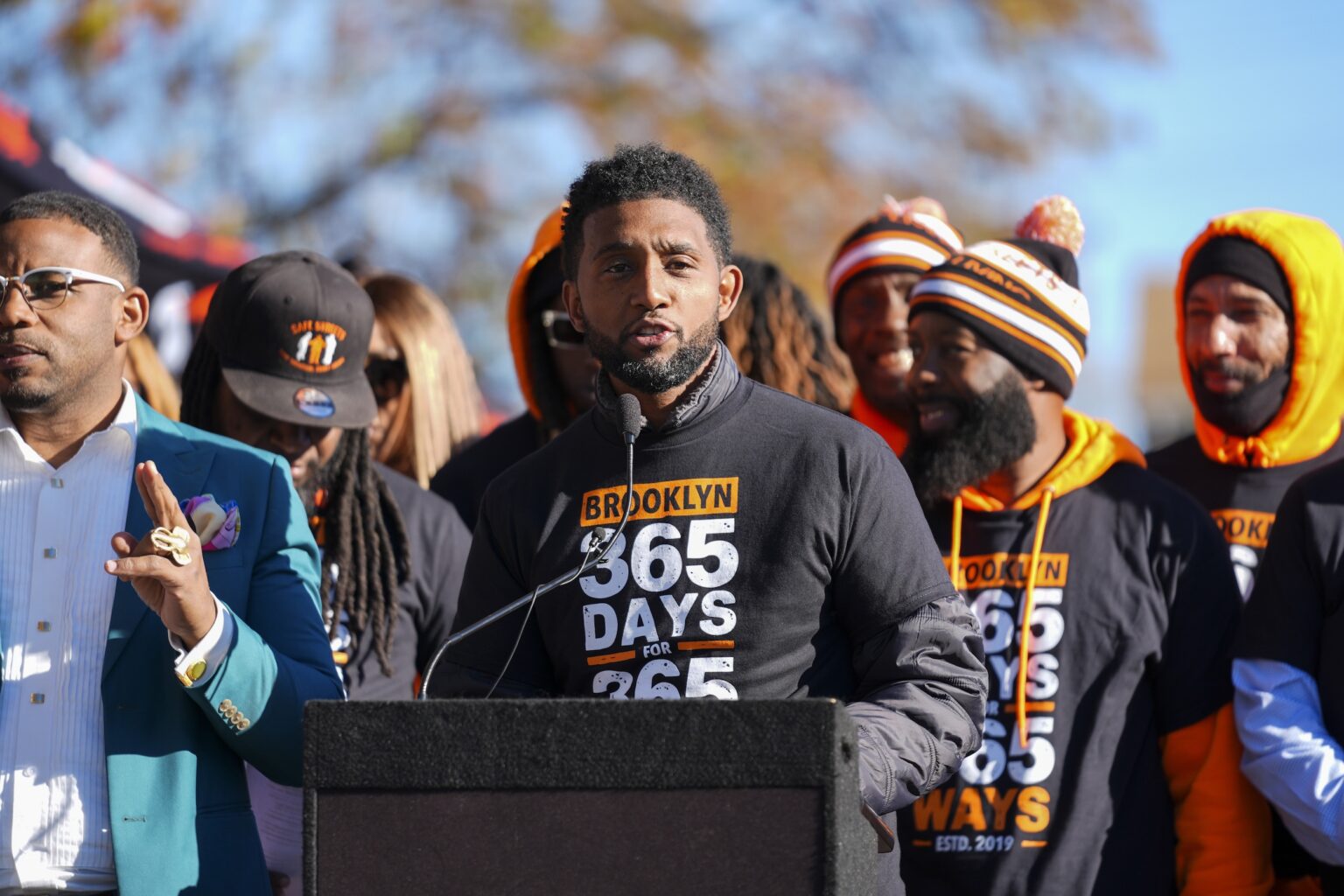
Above photo: Baltimore Mayor Brandon Scott speaks during a press conference to celebrate achieving over 365 days without a homicide within the Brooklyn neighborhood Safe Streets catchment zone, in November 2024. AP Photo/Stephanie Scarbrough.
A growing body of research suggests that the city’s approach to reducing shootings at scale may be one of the most effective yet.
When Baltimore Mayor Brandon Scott proposed his signature violence reduction strategy in 2021, he was asking community members to believe that an effort that had already failed — twice — could work if the city tried again.
Baltimore had tried versions of the strategy, known as focused deterrence, in the 1990s and in 2014. The approach — often oversimplified as a “carrot-and-stick” tactic for violence prevention — aims to identify the small number of people most likely to be involved in shootings and offer them both help and the promise of legal consequences if violence continues. Focused deterrence had a long history, including successes in other cities, and a strong research pedigree. But in Baltimore, both efforts fizzled, undermined by impatience, uneven follow-through on enforcement, and a failure to deliver the services that officials promised.
That history hung over Scott’s plan as his administration prepared to launch what became known as Baltimore’s Group Violence Reduction Strategy, or GVRS, in early 2022. The city was coming off seven consecutive years with more than 300 homicides. Community meetings meant to build support for the plandrewsparse attendance. Some residents were weary of new crime plans. Others doubted City Hall could keep its promises.
Nearly five years later, Baltimore is in a very different place.
Through the first six months of 2026, the city logged 50 homicides — the fewest in Baltimore during the first half of a calendar year since at least the 1960s, according to the city. Homicides were down 23 percent compared with the same point last year, while nonfatal shootings were down 2.5 percent. From 2019 to 2022, Baltimore had already surpassed 150 homicides by the midpoint of the year. In 2023, the city recorded 142 by this time of the year. But in 2024, Baltimore fell below 100 homicides in the first six months for the first time since 2014, and the number has been declining since.
“We are making progress on public safety that many thought was impossible,” Scott said in a statement announcing the numbers last week.
It’s unlikely that a single program caused Baltimore’s almost miraculous decline in violence. Instead, a growing body of research suggests that the city’s approach — a coordinated system combining focused deterrence, community violence intervention, victim services, improved investigations, and sustained leadership from City Hall — may be one of the clearest examples yet of a city reducing gun violence at scale.
The strongest evidence comes from a newevaluationof GVRS by researchers affiliated with the University of Pennsylvania’s Crime and Justice Policy Lab. The strategy launched in January 2022 in the city’s Western District, then Baltimore’s most violent police district, before expanding elsewhere. The study found that within 18 months, GVRS was associated with a roughly one-third decline in shootings and homicides in the Western District compared with similar areas of Baltimore that had not yet received the strategy. Carjackings also fell by roughly 40 percent.
Ben Struhl, executive director of the Crime and Justice Policy Lab, said one reason Baltimore’s effort worked better than past attempts is that the city treated GVRS not as a stand-alone program but as an approach to governing.
“It’s not a program,” Struhl said. “It is a city strategy that starts with the mayor as one of the key political authorizers, and then tries to arrange government through a lot of different management means and some theory-driven activities to actually bring down violence at scale.”
That distinction is important, Struhl said, because cities often adopt pieces of focused deterrence — call-in meetings, community messaging, or enforcement actions — without building the full system needed to reach community members with resources and support to make the strategy work. Baltimore’s earlier attempts suffered from that problem. Using the “carrot-and-stick” simplification, Baltimore haphazardly wielded the stick and forgot the carrot. The current version, he said, was built around data, weekly reviews of shootings, a real service component, community messengers, and credible follow-through.
“In our experience, it’s never seemed to work anywhere with just the stick,” Struhl told me. “There always needs to be a genuine offer of support that you can follow through on.”
That was one of the central lessons Baltimore officials say they took from past failures.
Stefanie Mavronis, director of the Baltimore Mayor’s Office of Neighborhood Safety and Engagement, said the city had previously tried to scale focused deterrence too quickly and had not invested enough in the service side of the strategy. This time, she said, the city launched in one district and spent a full year there before beginning a measured expansion.
“We’ve had to be really intentional and have candid conversations and collaboration with our law enforcement to make sure that we’re not moving in such a way that outstrips capacity,” Mavronis said.
Today, GVRS is operating in six of Baltimore’s nine police districts, with plans to expand citywide. The strategy brings together the neighborhood safety office, police, prosecutors, probation, the Department of Juvenile Services, community messengers, and community-based service providers, includingRocaandYouth Advocate Programs. After shootings or other serious incidents, the city identifies people at elevated risk of being involved in retaliation or future violence. Some receive direct communications warning them to stop shooting and offering help. Others are referred to service providers.
Online donations are back! Keep independent media alive.
Due to the attacks on our fiscal sponsor, we were unable to raise funds online for nearly two years. As the bills pile up, your help is needed now to cover the monthly costs of operating Popular Resistance.
Due to the attacks on our fiscal sponsor, we were unable to raise funds online for nearly two years. As the bills pile up, your help is needed now to cover the monthly costs of operating Popular Resistance.
Independent media outlets are being suppressed and dropped by corporations like Google, Facebook and Twitter. Sign up for our daily email digest before it’s too late so you don’t miss the latest movement news.