
Marine, Navy, Army and Airforce Veterans and Police Vow to Protect Innocent Protesters
WashingtonsBlog
October 31, 2011
In response to the police brutality against peaceful American protesters – here, here, here, here, here
In fact, many in the military support the protests (and see this).
As of today, OccupyMarines, Occupy Police, Occupy Navy, Occupy Airforce, and Occupy Army have formed to protect the people against police brutality.
After Veterans for Peace member Scott Olsen – a Marine Corps veteran twice deployed to Iraq – was critically wounded in the Occupy Oakland protest, Occupy Marines tweeted:
WHEN YOU SHOOT ONE MARINE, YOU SHOOT AT ALL OF US. OORAH. Do It Peacefully Occupy We Stand In Solidarity
Source: WashingtonsBlog
A Warning to the Economic and Political Elites: Listen Now
Occupying Public Space is the Beginning of an American Revolt
By Kevin Zeese
The Occupy Movement is not only resulting in the occupation of public space, but also in political space. We are already shifting the dialogue and the movement has just begun.
When we started planning the occupation of Freedom Plaza six months ago, our goal was to create a place where the ignored voices of the American people could be heard. They are starting to be heard thanks to occupations all over the country. If it is not clear to the economic and political elites, this is the beginning of an American revolt.
Before considering occupation, we tried other avenues: elections, lobbying, petitioning, email campaigns, telephone campaigns, marches, rallies – but they were ineffective. The country continued going in the direction of concentrated wealth, rather than where super-majorities of Americans wanted to go.
The occupation of Freedom Plaza in downtown Washington, DC and occupations around the country display our message of anger at the unfairness of the economy, the expanding war quagmires and the corruption of government that result in the people’s urgent necessities being ignored in favor of more wealth for the top 1%.
I don’t like sleeping in a tent in Freedom Plaza. But we see no other way to get our voices heard. We are occupying Freedom Plaza because Americans have been kept out of the political process. Money rules elections and lobbying, while the 99% are ignored.
We occupy Washington, DC because it is where big business money combines with campaign laws that corrupt government so that it does not respond to the people. Washington, DC is corporate occupied territory with 18,000 professional lobbyists, most of who work for business interests pushing the agenda of concentrated wealth.
The great health care reform “triumph” of the Obama administration highlighted how out of touch government is with the people. For more than a decade Americans have simply wanted improved Medicare and for all and removal of the unnecessary insurance industry. Instead, President Obama and the Democratic leadership pushed “reform” that further entrenched the insurance industry with hundreds of millions of dollars in annual tax subsidies and forcing Americans to purchase flawed insurance. They kept single payer out of the debate because Medicare for all compared with insurance-based health care is less expensive, covers everybody and improves the quality of health care.
The response to the financial crisis was also inadequate. People from Wall Street responsible for the collapse were put in key positions in the administration. Congress was unable to pass a real stimulus early in the Obama era. Instead a weak, partial stimulus was passed that may have slowed the economic collapse but missed the opportunity to turn things around. The financial reform was inadequate as it failed to break up the big banks, bring back Glass-Steagall or adequately regulate derivatives. Last week Citibank got off easy with a $285 million fine for the sale of a billion dollars in fraudulent mortgage derivatives but this was only one of many corrupt Citibank deals, the rest will not even be investigated. Once again, obvious and necessary steps were impossible due to corporate power.
Occupying public space is an opportunity to discuss political taboos. As the war drum against Iran began to beat Freedom Plaza held an Iran night with Persian food, music, dancing and discussion. We discussed why war on Iran was wrong, as well as the problems in the U.S. relationships with Saudi Arabia and Israel. And, we mentioned a reality almost never heard in U.S. media or politics – U.S. Empire. While the military will not say how many bases and outposts it has the most thorough review estimates more than 1,100 around the world and now a new empire of drones. The British Empire had 37 bases at its peak and the Romans had 36. The U.S. Empire is a secret to most Americans only discussed as a euphemism –policeman of the world. This false description hides the real facts of exploitation and domination. This taboo needs to be broken so Americans can debate whether empire is good for the nation and the world.
The Occupy Movement is being driven by economic insecurity. Almost all Americans feel it that is why we are all part of the 99%. The economic insecurity is not because of lack of resources, but because political elites consistently send money to economic elites through tax breaks and giveaways resulting in the wealthiest 400 Americans having the wealth of 154 million of us, yet paying 17.4% in federal taxes while working Americans pay 25% to 30%. The tax structure needs to be restructured so wealth is taxed more than work, purchases of stocks, bonds and derivatives are taxed (we pay taxes on purchase food, clothing and shelter) and a truly progressive income tax is put in place. It is this unfairness at a time of economic fear that is driving the Occupy Movement.
A warning to the elites: occupations are only the beginning. This movement is in its early stage and is going to grow in ways that are hard to imagine right now. We know that decades of the expansion of corporate power will not be undone with one occupation. Plans are being made by some of us to move “Beyond Occupation” to the next steps of building a movement that represents all Americans – youth burdened with college loans and lousy jobs, seniors stuck in poverty retirement with their Social Security and Medicare threatened, the middle class who worked their whole lives and are now part of the long-term unemployed, live in homes with underwater mortgages and fear foreclosure and of course the poor, homeless and mentally ill whose mistreatment has become more obvious as the public space we occupy draws them to us for food and housing.
A message for the elites: THIS IS JUST THE BEGINNING. LISTEN TO US NOW OR THE PRICE OF CHANGE WILL GET MORE EXPENSIVE FOR YOU: What do we seek? We seek an end to corporate rule and shifting power to the people.
Kevin Zeese is one of the organizers of the Freedom Plaza Occupation, www.OccupyWashingtonDC.org.
Is Freedom Plaza an Alternative to Anti-Depressants?
The last section of this article describes the author's visit to Freedom Plaza and how uplifting it was.
400% Rise in Anti-Depressant Pill Use: Americans Are Disempowered -- Can the OWS Uprising Shake Us Out of Our Depression?
By Bruce Levine
Alternet, October 26, 2011 |

TAKE ACTION
The U.S. Centers for Disease Control and Prevention (CDC) recently reported that antidepressant use in the United States has increased nearly 400 percent in the last two decades, making antidepressants the most frequently used class of medications by Americans ages 18-44. Among Americans 12 years and older, 11 percent were taking antidepressants by 2005-2008 (the most recently reported study period), and 23 percent of women ages 40–59 years were taking them.Why has U.S. antidepressant use skyrocketed? Are the symptoms of what is commonly called depression—helplessness, hopelessness, and immobilization—always evidence of a medical condition? Or is it time to repoliticize a great deal of our despair, and reconsider the old-fashioned antidepressant of political activism?Common Explanations for Soaring Antidepressant Use
Nowhere in the CDC report is there any explanation for the 400 percent increase of antidepressant use from 1988 to 2008, however, there are several common explanations offered by mental health professionals and journalists.
Money is a large factor. It has become more lucrative for psychiatrists and other physicians to prescribe medication than to provide talk therapy. This was detailed in the New York TimesMarch 2011 investigative report “Talk Doesn’t Pay, So Psychiatry Turns Instead to Drug Therapy” which reported, “A 2005 government survey found that just 11 percent of psychiatrists provided talk therapy to all patients.” Actually, most antidepressant prescriptions are written by physicians other than psychiatrists and, according to the recent CDC report, among Americans taking one antidepressant, less than one-third of them have seen a mental health professional in the past year.
Antidepressant use has also skyrocketed because of the increased practice of prescribing antidepressants for many conditions other than severe depression, and prescribing them for longer periods of time. Among the 2005-2008 antidepressant user group (no data offered on earlier study periods), only 33.9 percent had severe symptoms of depression; 28.4 percent of antidepressant users had moderate symptoms; and 19.2 percent had mild symptoms; while 7.6 percent had no depression symptoms. And, according to the CDC report, more than 60 percent of Americans who are taking antidepressants have taken them for 2 years or longer, with 14 percent having taken them for 10 years or more.
According to antidepressant manufacturers, the increase in antidepressant use has been caused by their creation of more effective antidepressants, including the so-called selective serotonin reuptake inhibitors (SSRIs) such as Prozac, Paxil, and Zoloft which came on the market in the late 1980s and early 1990s. However, by the late 1990s, psychiatry textbooks had already rejected the idea of increased effectiveness of SSRIs (for example, Robert Julien’s A Primer of Drug Action (1998) states, “The newer antidepressants [SSRIs] are not necessarily more effective than the older TCAs [tricyclics] ).”
Rather than SSRIs’ greater effectiveness, it was their greater publicity that stimulated public acceptance. One publicity coup commenced in 1997 when U.S. government agencies changed the rules for broadcast advertising, no longer requiring full information about side effects (which had previously made it problematic for drug companies to run a thirty-second spot). TV advertising dramatically increased patient requests for antidepressants from their physicians. A study reported in 2005 by the Journal of the American Medical Association, “Influence of Patients’ Requests for Direct-to-Consumer Advertised Antidepressants,” concluded, “Patients’ requests have a profound effect on physician prescribing.”
A Neglected Explanation: The Depoliticizing of Despair
A largely neglected explanation for the huge growth of antidepressant use is that Americans have increasingly been socialized to equate all states of demoralization and immobilizing despair with a medical condition, and to seek medical treatment rather than political remedies.
Depression is highly associated with a variety of overwhelming pains, including physical pain, relationship pain (such as a dissatisfying marriage and social isolation), trauma—and financial pains.
Financial pains include unemployment, poverty, and debt. In 2007 the U.S. Substance Abuse & Mental Health Services Administration reported depression in 12.7 percent of unemployed people compared to 7 percent of employed people. And the Urban Institute in 1996 reported that Americans on public assistance have at least three times higher rate of depression than those not on public assistance. A person who has suffered mental illness is three times more likely to be in debt than someone who is not in debt, according to Richard Wakerall, director of the U.K. mental health organization Mind in Plymouth.
Recently, I had a chance encounter at Cincinnati’s Findlay Market with five young adults who reported large student-loan debt and who appeared mildly depressed about it. I happened to be in a charged-up mood, having just participated in an Occupy Cincy march, and I told them that the entire U.S. $1 trillion student-loan debt could be forgiven if the U.S. government paid it off rather than funding the damn military-industrial complex, which costs us over $1 trillion a year if you include everything. They started to smile and look more energized, and three of them seemed interested in the Occupy Cincy movement. If America’s millions of depressed student-loan debtors could politicize their despair and take it to the mall in Washington D.C., we could dwarf the crowds in Tahrir Square.
Can Activism Be an Antidepressant?
Almost as soon as I entered Freedom Plaza in Washington D.C. on October 6, I experienced a wave of pleasant feelings and energy. My wife, Bon, and I showed up about 10am on the first day of “October 2011” (“Occupy Freedom Plaza”) in Washington D.C. after driving there from Cincinnati. In sharp contrast to the blank and depressed faces that I had just seen on the D.C. Metro and on the D.C. streets, we were now surrounded by a thousand or so people who were smiling, laughing, engaged in political discussions, and eagerly awaiting the day’s events. I chatted with two of the organizers, David Swanson and Margaret Flowers, and found their hope and energy a supreme antidote to cynicism. The opposite of depression is vitality, and so by just stepping into Freedom Plaza, I had received a strong antidepressant.
Then came the day’s major march. Depression is much about feeling hopeless, alienated, isolated, and powerless, and this march was an antidote to all those feelings. For a couple of hours, we felt some real power. We marched on the streets— not the sidewalks—and traffic was blocked by police, who for those moments in time actually were the People’s servants. We marched past the White House and the Treasury, paused at the U.S. Chamber of Commerce to “drop off some job resumes” and for some short speeches, then up and over to K Street, with many cars honking approval and some non-marchers on the sidewalks raising their fists and shouting encouragement. Then back to the Plaza, and a couple of hours later a General Assembly.
The General Assembly was attended by about 500 people who experienced, some for the first time, a non-hierarchical, anti-authoritarian, respectful democracy where the issues of the day were discussed. No one was rude and all seemed jovially patient. We hadn’t planned to stay more than that day, but leaving the Plaza late that evening, we had an urge to return.
The next morning, I found my pace quicken as I headed from the Metro station back to Freedom Plaza, as I was excited to return to this piece of “federal property” that had begun to feel like a “People’s Oasis.” We had succeeded, at least for the time being, in taking back a small piece of the United States and restoring it to some kind of sanity and humanity. A section of the Plaza was filled with sleeping bags, backpacks and cardboard shelters, and our food, media, and first-aid tents still stood.
We decided to prolong our visit and stay for the afternoon march to the Martin Luther King Memorial. At this march, there were the chants that are common to all Occupy marches: “We are the 99 percent.” “The banks got bailed out, we got sold out.” “Hey, hey, ho, ho, corporate greed has got to go.” “Show me what democracy looks like. This is what democracy looks like.” On this march, we paused at the International Trade Center (in the Ronald Reagan Building), where there were about 75 demonstrators protesting the tar sands pipeline. As some of our marchers had earlier participated in their protest, the pipeline protesters returned the favor by joining our march. We shouted our appreciation and our morale kicked up another notch.
Leaving Freedom Plaza at the end of my short stint there, I thought that even a little dose of democracy, especially when it has not been experienced, is the best damn antidepressant that many people will ever experience. And even if the cynics are right and the movement dies from cold weather or gets large enough for the corporatocracy to bring out their tanks and crush it, something still will have been won. Everybody who participated will remember that their demoralization and despair was “cured,” at least for a time, not by a pill or any other consumer product but by their own political actions.
Bruce E. Levine is a clinical psychologist and author of Get Up, Stand Up: Uniting Populists, Energizing the Defeated, and Battling the Corporate Elite (Chelsea Green, 2011). His Web site is www.brucelevine.net.
The Commonwealth Creates Most Wealth and Needs to be Paid Back
Most wealth comes from the commonwealth and the failure to replinish the commonwealth, repay it for the wealth it has helped to create, has led to the undermining of the economy, economic insecurity and the wealth divide . . .
How the 99 Percent Really Lost Out - in Far Greater Ways Than the Occupy Protesters Imagine
by: Gar Alperovitz, Truthout | Op-Ed

Joanne Kathleen Farrell, a protester from Occupy Albany, waved an American flag on Washington Avenue, which borders Academy Park near the state Capitol, in Albany, New York, October 26, 2011. (Photo: Nathaniel Brooks / The New York Times)
"Property is theft," French anarchist Pierre-Joseph Proudhon famously declared in 1840 - a judgment clearly shared by many of those involved in the occupations in the name of the 99 percent around the country, and especially when applied to Wall Street bankers and traders. Elizabeth Warren also angrily points out that there "is nobody in this country who got rich on his own. Nobody." Meaning: if the rich don't pay their fair share of the taxes which educate their workers and provide roads, security and many other things, they are essentially stealing from everyone else.
But this is the least of it: Proudhon may have exaggerated when, for instance, we think of a small farmer working his own land with his own hands. But we now know that he was far closer to the truth than even he might have imagined when it comes to how the top 1 percent really got so rich, and why the 99 percent lost out. The biggest "theft" by the 1 percent has been of the primary source of wealth - knowledge - for its own benefit.
Knowledge? Yes, of course, and increasingly so. The fact is, most of what we call wealth is now known to be overwhelmingly the product of technical, scientific and other knowledge - and most of this innovation derives from socially inherited knowledge, at that. Which means that, except for trivial amounts, it was simply not created by the 1 percent who enjoy the lion's share of its benefits. Most of it was created, historically, by society - which is to say, minimally, the other 99 percent.
Take a simple example: In our own time, over many decades, the development of the steel plow and the tractor increased one man's capacity to farm, from a small plot (with a mule and wooden plow) to many hundred acres. What changed over the years to make this possible was a great deal of engineering, steelmaking, chemistry and other knowledge developed by society as a whole.
Another obvious example: Many of the advances that have propelled our high-tech economy in recent decades grew directly out of research programs financed and, often, collaboratively developed, by the federal government and paid for by the taxpayer. The Internet, to take the most well-known example, began as a government defense project, the Advanced Research Projects Agency Network (ARPANET), in the 1960s. Today's vast software industry rests on a foundation of computer language and operating hardware developed, in large part, with public support. The Bill Gateses of the world might still be working with vacuum tubes and punch cards were it not for critical research and technology programs created or financed by the federal government after World War II.
The iPhone is another example: Its microchips, cellular communication abilities and global positioning system (GPS) all flowed from developments traceable to significant direct and indirect public support from the military and space programs. The "revolutionary" multi-touch screen was developed by University of Delaware researchers financially supported by the National Science Foundation and the CIA. It is not only electronics: of the 15 modern US-developed "blockbuster" drugs with over $1 billion in sales, 13 received significant public research and development support.
But taxpayer-financed government programs (including, of course, all of public education!) are only the tip of the iceberg. And here we are not talking rhetoric, we are talking the stuff of Nobel prizes. Over the last several decades, economic research has begun to pinpoint much more precisely how much of what we call "wealth" society in general derives from long, steady, century-by-century advances in knowledge - and how much any one individual at any point in time can be said to have earned and "deserved."
Recent estimates indicate, for instance, that national output per capita has increased more than twentyfold over the 200-plus years since 1800. Output per hour worked has increased an estimated fifteenfold since 1870 alone. Yet the modern person is likely to work each hour with no greater commitment, risk or intelligence than his counterpart from the past. The primary reason for such huge gains is that, on the whole, scientific, technical and cultural knowledge has grown at a scale and pace that far outstrips any other factor in the nation's economic achievement.
A half-century ago, in 1957, economist Robert Solow showed that nearly 90 percent of productivity growth in the first half of the 20th century alone, from 1909 to 1949, could only be attributed to technical change in the broadest sense. The supply of labor and capital - what workers and employers contribute - appeared almost incidental to this massive technological "residual." (Solow received the Nobel Prize for this and related work in 1987.) Another leading economist, William Baumol, calculated that "nearly 90 percent ... of current GDP [gross domestic product] was contributed by innovation carried out since 1870."
The truly central and demanding question is obviously this: If most of what we have today is attributable to knowledge advances that we all inherit in common, why, specifically, should this gift of our collective history not more generously benefit all members of society? The top 1 percent of US households now receives far more income than the bottom 150 million Americans combined. The richest 1 percent of households owns nearly half of all investment assets (stocks and mutual funds, financial securities, business equity, trusts, nonhome real estate). A mere 400 individuals at the top have a combined net worth greater than the bottom 60 percent of the nation taken together. If America's vast wealth is mainly a gift of our common past, how, specifically, can such disparities be justified?
Early in the American republic, Thomas Paine urged that everything "beyond what a man's own hands produce" was a gift that came to him simply by living in society, and, hence, "he owes on every principle of justice, of gratitude, and of civilization, a part of that accumulation back again to society from whence the whole came." Another American reformer, Henry George, challenged what he called "the unearned increment" that is created when population growth and other societal factors increase land values.
To be sure, someone who genuinely makes a real contribution deserves to be rewarded. But Proudhon is right on target for many, many others: when what is created by all of society for many centuries gets turned into wealth, and, somehow, directly or indirectly, shunted away from the 99 percent by the 1 percent, much of that process, in fact, is reasonably described as "theft." The demand of the occupations that this theft stop, that it be reversed, is also right on target - both in what we know about how wealth is created, and, above all, in what we know about how a just society ought to organize its affairs.
Google Refused Law Enforcement Request To Pull Police Brutality Video
The Huffington Post, October 28, 2011

A U.S. law enforcement agency petitioned Google to take down a YouTube video showing police brutality, the web giant revealed in a new report.
Google said it refused the request, placed sometime between January and June of this year, though it did not specify why.
"We received a request from a local law enforcement agency to remove YouTube videos of police brutality, which we did not remove," Google wrote in its Transparency Report. "Separately, we received requests from a different local law enforcement agency for removal of videos allegedly defaming law enforcement officials. We did not comply with those requests, which we have categorized in this Report as defamation requests."
Of the 757 items that Google was asked to remove by the U.S. government in the first half of 2011, eighty percent were motivated by allegations of defamation.
The company complied with 63 percent of the U.S. government's requests. Google noted that it may decline to comply with requests to remove content because an agency has failed to obtain a court order.
"Some requests may not [be] specific enough for us to know what the government wanted us to remove (for example, no URL is listed in the request), and others involve allegations of defamation through informal letters from government agencies rather than a court orders [sic]," Google wrote. "We generally rely on courts to decide if a statement is defamatory according to local law."
The Atlantic’s Rebecca Rosen praised Google for its decision to deny the law enforcement agency’s request, arguing that the move sets a powerful precedent:
With this report, Google seems to be indicating that users who post such videos have the company's protection. In places like Egypt and Tunisia, the spread of videos portraying government brutality seems to have galvanized protesters. If Google were to take down such videos, that could have a powerful detrimental effect on the Occupy movement.
TechCrunch likewise suggests Google is attempting to send a message both to users and to governments in an attempt to position itself as a trustworthy resource:
I think that in this time of turmoil, Google is saying very quietly what it wouldn’t really be tactful to say loudly: “Put your sensitive and controversial video data here.” Certainly a site like LiveLeak is also an option, but YouTube finds itself the center of attention more frequently, and being more of a popular culture community, it wants to emphasize its legitimacy in matters like this. The transparency report is a way for them to encourage users to trust them, and perhaps, governments to respect them.
Between January and June 2011, American government entities filed 5,950 requests for information on Google users, 93 percent of which the company complied with.
The U.S. topped charts as the government that placed the third highest number of content removal requests, behind Brazil and Germany, but ahead of China. The U.S. also put in more requests for user data than any other country in the world.
Second Public Radio Freelancer Fired for OWS Support
WNYC web producer shown the door after taking part in New York demonstration.
Slate, Oct. 28, 2011

A second public radio freelancer has lost her job for taking part in the Occupy Wall Street protests.
Caitlin Curran, who says she was fired from her freelance position with WNYC’s The Takeaway after her bosses learned of her participation in a demonstration in New York City, recounted her story in a first-person account for Gawker that was published Friday.
Curran’s version of events breaks down roughly like so: She attended the event more or less as a spectator, but when her boyfriend began to suffer from "sign-holding fatigue," she briefly took over. A photo of her, sign in hand, quickly made the rounds on the Internet. Thinking she had a great story on her hands, she pitched a segment on her newfound notoriety to her producers, who were less than impressed with her journalistic chops and fired her, saying that she had "violated every ethic of journalism."
(If you’re wondering, the quote on the sign she was holding is paraphrased from an article from The Atlantic’s Conor Friedersdorf. You can read that here.)
The news of Curran’s firing comes one week after another public radio freelancer, Lisa Simeone, lost her gig with WAMU after her bosses discovered she had served as an occasional spokeswoman for one of the OWS offshoots in Washington, D.C.
Despite some initial confusion that crept its way into initial reports about both Simeone and Curran, neither worked directly for NPR. Simeone was fired by SoundPrint, an independent documentary show, albeit one that had adopted NPR’s code of ethics for its staff. Curran worked as a Web producer for The Takeaway, which is produced jointly by WYNC and Public Radio International.
Occupy Protests Look Toward Future
As Occupy protests around the country continue after starting more than a month ago, some involved with the movement are beginning to look toward the future. The protests have succeeded in bringing their concerns about corporate influence in politics and the economy onto the national stage. And Occupy movements are beginning to talk with each other about what comes next.
Protesters from Occupy D.C., were outside the hearing room of the congressional Super Committee, tasked with cutting the federal deficit.
Capitol Police moved in to issue the first of three warnings before arrests were made.
"You must cease your activities or be subject to arrest. That is your first warning."
The demonstrators know how far they can go to make their point without being arrested.
"One of the goals of the action is to cause some disruption and get some attention in this city," said Margaret Flowers, a pediatrician from Baltimore, Maryland. "We need people to realize that is why we take over the streets and disrupt the streets."
Three weeks into the Occupation at Freedom Plaza in Washington, demonstrators gather to organize protests.
But many people are beginning to wonder whether the Occupy protests have outlived their purpose. Kevin Zeese is an activist and lawyer from Maryland. Zeese says their message of ending corporate greed and justice has resonated with the public.
"The debate is not what it was before when we started," said Zeese. "So, I think we have had a great impact. The question is, and I am not sure what the answer is, and we are starting to wrestle with it, is, what is next for the Occupy movement?"
Zeese says protesters at Freedom Plaza are addressing that very question. Options range from staying at Freedom Plaza through the winter, to creating a more organized national movement.
Margaret Flowers says Occupy movements around the country are also talking through Web conferences. She would like to see a nationally organized movement.
"We are trying to put more guidance in there," explained Flowers. "And more of the tools that we used to learn about how you use non-violent means to change the power structure."
The conversations are very preliminary and geared toward building on the momentum Occupy has achieved nationally. Protesters say they represent the 99 percent of Americans who are suffering in the current economy, while the other 1 percent prospers.
"Ending corporate rule and shifting power to the people is a complicated task," said Zeese. "And the occupation is a tactic to achieve a step toward that task and build the kind of independent movement we need to achieve it."
For now, the Washington Occupy demonstrators will continue with their daily protests. Today, they back down before police make any arrests. They retreat outside and carry on bringing their message of ending corporate greed to the people.
Source: Voice of America (includes video)
Proposed Statement of Environmental Committee, October2011.org
In April, 2010, at the World People's Conference on Climate Change and the Rights of Nature in Cochabamba, Bolivia, the "Universal Declaration of the Rights of Nature" (http://therightsofnature.org/
The preamble to the Declaration acknowledges the fact that we are all part of an interdependent, interrelated community of living beings and that we owe our existence to the world of nature, to our Mother the Earth and our Father the Sun, which together provide everything necessary for life. The Declaration affirms that as an interdependent living community, it is not possible to recognize the rights of human beings alone, without causing an unsustainable imbalance within the larger living community. The Declaration further recognizes the urgency of taking decisive, collective action to transform those structures and systems that cause climate change and other threats to our natural living world.
We are approaching the threshold of the earth's ecological collapse due to our abuse, commodification, degradation and manipulation of the world's natural systems, resulting in a precipitous loss of biodiversity. Thus, the Environmental Committee urges October2011.org to endorse and support the Universal Declaration of the Rights of Nature, and further, to take immediate action to stop or curb violations of said Universal Declaration of the Rights of Nature to the greatest extent possible, whenever and wherever they occur.
Although assaults on Nature occur almost continuously worldwide, the Keystone XL Pipeline poses the most serious and immediate risk to people and natural systems, both in the US and internationally: a clear and present danger, if implemented. According to James Hansen of NASA's Goddard Space Institute, "the environmental impacts of tar sands development include: irreversible effects on biodiversity and the natural environment, reduced water quality, destruction of fragile, pristine Boreal Forest and associated wetlands, aquatic and watershed mismanagement, habitat fragmentation and loss, disruption to life cycles of endemic wildlife, particularly bird and caribou migrations, fish deformities and negative impacts on human health in downstream communities". Hansen claims that if emissions from tar sands oil are added to the current of mix of emissions from coal and other fossil fuels, "it is essentially game over" for the planet.
We hope that October2011.org will endorse not only the Universal Declaration of the Rights of Nature, but will also agree to endorse a Pledge of Resistance to the Keystone XL Pipeline, through pre-planned action, especially if the President approves it. We welcome any suggestions for appropriate direct action, including ways to educate the public on this critical issue. Respectfully submitted:
Environmental Committee, October2011.org
Egyptian Protesters To Hold Pro-Occupy Rally Friday
By Joshua Hersh
Huffington Post, October 28, 2011
Egyptian protesters who have camped out in Cairo's Tahrir Square are set to march to the U.S. Embassy Friday, in a rally of support for the Occupy Wall Street movement.
The news broke Thursday across Twitter, a preferred medium for protesters across the world:

 @TheBigPharaoh
 The Big Pharaoh
This is epic. Protesters in Tahrir tomorrow will march to the US embassy to protest the violent crackdown of #occupyoakland protests.
The Daily Kos, which has been closely following these developments Thursday, noted that earlier in the week, Egyptian activists -- writing under the pen name "Comrades in Cairo" -- had published an open letter of support to the Occupy movements in the Guardian.
"To all those across the world currently occupying parks, squares and other spaces, your comrades in Cairo are watching you in solidarity," the letter began.
Indeed, we are now in many ways involved in the same struggle. What most pundits call "the Arab Spring" has its roots in the demonstrations, riots, strikes and occupations taking place all around the world, its foundations lie in years-long struggles by people and popular movements. The moment that we find ourselves in is nothing new, as we in Egypt and others have been fighting against systems of repression, disenfranchisement and the unchecked ravages of global capitalism (yes, we said it, capitalism): a system that has made a world that is dangerous and cruel to its inhabitants. As the interests of government increasingly cater to the interests and comforts of private, transnational capital, our cities and homes have become progressively more abstract and violent places, subject to the casual ravages of the next economic development or urban renewal scheme.
The common aims and tactics of the two movements have occasionally led to direct ties. In early October, The Huffington Post reported on an Egyptian activist from Tahrir Square who delivered a powerful speech to the Occupy crowd in downtown Manhattan.
And as Wired noted recently, Ahmed Maher, one of the leading figures of the Egyptian movement, recently came to Washington, D.C., to help organizers there extend their reach.
But after a dramatic Tuesday night in Oakland, where police officials attempted to disburse a crowd of Occupy protesters using tear gas and other non-lethal weapons, many have seen growing similarities between the two movements -- and the type of resentment they seem to stir up.
Numerous people were injured in the police action Oakland, which filled American television screens with images strikingly similar to those streaming from Tahrir square during the early days of the Egyptian uprising in January and February.
Although no one was killed in Oakland, HuffPost reported that an Iraq-war veteran was critically wounded when a projectile allegedly fired by police hit him in the head.
New Inequality Data Likely to Boost “Occupy” Movement
By Jim Lobe
Nation of Change, October 27, 2011
A major study on income equality by a non-partisan government agency is likely to boost the "Occupy Wall Street" movement, whose standing with the general public appears on the rise, according to a new poll.
The study, released here Tuesday by the Congressional Budget Office (CBO), found that the average after-tax real income of the top one percent of the nation's households grew by 275 percent between 1979 and 2007 - about seven times greater than the increase in income by the remaining 99 percent over the same period.
And the income of the poorest 20 percent of the nation's earners grew by a mere 18 percent during that period, according to the report, which had been requested by the senior Democratic and Republican members on the Senator Finance Committee several years ago. That was less than one percent per year.
The report – the latest in a series of private or non-profit studies that confirm a sharp rise in income and wealth inequality over the past generation – came as a new New York Times/CBS News poll showed stronger-than-expected popular support for the "Occupy" movement, which has spread to dozens of cities across the country.
The movement, which was launched in Wall Street's Zucotti Park Sep. 17, has sought to draw public attention to the growing concentration of wealth in the hands of a tiny minority of people compared to the increasingly difficult plight of the middle class, the poor, and the unemployed. The movement has also protested what it regards as the excessive influence of Wall Street banks and big corporations on government policies.
A 43-percent plurality of the 1,650 respondents queried by the poll said they agreed with the views expressed by the movement, compared to 27 percent who said they disagreed. Thirty percent –the same percentage who said they had heard little or nothing about the movement - said they had no opinion.
The poll found stark partisan differences on the question: 54 percent of Democrats said they agreed with the movement's views, while only 13 percent disagreed. Among Republicans, however, the numbers were virtually reversed: 19 percent agreed, while 57 percent disagreed.
Among self-identified independents - the 30 to 40 percent of the electorate who will likely decide next November's presidential election - 48 percent agreed with the movement's views, while only 20 percent disagreed.
Moreover, a strong plurality of 46 percent of all respondents agreed with the proposition that the "views of the people involved in the Occupy Wall Street movement generally reflect the views of most Americans." Thirty-four percent said they disagreed, while the rest said they had no opinion.
Those percentages marked a sharp boost in the movement's popular support and visibility from just two weeks ago when the mainstream U.S. media began to cover it. A Gallup poll conducted in mid-October found that only 22 percent said they "approved" of the movement's goals, while 15 percent said they disapproved, and 63 percent said they didn't know enough to judge.
They also suggest that the Occupy movement enjoys substantially greater popularity and acceptance than the so-called "Tea Party", a mainly right-wing, populist movement that played a key role in the Republican victories in the 2010 mid-term elections and has since driven demands for big cuts in government spending.
According to recent polls, only about 25 percent of respondents say they support the "Tea Party" and its policies.
"In just one month, the protesters have shifted the national dialogue from a relentless focus on the (government) deficit to a discussion of the real issues facing Main Street: the lack of jobs - and especially jobs with decent benefits - spiraling inequality, cash- strapped American families' debt-loads, and the pernicious influence of money in politics that led us to this point," wrote Joshua Holland, the editor of the progressive, California-based website Alternet, Wednesday.
The poll, which found historically low levels of public confidence in Congress and the federal government, also found strong support for a more equal distribution of "money and wealth" in the country. Two- thirds of respondents said the distribution should be "more even", while only 26 percent said that the current distribution of money and wealth was "fair".
And in an ominous sign for the Republican Party, nearly 70 percent of respondents said they think the policies of Republicans in Congress favour the "rich" over the middle class and the poor.
Since taking control of the House of Representatives in 2010, Republican lawmakers have effectively blocked all efforts to increase taxes on the corporations and wealthiest individuals, initiatives supported by about two-thirds of the public, according to the poll.
The CBO findings should bolster popular support for such efforts. While the after-tax income of the poorest 20 percent of U.S. households grew by an average of less than one percent per year, the next 60 percent – the broad middle class – did not fare much better. The average growth in its after-tax income over the 28 years came to only about 1.4 percent annually.
As a result, the wealthiest 20 percent of the population received substantially more of the total after-tax household income in 2007 – 53 percent – than all of the rest. In 1979, the same wealthiest 20 percent received 43 percent, according to the CBO.
In a second report released here Wednesday, the Economic Policy Institute (EPI), a think tank closely associated with the U.S. labour movement, found an even greater disparity in income between the very rich and the rest of the country.
According to its calculations, the incomes of the top 0.1 percent of households grew 390 percent between 1979 and 2007, while incomes of the bottom 90 percent grew by only five percent during the same period.
"The sense that most of us have been ignored by those in charge of economic policy is totally justified," said EPI economist and co- author of the report, Josh Bivens. "And I think it is what is driving the energy of the Occupy Wall Street campaign."
Some conservative analysts noted that the CBO report only covered the period through 2007 and did not take account of the impact of the 2008 "financial crisis".
Citing data from the pro-business Tax Foundation, Michael Tanner of the libertarian Cato Institute argued that the wealthiest were particularly hard hit by the fallout.
"(T)here has been a 39 percent decline in the number of American millionaires since 2007," he wrote on the right-wing National Review website Wednesday. "Among the so-called super rich, the decline has been even sharper. The number of Americans earning more than 10 million (dollars) per year has fallen by 55 percent. Perhaps someone should tell the folks in Zuccotti Park: Inequality is actually declining."
Source: NationofChange
Black America: It is Time to Rejoin the Developing Revolution
By Larry Pinkney
Black Commentator
What happens to a dream deferred?Does it dry uplike a raisin in the sun?Or fester like a sore--And then run?Does it stink like rotten meat?Or crust and sugar over--like a syrupy sweet?Maybe it just sagslike a heavy load.Or does it explode?
-Langston Hughes
“Power concedes nothing without a demand. It never did and it never will.”
-Frederick Douglass
The struggles for economic, political, and social justice of everyday Black, White, Brown, Red, and Yellow peoples has been, and remains, a long, arduous, and protracted one. The legacy of Black America in this regard has been a particularly sterling one.
The wealthy elite of this nation have always sought to mask, co-opt, and distort the history of these ongoing struggles. Since the very inception of this nation, color, gender, and class have consistently been used by the aforementioned wealthy elite to divide, stifle, and bury revolutionary movements. This is nothing new.
However, the wealthy elite (now known as the corporate elite) have, like mad scientists, consistently tweaked their insidious designs against ordinary everyday people. Their objective to divide, distort, stifle, and bury genuine people’s movements remains precisely the same.
Even as the United States, and humankind as a whole, have entered into the 21st century, the corporate elite of this nation has dipped yet again into its hypocritical and bloody bag of tricks to neutralize the legitimate yearning of Black America (and everyday people of all colors) for economic, political, and social justice nationally and globally. A new trick was needed. The essence of that trick was put forth by the corporate elite in the form of the articulate, nominally “black,” de facto Wall Street-backed Barack Obama.
It was decided that the most effective way to neutralize Black America’s cultural, political, economic, and social struggle would be to present us with the illusion of change, but with absolutely no real systemic change at all. Thus, while many everyday people of all colors were euphorically celebrating and bamboozled by this illusion, the clock was in fact being turned backwards by the corporate elite, by way of their articulate tool, the corporate-brand Barack Obama.
Under the corporate, profit-driven auspices of Barack Obama, joblessness among everyday Black people in this nation has virtually tripled. The incarceration rate of Black people under the Obama regime (including the privatization of prisons) has more than doubled. The rate of Black people attending colleges and universities has, and continues, to rapidly dwindle. The unconstitutional so-called “Patriot Act” has been extended and enhanced, as has the U.S. program of international kidnapping and torture known euphemistically as “extraordinary rendition.” Openness in government has become null and void. Universal single payer health care remains but “a dream deferred.” Judicial justice is now overwhelmingly a sick joke. And of course U.S. wars abroad, and economic austerity at home, continue unabated.
None of these horrible realities should come as a surprise in view of the fact that Obama’s past and present “hope and change” rhetoric was, and continues to be, nothing more than a corporate-brand smoke screen. Instead of “hope and change,” what Black America (and indeed all everyday people in this nation) have received, is the smoke and mirror reality of the corporate / military’s systemic rope and chain.
What Barack Obama arrogantly refers to as “whining” on the part of everyday people who are in terrible pain, is what is known, in any serious democracy, as being held accountable to one’s constituency.  But of course Obama’s de facto constituency is the corporate pharmaceutical, insurance, and banking, etc. corporate elite. It is time for everyday Black Americans to return to our proud legacy of serious struggle. We have been bamboozled and economically and politically pimped long enough. Enough already!
Indeed, what does happen to a dream deferred? The time has come for everyday Black Americans to collectively and resoundingly answer that question for Barack Obama and his Democrat and Republican corporate accomplices. We must remember the words of Frederick Douglass: “Power concedes nothing without a demand. It never has and it never will.” It is time for systemic change. Time to collectively rejoin the developing revolution in this nation and around the world! Wake up and organize as a part of this protracted struggle while there is yet time!
Onward, then, my sisters and brothers! Onward!
BlackCommentator.com Editorial Board Member, Larry Pinkney, is a veteran of the Black Panther Party, the former Minister of Interior of the Republic of New Africa, a former political prisoner and the only American to have successfully self-authored his civil / political rights case to the United Nations under the International Covenant on Civil and Political Rights. In connection with his political organizing activities in opposition to voter suppression, etc., Pinkney was interviewed in 1988 on the nationally televised PBS News Hour, formerly known as The MacNeil / Lehrer News Hour. For more about Larry Pinkney see the book, Saying No to Power: Autobiography of a 20th Century Activist and Thinker, by William Mandel [Introduction by Howard Zinn]. (Click here to read excerpts from the book.) Click here to contact Mr. Pinkney.
Oakland Protesters Call for General Strike Against City
By Peter Henderson
An Iraq war veteran badly wounded in clashes between protesters and police remained in hospital on Thursday morning as activists called for a general strike against the Bay Area city.

Occupy Oakland protester Scott Olsen, a former U.S. Marine and Iraq war veteran, is carried away after being injured during a demonstration in Oakland, California October 25, 2011. (Credit: REUTERS/Jay Finneburgh) Occupy Oakland organizers said they had voted to stage the strike next week, intending to shut down the city following what a spokeswoman called the "brutal and vicious" treatment of protesters, including former U.S. Marine Scott Olsen.
Olsen, 24, has become a rallying cry for the Occupy Wall Street movement nationwide.
"We mean nobody goes to work, nobody goes to school, we shut the city down," organizer Cat Brooks said. "The only thing they seem to care about is money and they don't understand that it's our money they need. We don't need them, they need us."
Here's the full Occupy Oakland statement, that was passed by their General Assembly with a 96.9% majority:
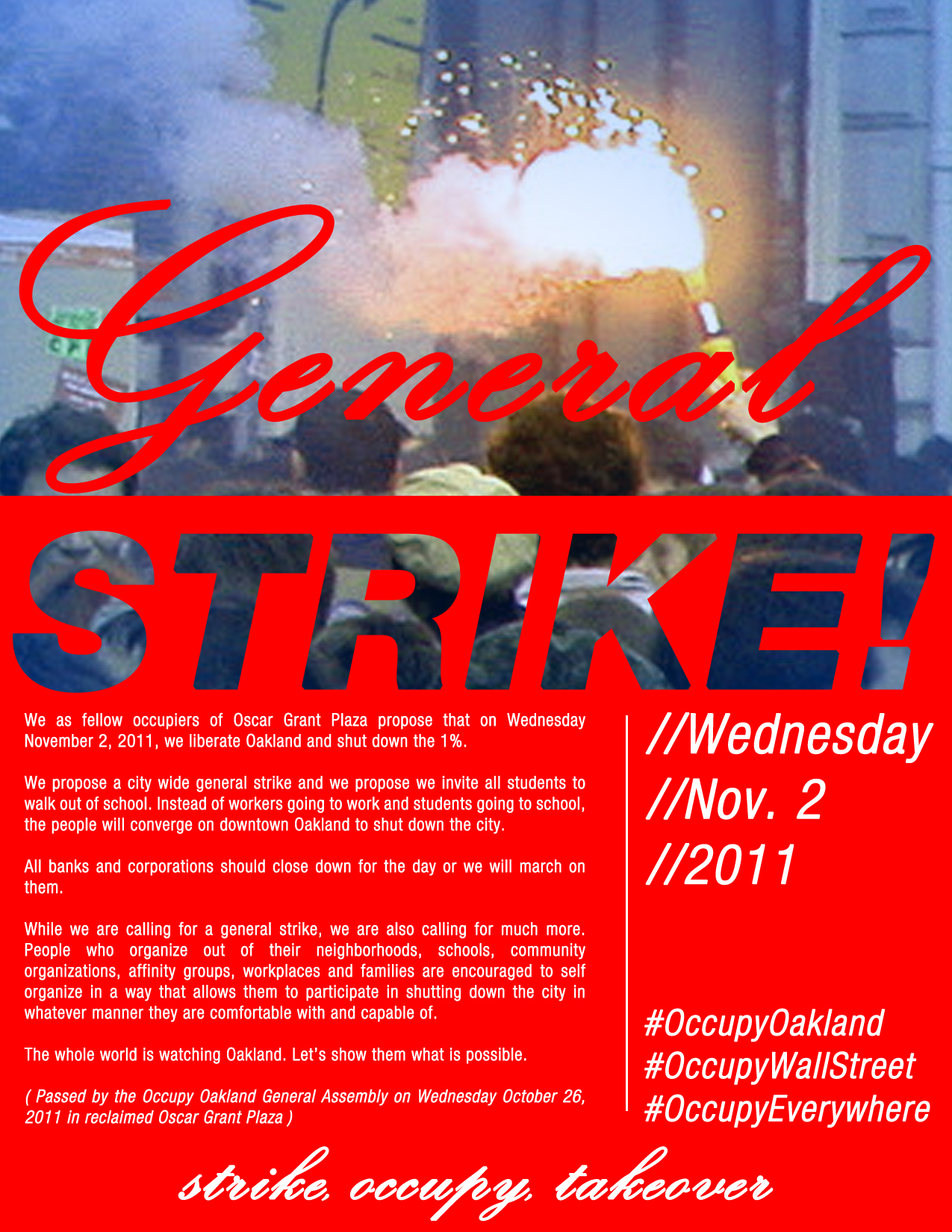
We as fellow occupiers of Oscar Grant Plaza propose that on Wednesday November 2, 2011, we liberate Oakland and shut down the 1%.
We propose a city wide general strike and we propose we invite all students to walk out of school. Instead of workers going to work and students going to school, the people will converge on downtown Oakland to shut down the city.
All banks and corporations should close down for the day or we will march on them.
While we are calling for a general strike, we are also calling for much more. People who organize out of their neighborhoods, schools, community organizations, affinity groups, workplaces and families are encouraged to self organize in a way that allows them to participate in shutting down the city in whatever manner they are comfortable with and capable of.
The whole world is watching Oakland. Let’s show them what is possible.
The Strike Coordinating Council will begin meeting everyday at 5pm in Oscar Grant Plaza before the daily General Assembly at 7pm. All strike participants are invited. Stay tuned for much more information and see you next Wednesday.
Spokeswomen for the city of Oakland and Mayor Jean Quan could not immediately be reached for comment.
Brooks said a general strike was a "natural progression" following a crackdown by the city of Oakland early on Tuesday morning in which protesters were evicted from a plaza near city hall and 85 people were arrested.
Protesters sought to re-take that plaza on Tuesday night and were repeatedly driven back by police using stun grenades and tear gas. It was during one of those clashes that protesters say Olsen was struck in the head by a tear gas canister fired by police.
A spokesman for Highland General Hospital in Oakland has confirmed Olsen was listed in critical condition from injuries sustained during the protest, but could not say how he was hurt.
Acting Oakland Police Chief Howard Jordan told a news conference his department was investigating the incident.
Olsen is believed to be the most seriously wounded person yet in confrontations between police and activists since Occupy Wall Street protests began last month in New York.
News of his injury ignited a furor among supporters of the protests. Activists in Oakland and elsewhere took to Twitter and other social media urging demonstrators back into the streets en masse.
More than 1,000 protesters moved onto the streets of Oakland again on Wednesday night as police largely kept their distance.
Friends say Olsen had been active in several anti-war veterans groups and had joined Oakland protesters in a gesture of solidarity after learning of the police crackdown there.
Keith Shannon, 24, who said he served with Olsen in Iraq, told Reuters his friend suffered a two-inch skull fracture and brain swelling and had been sedated and placed on a respirator in the hospital's emergency room trauma center while neurosurgeons decided whether to operate.
Olsen served two tours in Iraq from 2006 to 2010 with the 3rd battalion, 4th Marine Regiment, Shannon said, adding that he and Olsen deployed together and were assigned to a tactical communications unit.
(Additional reporting by Dan Whitcomb, Ben Berkowitz, Emmett Berg and Mary Slosson; Writing by Dan Whitcomb; Editing by Jerry Norton)
Source: Reuters
Councilmember Evans Represents the 1%, Not the Occupiers in His Ward
Listen/Watch John Hanrahan HERE
Ward 2 Councilmember Jack Evans represents the 1% much more than the 99. Ironically – or maybe appropriately – both of D.C.’s ongoing occupations, at Freedom Plaza and McPherson Square, are located in his ward.
Evans embodies precisely what the occupiers oppose: undue corporate influence on government. In addition to his $125,000 council salary, Evans earns $240,000 a year from Patton Boggs, but good luck trying to figure out what the councilmember does for the powerful law/lobby firm.
Continued at TheFightBack.org