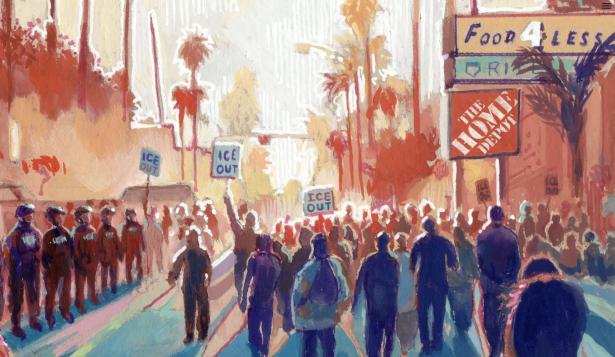
Above photo: Andy Rios Toro for Hammer & Hope.
The LA Tenants Union Knows Why.
The union’s daily presence tries to give the city’s most vulnerable immigrant workers a measure of safety and gum up Trump’s deportation machine.
Arturo had only ever seen agents at the border before, never in Los Angeles. But on Friday, June 6, the Department of Homeland Security descended on a Home Depot near MacArthur Park. As on any other morning, Arturo had arrived at the store to wait alongside more than a hundred jornaleros for a day, or even a few hours, of construction work. He saw people running and heard screams of “la migra” before he laid eyes on the men in fatigues or understood that they were making arrests. He broke into a run, following a crowd through the store’s automatic doors. Agents were grabbing people seemingly at random “by their backpacks and without questioning them,” Arturo said. DHS seized 24 people at that Home Depot and 60 others in raids carried out throughout the city that day. He hasn’t seen two of his friends since.
Los Angeles has long been an urban laboratory for militarized repression — the Los Angeles Police Department invented SWAT teams and pioneered the use of police helicopters. But on June 6, the federal government made its opening gambit in what Trump called “the largest deportation operation in American history,” turning Los Angeles into a “test case,” in the words of Mayor Karen Bass, for its fascist incursion into American cities. In both small “snatch and grab” operations and large-scale raids that maximize spectacle as much as detentions, DHS dispatched armed, masked agents to that same MacArthur Park Home Depot multiple times over the summer — to kidnap workers, street vendors, and bystanders, without warrants or warning.
But since that first raid, agents haven’t entered the lot without encountering a DHS watch, staffed entirely by volunteers and organized by the LA Tenants Union. Like DHS, LATU spent the summer experimenting. Organizers built a long-term protective presence, developing relationships with those targeted and connecting people in detention with financial and legal support. They can’t stop the raids, but they have seen the direct impact of their work in shortened raid times and lower arrest rates. As the Trump administration expands its deportation project across the country, LATU’s efforts demonstrate the infrastructure and commitment needed to mount a response to an ever-changing, militarized, and lawless assault.
On the first day of DHS’s escalation, Los Angeles responded in open revolt. Dozens of people gathered outside Ambiance Apparel downtown as a raid was still underway, chased more agents to Chinatown, and then reconverged in front of the Metropolitan Detention Center and downtown U.S. Immigration and Customs Enforcement field office. The next day, militant crowds responded to ICE officers staging near a Home Depot in Paramount, on the southern edge of Los Angeles County, throwing cinder blocks at ICE vehicles and setting off fireworks toward police. That night, Trump deployed thousands of National Guard troops to the city, over the protests of Bass and Gov. Gavin Newsom. Trump promised to “liberate Los Angeles from the Migrant Invasion, and put an end to these Migrant riots.”
By Sunday, the downtown demonstrations swelled to thousands. Protestors took over the 101 freeway, set Waymos on fire, and chucked Lime scooters at police cars. The LAPD responded by firing tear gas and rubber bullets into the crowd at close range. Bass issued a curfew for the area. The days of mass actions led to more than 200 arrests and multiple injuries. One LA Tenants Union member was shot with “less than lethals” in each knee and a shin. He said the initial wave of protests to claim the streets would set the tone for the summer: fighting for “the right to stay so that you wouldn’t be kicked out.”
But as energy waned and police repression escalated, organizers faced a familiar challenge: trying to channel an uprising into sustained and coordinated action. Many Angelenos joined rapid-response networks to support roving ICE watches in their communities. But as Kevin, a LATU organizer, explained, early ICE watches often devolved into games of “cat and mouse.” (Last names have been omitted in this article to protect its sources.) Alerts — sometimes false — would go out in massive group chats, sending people racing to the scene, but often too late to intervene or even document an arrest.
Instead, LATU organizers attempted to root themselves in a specific place and community. Founded in 2015 (I helped start the organization), LATU is run by volunteers and sustained largely by members’ monthly dues; it has grown to almost 3,000 members with 14 local chapters. The same demographics that inspire the Trump administration to call Southern California “ground zero for the effects of the border crisis” make immigrants the majority of LATU’s base. According to the latest data, nearly 1 million undocumented people now live in Los Angeles County, a full third of residents are immigrants, and more than half speak a language other than English at home. Arturo joined LATU the previous April because of deteriorating conditions at his building, a boardinghouse with multiple people sharing a bedroom and sometimes even a bed, where he rents “a closet” for $380 a month. But he never expected to rely on the tenant union at work.
To respond to DHS’s attack on their community, LATU organizers relied on existing capacities to develop relationships of trust and borrowed strategies from years of organizing against displacement in tenants’ homes and neighborhoods. “How do you orient yourself in one very particular place that is under attack,” Kevin asked, “where it’s less about a commitment to some abstract immigrant, but actual people who you can hopefully build relationships with?”
Organizers turned to the site of the very first raid in their neighborhood, the MacArthur Park Home Depot. They studied the rhythms of the space, with its two entrances along Wilshire and on Union Avenue. They slowly introduced themselves to the workers, some leaning on the green gate that wraps around the block, ready to greet vehicles, others sitting around folding tables at the Central American Resource Center (CARECEN) Day Labor Center, a simple shed with a corrugated metal roof that adjoins the Home Depot lot. They met the street vendors who start setting up before sunrise, lining that corner down Shatto to sell pupusas, fresh orange juice, and eggs.
Just one week after the first raid, on June 13, LATU’s Koreatown local launched the organization’s first Centro de Defensa Communitaria — “Community Defense Center” in English, and “Centro” for short. Butterflies adorned a “migration is sacred” banner that hung from one orange pop-up tent. On another, an Old English tattoo font spelled out “Chinga la Migra.” Volunteers used oranges as paperweights to keep know-your-rights flyers from blowing away. They handed out donated food and water and maintained a watch from 7 a.m. to 12 p.m., so that day laborers and vendors had a measure of safety in seeking a day’s work. In the first weeks, the Centro boasted 20 to 30 volunteers a day. Some would arrive and work at remote jobs via mobile hot spots, ready to participate in an instant protest if agents returned.
Over time, a routine was established, with a few people manning the tables and a few on patrols. Most critical were those stationed at each entrance, practicing the “ever-changing art,” as LATU organizer Zoie put it, of identifying ICE and Customs and Border Patrol vehicles. Volunteers looked for obvious tells — Sprinter vans, new American cars, tinted windows, paper license plates, plate numbers that don’t appear in public databases — and tracked their movements over walkie-talkies. Relying on information shared across a regional coalition, they matched plates with those seen at previous raids or emerging from DHS staging grounds on Terminal Island. Recently, DHS developed more elaborate disguises for their vehicles; one Ford SUV sported a “Coexist” decal on its trunk.
According to White House Deputy Chief of Staff Stephen Miller, DHS has set a goal of 1 million deportations this year. In June, Congress gave the department the resources to realize such results — $170 billion in funding that will turn ICE into the 16th-largest military force in the world and double its detention-bed capacity to more than 100,000 people. In May, Miller ordered ICE’s 50 top field leads not to bother targeting undocumented people with criminal records. “Just go out there and arrest illegal aliens,” he said. He specifically urged them to target Home Depots.
The pattern of raids in Los Angeles shows DHS heeded his directive. An independent study of 200 raids carried out in Los Angeles County between June 6 and August 14 revealed that three-quarters of arrests were made at workplaces and half at home improvement stores. Its authors call Home Depot parking lots “one of the most dangerous spaces for immigrant workers in Los Angeles.” But the threat of hunger and homelessness have forced many to return. Rent was due, Arturo told me; despite his fears, he had to go back.
From his post on Union Street, Kevin described the MacArthur Park Home Depot where Arturo often works as a “snapshot” of the U.S. economy, revealing “descending levels of vulnerability and expulsion from regular work and regular recognition.” In the parking lot, day laborers wait for work —“day kidnapping,” in the words of one organizer — and street vendors wait to serve them. Across the way, other men gather to play music from a boombox and drink — a surplus of the pushed out and given up.
CARECEN organizer Jorge Nicolas described the “symbiotic relationship” between big-box home improvement stores and the jornaleros drawn to them: “Home Depot grew because of day laborers. And day laborers grew because of Home Depot.” The “do it yourself” movement didn’t mean just you do the work; it meant you could cut out the contractor and hire cheaper and more.
Since it opened in 2004, the CARECEN center has negotiated wages between jornaleros and employers, helped guard against wage theft, provided occupational safety and know-your-rights workshops, and offered free hot meals every day. Some 200 to 400 workers gathered over the course of the day, and the line of vendors wrapped around the corner on both sides of Shatto Street. Before June, ICE agents had restricted their involvement with the Home Depot to “intimidation,” strolling through to “visit” on their off hours, Nicolas said. Now the Home Depot felt like a “funeral.” Nicolas updated the center’s record-keeping practices to protect people’s identities and canceled its daily meal provision.
The construction industry’s margins rely on squeezing labor costs, and contractors turn to temporary workers to perform the most grueling jobs. A quarter of California’s and 40 percent of Los Angeles’s construction workers are undocumented immigrants. Some have lived in the city for decades, while others are recent arrivals. Many, like Arturo, left their families in their country of origin. When Covid-19 shutdowns shuttered his business in Mexico City, Arturo was lured to the United States by the “strength of currency” and the potential for sending remittances to his wife and two kids. He turned to Home Depot when he found other employment options limited by his immigration status.
Jorge, a maintenance worker at a local nursing home who has worked as a day laborer on and off since coming to the United States, said that “a lot of doors are closed” to immigrants “based on our ethnicity and the color of our skin.” He joined LATU over a year ago when his landlord tried to illegally kick him out of his apartment. One day, she’d even changed his locks. With the support of the organization, he managed to secure his housing and his lease. This spring, Jorge was one of many undocumented workers subcontracted to do the most brutal and dangerous work of the city’s wildfire recovery, tasked with power-washing ash and “pure asbestos” from burned-down houses between the Pacific Palisades and Malibu. Recalling the long-term health impacts on 9/11 respondents, he quit. The agency paid him a third of what they’d originally promised.
LATU has compared the economic impact of the ongoing raids to the Covid-19 pandemic. Once again, people have holed up indoors, lost work, and lacked the resources for their biggest monthly expense: the rent. The UC Merced Community and Labor Center likened the scale of job loss in the city to December 2007, the first month of the Great Recession. Those statistics can be felt in empty streets and canceled celebrations, including the massive Central American Independence Day parade. At Los Angeles County Board of Supervisors meetings and local City Council offices, LATU has demanded that city officials back up their anti-Trump rhetoric with policies that will protect undocumented people; an eviction moratorium would give people refuge in their homes.
“In any other organizing situation, you can hold a meeting, you can hold a protest,” Kevin said. But in this case, “the very condition of being out in public is what’s endangering.” Forced to use public space as a workplace, jornaleros and street vendors are among the most vulnerable of DHS targets. And unlike farm workers, they don’t have organized bosses advocating for a stable labor supply. Agribusiness appeals to the Trump administration slowed agricultural raids, but ICE and Border Patrol attacks on day laborers and vendors have only intensified. The economic leverage that forced past waves of legalization and was dramatized in previous “Day Without Immigrants” protests doesn’t exist for those barely hanging on or shut out of work. Throughout the summer, reports circulated of CBP agents rounding up unhoused people.
On June 21, two weeks after the ICE invasion began, agents with black gaiters pulled over their faces leaped from a Dodge Charger on Union Street right next to the Home Depot. They snatched one man from his car, tackled and arrested another who tried to intervene, and pepper-sprayed a volunteer in the face from just inches away.
Though agents never crossed into the parking lot, it was the first test of Centro’s response and LATU’s new strategy of defense. “We’re a moral force,” Kevin said, “and hopefully that boosts the morale of people in the area in terms of people who are willing to step in.” Using their documentation of the event as well as their connections to the Labor Center and workers on the ground, they were able to identify the men whom DHS arrested, ensuring they would be connected to their communities and to legal counsel from the Immigrant Defenders Law Center (IMMDEF). DHS often publicizes humiliating photos of arrestees, but never a complete list of names. Without on-the-ground work to identify people taken, they effectively disappear — a family member simply wouldn’t come home one night; a co-worker wouldn’t return the next day.
“The goal of the raids is to isolate,” said Sarah Houston, a lawyer with IMMDEF’s new rapid-response team. DHS often delays or obscures its detainees’ entries into its location databases, making people difficult to track or reach when in custody. It also consistently denies them access to phone calls to contact their loved ones or legal counsel. That two-way isolation helps DHS pressure people to give up their rights to a full immigration hearing and sign voluntary departure agreements.
So do the conditions in detention centers. Designed as a temporary holding facility, the basement of the downtown ICE field office has since June served as a detention center in its own right. Those in custody report being stuck for over a week before transfer, forced to sleep on the floor, lacking access to showers and private bathrooms, and handed bags of potato chips and animal crackers as meals. They are also consistently denied medical care, even when agents’ violence during arrests leave them with cuts, bruises, and even broken bones.
The Adelanto ICE Processing Center, an hour and a half north in San Bernardino, is no better. Run by the second-largest for-profit prison company in the United States, Adelanto has a track record of abysmal conditions — and at least three in-custody deaths — since it opened in 2011. This summer, its captive population quadrupled in just two months. Recent inspections reveal a lack of adequate food, linens, or even beds, and a pattern of withholding necessities like blood-pressure medication. Current detainees have described being “treated like dogs.”
Historically, detained undocumented people with access to legal defense are more than 10 times more likely to avoid deportation. Houston believes the same will hold true today, based on her recent experience securing the release of detainees in immigration and district court. And she’s hopeful about ongoing collaborations between community and legal defense. The documentation that volunteers gather may do more than bear witness to injustice; an illegal arrest can void an entire deportation case. In the meantime, Centro fund-raising efforts help deliver necessities to people inside and support families robbed of their breadwinners.
On July 3, IMMDEF, the ACLU, United Farm Workers, and other immigrant defense organizations filed a class-action lawsuit against the federal government. The suit argued that DHS’s “dragnet” violated the Fourth and Fifth Amendments — protections against unreasonable searches and violations of due process — and discriminated against individuals based on “the color of their skin” or “where they live or work.” A few days later, both the city and county of Los Angeles joined as plaintiffs.
That same week, Kevin watched from his volunteers’ table at the Home Depot as Border Patrol Tactical Units rolled down Wilshire. They were headed two blocks west to MacArthur Park. Soon armored vehicles blocked street traffic, a federal helicopter circled overhead, and nearly 100 agents fanned out through the park, alongside others on horseback. The National Guard helped provide “security.” No arrests were made.
Leaked documents about the operation confirmed that its purpose was a mere “show of presence.” Internal Army assessments claimed that “lethal violence” might result from encroaching on MS-13 “turf” and that the park served “as the largest open-air market of fake identification to enable illegal immigration.” But what agents encountered that day was St. John’s Community Health workers conducting outreach to unhoused people and schoolchildren at day camp. One L.A. City Council member commented that DHS should have “appl for a film permit.”
Overseeing so-called Operation Excalibur on the ground and fielding media requests in its wake was Gregory K. Bovino, the U.S. Border Patrol El Centro sector chief. Bovino was nearly pressured to resign under Biden, in part for posting a photo of himself with an M4 assault rifle on social media. But his star has risen under Trump. Now that photo is his profile picture, and he’s made content creation a part of his job. He often posts videos of foot chases at Home Depots set to dramatic soundtracks. In another video post, agents cuff, arrest, and place a sheer bag over the head of a protester “accused of assaulting a federal agent by spitting on him.”
Bovino celebrated Operation Excalibur in a Fox News interview, warning that the country had “better get used to us now, ’cause this is going to be normal very soon.” Bass also claimed victory after the event, as if she’d ordered the agents out of the park, but in her own words, they were already “getting ready to leave.” DHS has exposed the limitations of “sanctuary cities,” a technical designation that blocks local agencies from sharing information with the federal government but does not proactively protect undocumented people. Beyond a yet-unrealized promise of minimal cash assistance and her city attorney’s collaboration in the class-action suit, Bass’s fight against Trump’s deportation efforts has largely been rhetorical.
On July 12, the legal strategy claimed an initial win. A federal court in the Central District of California issued a restraining order preventing ICE and CBP from detaining people based on their race, language, and presence at locations like home improvement stores. For a few weeks, arrest rates did seem to slow. Zoie, the LATU organizer, began planning the best way to wind down the Centro and fold volunteers into the ongoing work of local tenant associations.
But the reprieve was short-lived. Just before 7 a.m. on Aug. 6, a yellow Penske truck pulled into the Home Depot lot from the Union entrance. The driver beckoned workers closer, speaking in Spanish and promising jobs. Then the truck’s rear door rolled up, revealing a cluster of CBP agents and an embedded Fox News reporter. Centro volunteers had just begun setting up their tents. They managed to document agents brandishing rifles at cooktops, coolers, and bags of chips. One street vendor was led away with her hands behind her back, checkered kitchen rag hanging from her belt.
Bovino dubbed the raid “Operation Trojan Horse,” writing on Instagram that the “legendary ruse” was used to “swiftly defeat potentially violent Anti-ICE protesters.” It was a chilling visual echo of a tactic used by the white supremacist Patriot Front, whose supporters had leaped from a Penske truck to disrupt a Pride event in Springfield, Mo., a month prior. It also seemed a blatant violation of the federal court’s restraining order. “For those who thought immigration enforcement had stopped in Southern California, think again,” acting Los Angeles U.S. Attorney Bill Essayli said that day. “There are no sanctuaries from the reach of the federal government.”
A DHS press officer said of the raid that the MacArthur Park Home Depot was once again targeted because local gangs had a “chokehold” on the area. But of the 16 people arrested, none had gang ties or had been convicted of a violent crime. Four were street vendors. Agents claimed they “got past these violent protesters to go conquer MS-13,” Zoie summarized. “No, you tackled a woman making pupusas and left her children without a mother.”
DHS’s emphasis on spectacle may satisfy the right’s thirst for public displays of cruelty. It may also be succeeding in instilling fear in undocumented people. While the ultimate promises of Trump’s deportation schemes — safer cities, better jobs, and cheaper housing for U.S. citizens — haven’t materialized, immigration itself has declined for the first time in nearly 60 years. Anecdotal evidence suggests many immigrants are questioning their ability to stay. “If things don’t change,” Arturo admitted, “I may self-deport.”
During one of my visits to the McArthur Park Home Depot, a worker approached volunteers to thank them for stepping up when he himself could not. Kevin returned the gratitude, but told me he disagreed. Over time, he hoped the Centros could erode the division of labor between defenders and people most at risk. “You’re looking at thousands of family members in L.A. who have had people taken,” he said. “If you do ultimately want to stop what’s happening, it will take the people who are being affected organizing themselves.”
Jorge, the former day laborer, agreed. “We can’t let this fear beat us,” he said, “because eventually, fear will defeat everything.” Jorge called the raids a “massacre.” And the results have been deadly. At least three people died during DHS raids over the summer — among them Roberto Carlos Montoya Valdez, who was struck by a car and killed while fleeing a Home Depot raid in an L.A. suburb. Still, though Jorge’s family in Oaxaca has begged him to return, he has refused. He likened the experience of waiting to be kidnapped to getting touched by the grim reaper. “If I’m gonna die, I’m gonna die protecting my people,” he said. “I’ve got blood family, but these are my people, too. These are my neighbors.”
After the Penske raid, the Centro refined its hours and recommitted to the watch seven days a week. They launched a new shift to protect the three elementary schools in the area, sending volunteers to patrol in a safety vest with “Education sí, migra no” emblazoned on the back. Zoie and Nicolas started planning a new collaboration on roving food distribution, combining CARECEN’s resources and LATU’s network of tenant associations. By then, DHS had begun striking another target, L.A.’s car washes. “We’re catching sudspects across Southern California,” Bovino joked. “Wash, rinse, repeat.”
“They’re kind of like us,” Kevin observed. “Whenever there’s a movement, you try to find [a form] that’s replicable and intelligible.” The Centro model developed in MacArthur Park has been taken up by five other LATU local chapters and more defense organizations at Home Depots across the city. Organizers trade best practices — Centros have abandoned car patrols and added orientations to pull in new leaders — share information, and serve as one another’s support systems as they continue their work.
By late August, volunteers at the MacArthur Park Centro knew they were being watched. On Aug. 21, organizers tracked a suspicious car that twice circled the block and lingered in the Home Depot lot, though no one got out to shop. Sure enough, its plates matched those of a vehicle photographed at a car wash raid the day before. But agents basically admitted who they were; when they drove past the Wilshire table, Zoie said, the passenger leaned out the window and spat at her.
One week later, ICE returned in force, with a half dozen cars and nearly 40 agents. On the Wilshire side, two white vans careened to a stop, effectively blocking the entrances. Agents in fatigues or police vests and jeans jumped out to snatch the first people they could. Zoie picked up the bullhorn. “La migrá esta aqui,” she announced, as she’d rehearsed in her head for months. Many workers had remained close to the entrance and broke into a run down the street. One made a 20-foot leap from the lot onto Burlington Avenue, mangling his ankle. Zoie pointed her phone camera at the agents, their cars, and three jornaleros the agents managed to capture, shouting for their names and emergency contacts.
On the Union side, agents peeled in with equal speed, grabbing a vendor and multiple workers lining the descending ramp to the Home Depot lot. More agents turned against the dozens of volunteers, vendors, workers, and passers-by, escalating into riot dispersal tactics. They deployed pepper spray, scattered half a dozen pepper balls, and set off at least three tear gas canisters. “Back up for your safety,” one agent said, shoving a volunteer. “Get out of our city for our safety,” another volunteer snapped back, before the agent kicked a tear gas canister toward him. Agents tackled one worker to the ground as he tried to escape into the CARECEN center, stripping him of his shirt. “You don’t belong in our country,” Kevin shouted into the smoke.
Inside the store, the scene “felt like an active shooting,” one witness said. Home Depot employees, day laborers, and vendors streamed in to duck behind the exit’s sliding doors, some already sobbing. The entire event lasted less than five minutes. In all, the agents had taken nine people. They left behind a stinging haze, overturned shopping carts, and a community oscillating between despair and rage. On Shatto Street, a silver Toyota was stranded with its hazards on, plastic to-go containers still waiting on its trunk.
“At least we were here,” Zoie said, hopeful that the Centro’s presence had shortened the length of the raid. She collected a backpack from the asphalt to search for some kind of identification. The volunteers knew their tasks. They reviewed their footage to identify anyone who’d been taken. One isolated a face and went to the lumberyard where he’d often worked to match the image with a name. Others pulled out screenshots of the vehicles to share with the broader response network. CARECEN’s Nicolas made the calls to coordinate the removal of the abandoned Toyota; it wasn’t the first time DHS had taken someone and left their vehicle behind. A vendor told me she had no choice but to continue working, though her head and chest hurt from the gas. “The rent is coming,” she said.
About an hour later, Jay and his father came to the Home Depot to see if a day laborer who hadn’t shown up for work that morning had been taken. Second- and first-generation immigrants with a shared construction business, both had been present at previous raids; in Cypress Park, agents had slammed Jay to the ground and attempted to detain him. Jay said the Trump administration was using the tactics of El Salvador’s strongman president Nayib Bukele “as a template.” He wanted to make sure his worker didn’t end up in Salvadoran prison.
By 9 a.m., the police paid a visit. LAPD Central Bureau Deputy Chief German Hurtado said he and two other officers were present to “share the space” with the community and clarify that the LAPD was not a participant in the raid. But distinguishing his organization from immigration enforcement was all his department would do — any more would be against federal law. “People say, oh, you know, LAPD doesn’t follow the rules and this and that,” Hurtado said, “but now they don’t want us to follow the rules when it comes to obstruction of justice.”
After the agents peeled away, Zoie had dialed the number of one jornalero she saw detained, expecting no answer. Pablo and Zoie had been present almost every day, him leaning on a concrete pylon waiting for work, her watching the entrance. They’d bonded over a shared love of L.A.’s plant life, often texting each other pictures of nature’s odd interactions with urban space. On the morning of the late August raid, Zoie hadn’t gotten a chance to say hello before she spotted Pablo in the Border Patrol van. She was shocked when he picked up the phone. He was already on the bus, heading back to the Home Depot.
“She thought it was the last adios,” Pablo joked when he returned. He said he didn’t run from the agents, which might have given them “reasonable suspicion,” but he had another reason. Though he had crossed the border from Mexico when he was 16, he was a U.S. citizen. Before agents pulled the van into the downtown field office, they finally asked the workers about their immigration status. Pablo told them his Social Security number and handed them his ID. They dumped him out on the corner. He was relieved not to enter the gates. “Every second is forever in there,” he said. “Even the ride they took me on. It felt like forever.”
There will be no official record of Pablo’s seizure. DHS reported that eight people had been arrested at the raid. By September, it listed the location of those I could track as Adelanto Detention Center. Organizers told me that three had already signed agreements to leave the country. “Everybody’s rights have been violated,” Nicolas summarized, from the volunteers’ right to protest to the human right to migrate and make a home wherever you are.
In mid-August, DHS opened its largest detention center in California yet, a hundred miles north of Los Angeles. Once a state prison, the California City facility had been shut down after years of organized pressure. Now it’s operated by CoreCivic, one of many private companies turning the capture of undocumented workers into a revenue stream. Meanwhile, ICE has boasted 175,000 new applicants to its force. By Aug. 26, DHS had made 5,000 arrests in Los Angeles — a rate of 70 a day. And in early September, the restraining order against discriminatory raids was stayed by the Supreme Court, acting through its “shadow docket.” Bovino celebrated this “vindication” with the hashtag #WhoopsWeDidItAgain. Soon after, he and his army touched down in Chicago.
The challenge of this moment, Kevin said, will be continuing to organize “as the emergency becomes the norm.” Centro volunteers are committed to holding the line at the Home Depot through a daily presence, expanding collaborations with IMMDEF and CARECEN, and deepening relationships with the jornaleros and vendors who also return there each day. Each time their Home Depot had been raided, DHS had used more agents but managed to capture fewer people. LATU’s organizers feel they can slow down the administration’s plans. But to stop the largest deportation project in U.S. history will take much more. “People look to God for help, but God isn’t going to come down to help,” Jorge told me. “God gave us our brains and our hands to do something about it. And so we have to.”
[Tracy Rosenthal is a writer and an organizer. They are a co-author of Abolish Rent: How Tenants Can End the Housing Crisis, published by Haymarket, and their essays, features, and opinions have appeared in The New Republic, The Nation, the Los Angeles Times, and elsewhere. They are now on rent strike in New York City.]