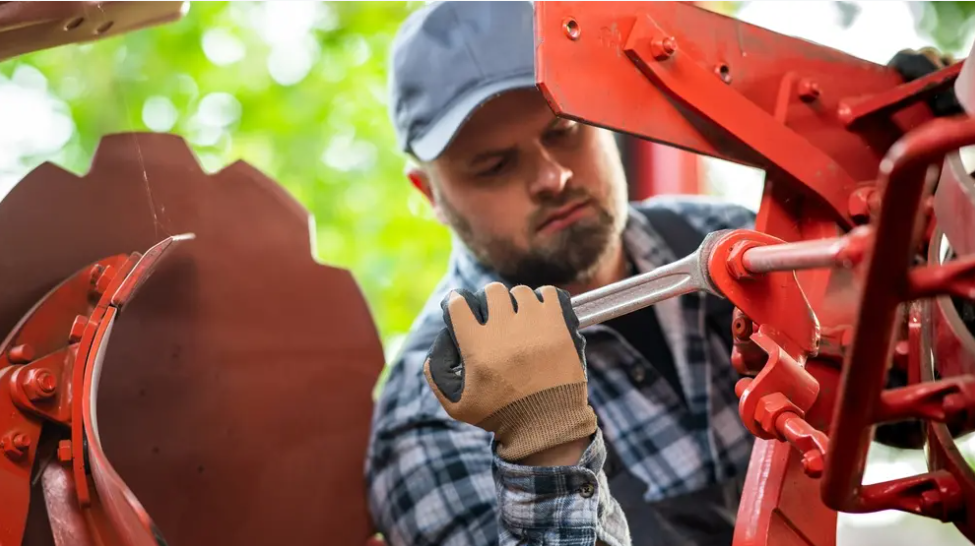
Above photo: Shutterstock.
The FARM Act would restore farmers’ Right to Repair.
Is everyone’s sanity next?
Did you see the movie The Martian (2015), where Matt Damon plays an astronaut stranded on Mars who constantly has to figure out how to keep surviving? In the newsletter for the CSA farm that I belong to, Terra Firma, Paul Underhill wrote that The Martian is one of the most accurate movie portrayals of what it’s like to be a farmer, even though it’s a sci-fi movie. It shows someone who constantly has to improvise, fixing things however they can with whatever they happen to have. Farmers are the original MacGyvers, he writes, “confronting daily setbacks and weather-related disasters with humor, ingenuity, and a pair of Vise-Grips.”
On Thanksgiving, as we give thanks for the ingenious farmers who grow and raise our food, let’s also urge our electeds to support the Freedom for Agricultural Repair and Maintenance Act (FARM Act), a new bicameral bill that restores farmers’ ability to fix their own equipment.
Why “restores”? Because complex hardware often has embedded software, and since 1998’s Digital Millennium Copyright Act (DMCA), which was designed to prevent copyright infringement, hardware manufacturers have applied its anti-circumvention provisions to prevent people from modifying the software on physical devices that they bought and own. This let manufacturers monopolize repair networks and software-enabled revenue streams— notwithstanding all the hackers and hobbyists who discovered, shared, and deployed jailbreaks for all of these devices.
But the Right to Repair is being restored. Last year, the U.S. Copyright Office granted an exemption to the DMCA that lets users legally tinker and modify software on their devices. And eight states, most recently Texas, have now passed laws that go beyond just software, requiring hardware manufacturers to ensure that the parts, tools, and documentation required for repairs are available to everyone, not just their own authorized networks. Every other state now has similar Right-to-Repair legislation introduced in its legislature.
Farm equipment has been some of the most tightly-controlled hardware of all, specifically equipment made by John Deere. For years, Deere tractors have had centralized software control that lets the company disable the vehicles remotely, as it did with 27 tractors stolen by Russians in Ukraine soon after its invasion. Deere has also prohibited unauthorized repairs and collected tractor sensor data to sell to Monsanto and commodities traders without also making the data available to the farmers themselves.
But in 2023, Deere agreed with the American Farm Bureau Federation, an agriculture industry org, to voluntarily support farmers’ right to repair. The recently introduced FARM Act now gives teeth to the principles in the 2023 agreement and applies them to all farm equipment manufacturers nationwide.
Embedded software can enable amazing capabilities in hardware, like how the tractor-pulled LaserWeeder uses AI and lasers to recognize and kill weeds growing around food crops, eliminating any need for herbicides. But as discussed here previously, complexity can also emerge for its own sake as a way to centralize power and shut out competition— which includes competition over repairs.
It costs a lot to keep device software, tools, and documentation up-to-date, especially if the embedded software uses standard code libraries and operating systems (unlike Deere). In such cases, manufacturers have to create new versions of their software and push it out to every device whenever a new threat is discovered in a code library or OS that the software relies on.
Manufacturers who monopolize their repairs have tolerated all of this overhead— perhaps helped by the fact that computer infrastructure always gets cheaper, which offsets the expense of complexity and bloat. But I hope that Right to Repair laws make it more profitable for them to start making commercial technology simpler again, because now the public will use the same tools and documentation that the manufacturers do, and will prefer things that they can understand and repair themselves. Am I just dreaming, or might more products now become simpler and more easily repairable at home?
At the Thanksgiving table, I’ll be thankful for ingenious American farmers like the ones at Terra Firma, and for the Right to Repair movement behind the FARM Act. As the famous Shaker tune goes, ‘Tis a gift to be simple, ‘tis a gift to be free.
This piece was corrected to say that Matt Damon played the lead in The Martian, not Leonardo DiCaprio.