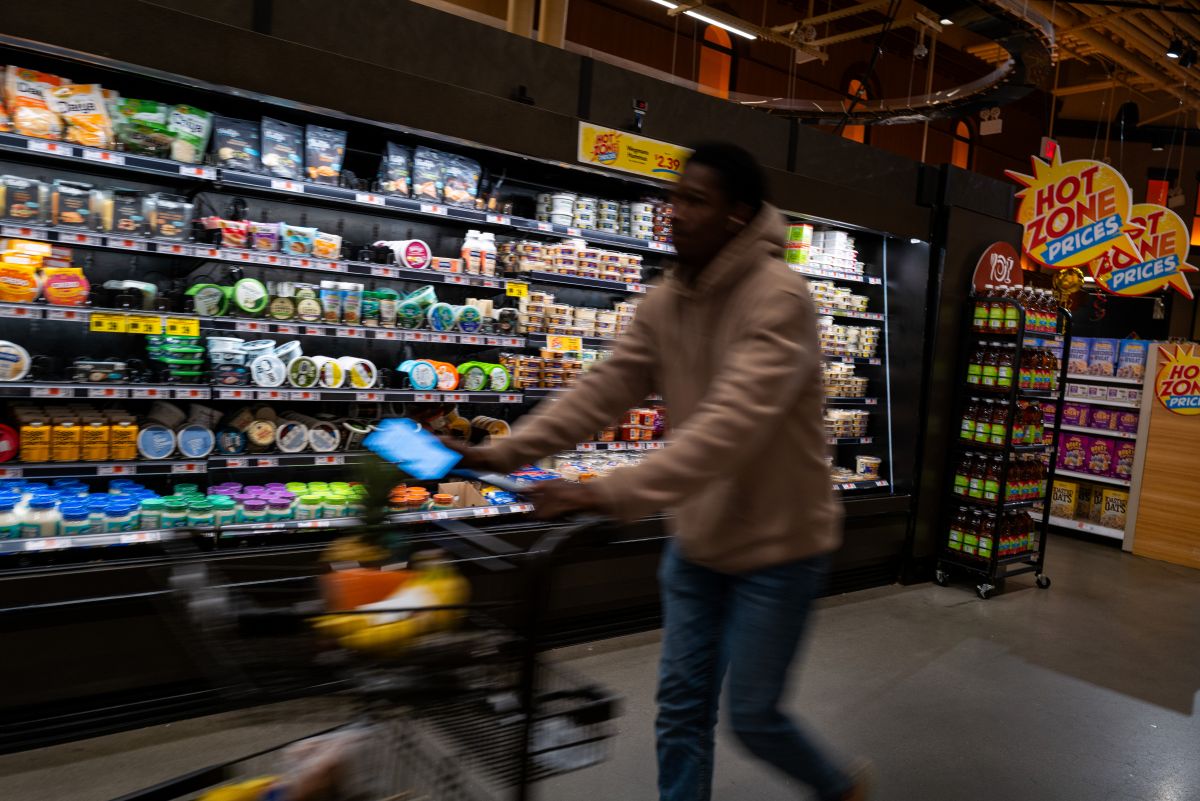
Above photo: Spencer Platt, Getty Images.
A hidden price adjustment scheme could cost families up to $1,200 a year.
Somewhere, a mom taps through her grocery app while waiting in the school pickup line, purchasing a box of Wheat Thins for $5.99. Across town, someone else scrolls through the same grocery app and adds the exact same box of Wheat Thins to their cart. For them, the crackers ring up at $6.99. It is the same item, from the same store, at the same time, but one unlucky shopper is stuck paying a higher price. Neither shopper has any idea this pricing game is even being played.
This is not a hypothetical scenario. Increasingly, it’s happening all over the country. Right now, grocery delivery app Instacart is conducting large-scale, hidden pricing experiments on unsuspecting shoppers to determine just how much money they can extract from customers on the groceries they buy to feed their families.
How do we know? Our team at Groundwork Collaborative had a feeling Instacart might be experimenting on shoppers, so we decided to run an experiment on them. Alongside our partners at Consumer Reports and More Perfect Union, we recruited over 400 volunteer secret shoppers to shop for the same basket of 20 items at the same grocery store at the same time. We ran the experiment in four different stores across the country.
The results were damning: at every store we tested, shoppers were charged different prices for an identical basket of groceries. Overall, Instacart basket totals varied by about 7 percent, with some items posting differences as high as 23 percent. For example: the exact same basket of groceries from a Safeway store in Seattle, Washington ran some shoppers $114.34, while other shoppers were charged $123.93. At a Target in North Canton, Ohio, prices varied by as much as $6, as some shoppers rang up a total of $84.43, while others were charged $87.91 or as much as $90.47.
Based on the company’s own estimates, this “Instacart tax” could drain as much as $1,200 from American households’ pocketbooks each year.
Meanwhile, Instacart is gloating about their ability to use unaware shoppers as guinea pigs to pad their bottom line profits. On their website, the company notes that, “End shoppers are not aware that they’re in an experiment. For any given shopper in any given store, prices only change on a few of the products they shop and only by a small margin; it’s negligible.” But we’re facing the greatest food affordability crisis in a generation. As grocery prices continue to rise and reliance on Buy Now, Pay Later is accelerating, it is painfully evident that an additional $1,200 a year is anything but negligible for many American families.
Unfortunately, Instacart’s predatory pricing is just one small piece of a much larger–and rapidly growing–economy of extraction. Enabled by corporate consolidation and artificial intelligence technologies, companies across industries now deploy a dizzying array of tactics designed to extract maximum profit from each individual. They tack on hidden fees, collude with their competitors on price increases, and individualize prices for consumers based on granular, personal data.
These predatory pricing strategies are not about managing scarcity or efficient markets. They’re corporations experimenting with your willingness to pay to see exactly how much they can squeeze out of you.
Since its release last week, our report has struck a national chord — earning front-page coverage in The New York Times, primetime coverage on broadcast news, and featuring in a video that has already amassed nearly 2 million views. Instacart’s own stock even dropped 6 percent the day after our report was published, which the Wall Street Journal attributed in part to our investigation.
This reaction is unsurprising: Americans dislike being surveilled, they resent being gouged, and they certainly don’t like being lab rats for profit-driven experimentation. Fair and honest markets are the bedrock of a healthy economy — and companies like Instacart jeopardize that trust by making prices opaque and unpredictable.
Our message to Instacart — and any corporation that would try to replicate their pricing experiment — is simple. Close the labs. American shoppers are not guinea pigs.