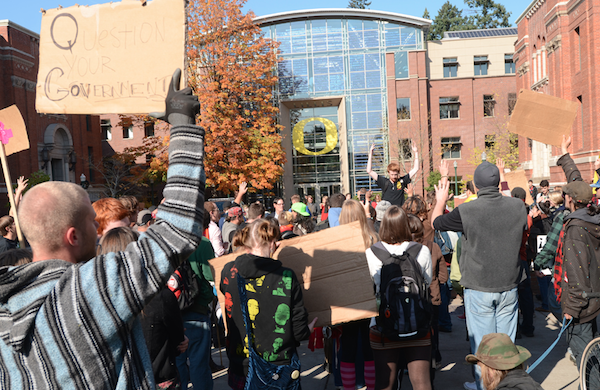
A federal judge in Eugene has found that a government agency infringed on protesters’ First Amendment rights when it limited the hours Occupy Eugene activists could demonstrate in a plaza in downtown Eugene.
In an opinion issued Wednesday, U.S. District Judge Michael McShane said the General Services Administration’s decision to allow Occupy Eugene to use the Federal Plaza only from 8 a.m. to 5 p.m. Monday through Fridays led to a “chilling” of protesters’ free-speech rights.
The case stems from protests in 2012 in which Occupy Eugene sought to bring attention to its message of financial fairness, homelessness and demands for corporate accountability. The group had protested under a 60-day permit that allowed their presence in the plaza, which had public access hours of 6 a.m to 11 p.m.
But as the group sought to renew its permit that July, the GSA alerted them to a new condition in which they could demonstrate only between 8 a.m. and 5 p.m. from Monday through Friday. The group objected and unsuccessfully challenged the time restriction, McShane noted. They were told that their permit extension had been denied.
Despite lacking a permit, protesters continued to demonstrate at the plaza. Federal security officers ordered them to leave mid-afternoon or face arrest and ultimately arrested one woman, Florence Semple, at 7:30 p.m. That was well before the normal end of public-access hours, McShane noted.
“The First Amendment does not go to sleep at 5 p.m. on Friday afternoon and wake up at 8 a.m. on Monday morning. Although GSA may generally use a permitting scheme to oversee access to the Plaza, GSA’s permitting process, given the facts present in this action, was not narrowly tailored to serve any significant government interest, and was therefore unconstitutional as applied to plaintiffs,” McShane wrote.
But the judge denied Occupy Eugene’s assertions that the government was targeting Occupy Eugene because of its message. McShane said the agency’s communications appear to focus on dealing with the type of protest — permanent, round-the-clock occupation of the area — and the problems it could pose to safety, access or health.
Nonetheless, Lauren Regan, director of the Civil Liberties Defense Center and lead attorney on the case, said the victory was an important one for activists around the country who “seek to assemble and protest at traditional public forums such as outside court houses or federal plazas. … It should also serve as a lesson to government agencies that restrict First Amendment rights without public transparency and without following the law.”
— Helen Jung