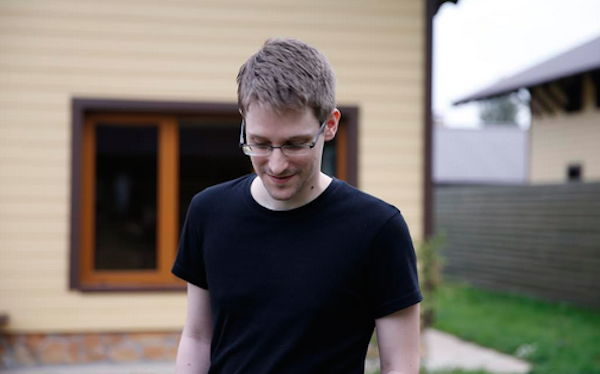
Note: Margaret Flowers and I attended an event in New York at the May Day Space in Bushwick where Laura Poitras spoke. She shared the trailer for her movie Citizen Four. This movie will debunk a lot of the propaganda about Edward Snowden put out by the government and their media allies and present people with a real view of who Edward Snowden is and why he took the actions he took. At the event, Jeremy Scahill made a strong plea for people to go see Citizen Four especially in the first two weeks of its release. Those weeks determine how widely the movie will be distributed and how long it will stay in theaters. So, if you see this movie in your city please go see it, bring people with you and urge others to do the same. KZ
[youtube width=”580″ height=”345″]https://www.youtube.com/watch?v=XiGwAvd5mvM[/youtube]
The new Edward Snowden documentary, Citizen Four, by Academy Award nominee and Pulitzer prize-winner Laura Poitras will be premiering at the BFI London Film Festival on October 17th. The premiere will be followed by a Q+A and will be broadcasted live to over 50 cinemas nationwide, you can get your tickets from: https://citizenfourfilm.com/.
This interview is between Shooting People member Jamie Kennerley, who shot this interview with Laura, back in 2012 for the MacArthur Foundation after they awarded her one of their annual “genius grants”. And Luke Moody, another Shooting People member and one of the distributors of Citizen Four at Britdoc who also gave early seed funding, just after Laura met with Edward Snowden.
When and why did Britdoc get involved?
We are big fans of Laura’s previous films My Country, My Country (2006) andThe Oath (2010). They marry a strong investigative mind with a narrative filmmaking vision. There’s been a great decline in traditional media support for long-form journalism, giving filmmakers and journalists the time, finance and trust they need to get to the heart of a story. Without this kind of support, investigative journalism and documentary storytelling are at risk of becoming sound bite churnalism.
We gave Laura a grant from the Bertha BRITDOC Documentary Journalism Fund in a support of a new film she was producing on the increasing US surveillance networks. BRITDOC has a partnership with New York Time Op-Docs allowing some grantees and Good Pitch participants to produce a short film for the NYT website. This led to the production of ‘The Program’ ashort film featuring NSA whistleblower William Binney. Snowden saw this and figured Laura was the right person to contact. The rest I guess is history: Laura and Glenn travelled out to Hong Kong to meet Snowden in a hotel room with a camera in hand.
In working with Laura, has this film and her broader profile as a documentarian given her a greater degree of safety with her work? Have there been any pressures to not show the film?
You would think so, but apparently being an Academy nominated filmmaker doesn’t offer much protection from border security agencies – Laura has been repeatedly detained at the US border having equipment seized and searched. Both Laura and Glenn Greenwald are still reluctant to enter the UK, since Glenn’s partner was held for 9 hours without a lawyer under the Terrorism Act.
It has been an incredibly difficult journey to make the film under such scrutiny, the production was based out of Berlin under very tight security protocols and a logistical nightmare of encrypted drives and communications. Planning for distribution has been equally difficult – trying to convince an exhibitor to show a film that they can’t watch, discuss or know the full content of is quite an ask! We hope the film does contribute to changing this situation; that journalists and filmmakers are given more protection and recognise the new dangers they face in protecting their sources.
How are you planning to distribute it? Are there any key differences compared to other ways you’ve distributed films?
We are co-distributing with Artificial Eye in the UK. Our distribution plan mixes a theatrical release model with a series of private influencer screenings to make sure the right people see the film to increase awareness, dialogue and change in policy. We’re keen to frame the film with wider cultural and political debates, commissioning public artworks hosting Q+As, and events such as crypto-parties during the release window.
Do you think there are different reactions to Edward Snowden in say the UK compared to the USA?
Yes, despite the revelation that our government collects huge quantities of our emails, Facebook posts, mobile phone data and internet search histories there has been little uproar from the British public. The general reaction here is ‘I did nothing wrong so I’ve got nothing to worry about.’ This lack of reaction in the UK has allowed national crime and security agencies to call for even more invasive surveillance powers. In the US there has been more of a fightback from major corporations and citizens, but there is still a lot of work to be done to make sure these incredibly worrying revelations are debated publicly.
What is your hope for the film?
The film premieres at BFI London Film Festival with a Q+A and will be broadcast to over 50 cinemas nationwide from London to Edinburgh on October 17th at 8pm. We’ll then go into theatres from October 31st. Incredibly, Laura manages to unfold a ground-breaking story of whistleblowing through both a consistently creative filmmaking vision and a brave journalistic drive. This is a rare moment in historical access where you are placed in the room with the protagonists as the story breaks. It is a work of cinema, a work of art and a work of journalism – something I encourage people to watch on a big screen. I think that the audience will be shocked by the revelations this film contains about the level of surveillance we are all subjected to by British and American governments.