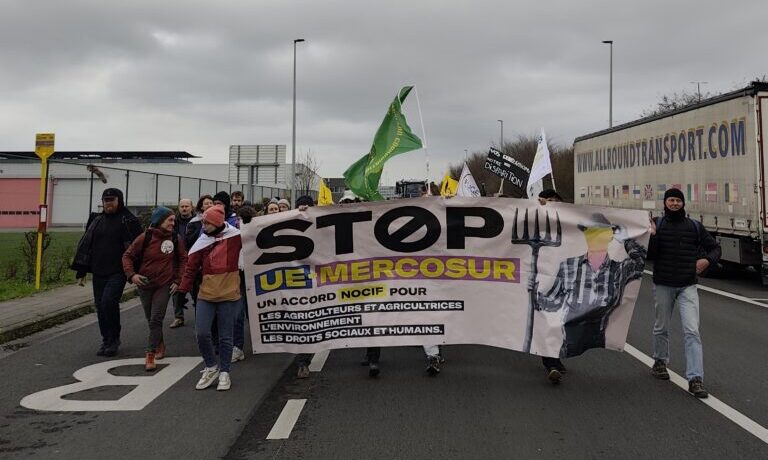
Farmers’ organisations from the European Milk Board (EMB) and European Coordination Via Campesina (ECVC) descended on Liège Airport together with civil society this Wednesday 17 December to express their anger at EU policies that jeopardize European agriculture. Farmers from Mig, AbL, FUGEA, Boerenforum, and La Confédération Paysanne gathered at this key hub for international trade with a common message that firmly rejects the EU-Mercosur treaty and calls for a strong CAP with a strong budget to guarantee farmers a decent income. Faced with the resurgence of large agricultural protests in France, Greece and Belgium, and on the eve of the European Council, the European Union cannot continue to ignore farmers’ demands.
Farmers and citizens made their voices heard, to the backdrop of imported products from all over the world entering the European market on cargo planes and trucks via Liege airport:
“The EU-Mercosur treaty is symbolic of an unfair and dangerous trade policy, where our farmers are forced to compete with models that do not respect our social, environmental and health standards. This unfair competition weakens our farms and our ability to produce local food, which is being replaced by imports”, added Philippe Duvivier, President of FUGEA (Wallonia).
“As things stand, farms that are already operating in a sustainable manner despite higher costs would be disadvantaged in three ways: the EU is relaxing environmental standards and eliminating minimum budgets for agri-environmental measures. It is opening up markets to cheap imports from Mercosur countries. Additionally, it does not set fair market rules to compensate for the loss of subsidies by guaranteeing higher prices to farmers. CAP funding must be allocated in a more targeted manner, and the proposals on degressivity and capping must be implemented on a mandatory basis,” added Bernd Schmitz from AbL (Germany).
“Farmers are already in a difficult financial situation due to the fall in milk prices, which will continue to decline. We no longer have profitable prices. Combined with the diseases affecting us, it’s a disaster! What are they planning for us?”, said Christian Wiertz, president of the MIG (Belgium).
“Today in France, anger is running high and there is deep unrest around sanitary issues, as we see with the crisis on lumpy skin disease (contagious nodular dermatosis). This is a free trade disease: we are killing our cows to protect international trade! Our fight against the EU-Mercosur agreement is central to the survival of farmers,” said Stéphane Galais, spokesperson for the Confédération Paysanne (France).
For farmers across Europe, the message is clear. Cutting and renationalising the CAP budget for 2028–2034 is unacceptable. We must also put an end to trade policies that force us to compete with imports that do not meet our social, environmental and health standards. This is the case with the EU-Mercosur agreement, where agriculture has once again been used as a bargaining chip for the interests of other sectors and the economy. Free trade agreements like the EU-Mercosur FTA will lead to a massive influx of low-priced agricultural products, putting pressure on the incomes of European producers, particularly for already vulnerable products like milk, meat, and honey.
In this tense geopolitical, economic, environmental and health climate, the EU must stop dismantling the mechanisms regulating agricultural markets as well as standards of quality, traceability, and sustainability (pesticides, GMOs, deforestation, carbon emissions). This deregulation is a pretext to promote new free trade agreements and force farmers from different regions to compete while having different standards and production costs. To support farmers and ensure generational renewal and the integration of young farmers, we need regulatory tools that guarantee fair prices, including strong CMO regulations based on food sovereignty and a revision of the Unfair Trading Practices Directive to include sales below production costs in the blacklist of commercial practices.