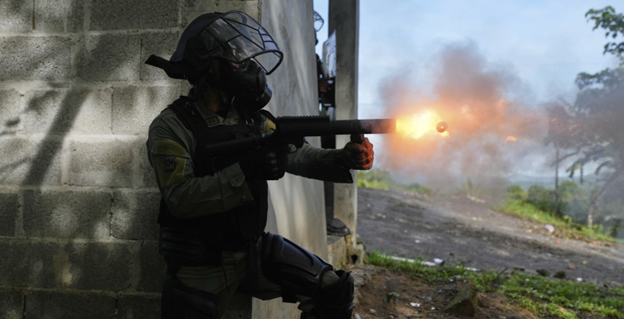
Above photo: Police fire tear gas to break up a blockade on the Pan-American Highway set up by anti-government protesters opposing social security reforms and a Panama-U.S. memorandum concerning the Panama Canal, in El Piro, Panama, Wednesday, May 14, 2025. AP Photo/Matias Delacroix.
Indigenous authorities in Panama have condemned the “escalation of persecution and repression” by the government of President Raúl Mulino. The traditional authorities of the Ngabe-Buglé Comarca claim that armed security agents have made violent house-to-house raids including the use of tear gas, large-caliber weapons and arbitrary arrests of indigenous leaders in various communities, such as Trinidad, El Piro, Ojo de Agua, Tolé, Viguí and El Prado.
Faced with nationwide strikes and protest, President Mulino has eschewed dialogue and instead deployed riot police and armed SENAFRONT (National Border Service) officers to disperse marches and gatherings using chemical agents. Dozens have been injured but the protests are continuing into their second month.
Indigenous Peoples united with teachers, doctors, trades unions, and students, in an alliance formed around several key demands: to prevent the privatization of social security through the repeal of the recent Law 462; to repeal the recent Memorandum of Understanding between Panama and the United States; to not reopen the controversial Cobre Panama copper mine in Donoso; and to not dam the Río Indio as a means to address falling water levels in the Panama Canal. The first three weeks of protests caused 480 road closures, including on the Inter-American Highway, and 196 arrests, according to Police Director General Jaime Fernández.
Tensions escalated in mid-May when the government deployed crowd control units at multiple protest sites across the country. Clear evidence of police brutality and of the excessive use of force was documented, with graphic photos on social media showing protesters with gaping head wounds, and women and infants suffering from the effects of tear gas.
Denouncing the Mulino regime as a “dictatorship”, a Ngabe-Buglé spokesperson said:
“The government is abusing the use of its security services, forcing leaders from their homes with blows, kicks, and tear gas, regardless of the presence of minors or vulnerable people… We hold President Mulino responsible for the crisis the country is facing. His arrogance and refusal to engage in dialogue keep the country in chaos. Peace is in his hands.”
Elected president in 2024, Mulino was a last-minute replacement for the candidacy of Ricardo Martinelli, the scandal-hit former leader of the right-wing populist party Realizando Metas (Realizing Goals, formerly Democratic Change). After abandoning the race to escape a 10-year prison sentence for embezzlement of public funds and money laundering, Martinelli endorsed Mulino as his successor, who won.
Martinelli previously held a tumultuous five-year Presidential term (2009-2014) which civil society and Indigenous people remember for its corruption and for the reckless handling of protests which resulted in several deaths. Mulino had been Martinelli’s Minister of Public Security (2010-2014) – the man in charge of Panama’s repressive state apparatus.
Today, the dominant issue mobilizing activists is Law 462, which privatizes the state social security fund (CSS). The protesters say the reforms threaten pensions and erode hard-won labour rights. The Mulino government claims they will improve the pension system and ensure its long-term sustainability.
On April 23, 2025, the public sector teachers’ union walked out in an “indefinite” strike over Law 462, closely followed by the militant construction worker union SUNTRACS (El Sindicato Único Nacional de Trabajadores de la Industria de la Construcción y Similares) and, in the province of Bocas del Toro, the banana workers’ union SITRAIBANA (Sindicato de Trabajadores de la Industria del Banano, Agropecuaria y Empresas Afines).
So far, the government is sticking with its plans. It refuses to amend the law or to recognize popular discontent, instead blaming the unrest on “leftist” agitators. Unions have been targeted by police raids and claim to be victims of political persecution. On May 21, the Second Prosecutor’s Office against Organized Crime issued arrest warrants for prominent SUNTRACS leaders Genaro López and Saúl Méndez for financial crimes allegedly committed in 2022. Around a dozen union leaders are reported to be under criminal investigation.
Environmental issues feature prominently in the activists’ agenda, too, reinforcing a broader narrative of an arrogant political elite grasping at common resources.
Communities living on the banks of the Rio Indio in Colón province have been mobilizing on land and water to raise awareness of threats to their river. A major dam and reservoir are planned for the Río Indio, which are intended to solve the Panama Canal’s chronic water shortages. The canal requires vast quantities of fresh water to operate its locks (most of which is flushed to sea), and its watershed has been impacted by drought and climate change.
Also fueling protest is the planned re-opening of the Cobré Panama copper mine in Donoso district in Colón province. Located in tropical rainforest in the ecologically sensitive Mesoamerican Biological Corridor, the open-cast copper mine is one of the world’s largest.
On November 28, 2023, Panama’s Supreme Court unanimously found that the contract between government of Panama and the mine’s operator, Canadian-owned First Quantum, was unconstitutional, forcing the mine’s closure. Mulino has recently stated that he intends to revive the mine without a contract by using the framework of an association to circumvent the National Assembly, which would otherwise block its reopening.
Finally, protestors are demanding the repeal of a controversial Memorandum of Understanding (MoU) between Panama and the United States. Signed on April 9, 2025, the agreement allows an enhanced US military presence in Panama, which opponents say potentially cedes sovereignty of the Panama Canal – and breaks the principle of neutrality under which the canal is operated. Panama has a long and complicated history with the United States, the American military, and with American colonialism, and the 1989 US invasion of Panama remains a painful event in living memory.
The MoU is also an affront to China, who has close diplomatic relations with Panama and a vested interest in the canal ports. In fact, Panama has been home to a sizeable Chinese community since the mid-19th century. Chinese immigrant labourers lived and died constructing the Panama railroad and, later, the Panama Canal.
Indigenous leaders across the country have responded to police violence with universal condemnation, denouncing the state and calling on the international community to remain vigilant.
On May 15, Elena Cruz Guerra, the General Cacique (elected leader) of the Ngäbe-Buglé Comarca in western Panama, ordered the suspension of all activities with government institutions. In a public letter to Mulino, she demanded “an immediate end to the persecution, harassment, excessive use of force, human rights violations, and the criminalization of protests by all state security forces.”
In eastern Panama, police deployed large quantities of tear gas in the Indigenous community of Arimae in the Emberá-Wounaan Comarca, including within the grounds of a school. On May 18, the General Congress of Emberá and Wounaan Collective Lands issued a statement forcefully condemning “the repression, abuses, and violation of human rights against brothers of the Ngäbe, Buglé, Emberá and Wounaan peoples.”
In Guna Yala, the traditional authorities called on Guna people to remain united and firm in their support of the national popular struggle, rejecting Mulino’s policies as having negative impacts on people and on life-sustaining ecosystems. Such policies, they said, violate Indigenous rights, exacerbate inequality, and encourage excessive resource extraction.
Finally, in the Caribbean province of Bocas del Toro, strikes and road closures have brought the banana town of Changuinola to a tense standstill. There have been no reports of serious violence, but a storm appears to be brewing.
On 23 May, Chiquita Brands International, formerly the United Fruit Company, announced the firing of nearly 5,000 banana workers in Bocas del Toro, citing a court ruling which found no legal basis for a strike that started on April 28. The company says it has lost more than $75 million since the walkout began.
The sudden departure of the region’s largest employer will have considerable social and economic impacts, generating significant uncertainty for vulnerable families, many of them Ngäbe. Worse yet, in response to the layoffs, Mulino has established a high-level commission to evaluate whether a state of emergency needs to be declared in the province. Panama’s crisis is far from over.