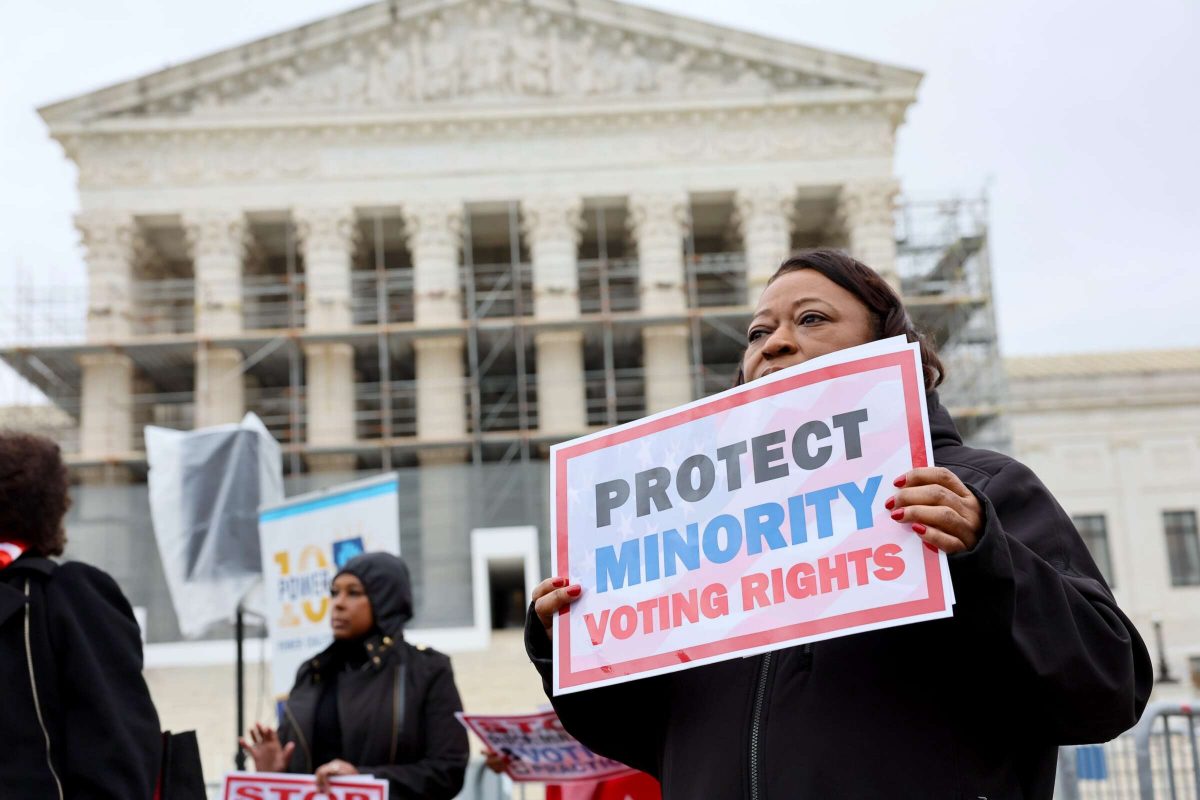
Above photo: Black Louisiana voters and civil rights advocates call on the Supreme Court to uphold a fair and representative congressional map in Louisiana v. Callais at the Supreme Court of the United States on March 24, 2025, in Washington, D.C.Jemal Countess / Getty Images for Legal Defense Fund.
We may well see the elimination of the 11 Black-majority districts — all Democratic — in GOP-controlled Southern states.
In what may prove to be the most consequential redistricting case to come before the Supreme Court, Louisiana is urging the court to gut the main provision of the Voting Rights Act of 1965 (VRA) and ban any consideration of race in redistricting. Louisiana filed its brief after the high court on August 1 asked the parties whether compliance with Section 2 of the (VRA) violates the Constitution’s 14th or 15th Amendments. By framing that question, the court may be signaling its intention to eviscerate the VRA.
Louisiana v. Callais reached the Supreme Court after a coalition of civil rights organizations and Black voters sought to reinstate a map that the state legislature had adopted in 2024. The map, which established a second majority-Black congressional district in the state, had been drawn in response to a 2022 U.S. district court ruling. In that case, the court ruled that a prior map, drawn in 2020, likely violated Section 2 because it included only one majority-Black district out of the state’s six congressional districts. The coalition had argued that the old map diluted the votes of Black residents, who constitute about one-third of the population of Louisiana.
The Fifth U.S. Circuit Court of Appeals had affirmed the district court’s ruling that the old map probably violated Section 2, and the appellate court ordered Louisiana to adopt a new map by January 15, 2024. The Louisiana Legislature complied and drew a map with a second majority-Black district.
A group of self-described “non-African American” voters then filed a federal legal challenge to the 2024 map, alleging that it was an unconstitutional racial gerrymander because it separated voters primarily on the basis of race. A three-judge panel of the U.S. district court agreed with them, but the Supreme Court stayed the district court’s ruling and allowed the 2024 map to be used in the 2024 elections while it considered the merits of the case.
In March 2025, the high court heard arguments but didn’t make a decision, instead delaying a ruling on the merits until the following term this fall. In its June 27 order, the court said it would “issue an order scheduling argument and specifying any additional questions to be addressed in supplemental briefing.”
That more specific order came on August 1, when the court directed the parties to brief the question of the constitutionality of Section 2 of the VRA. Reargument is scheduled for October 15.
In its brief filed on August 27, Louisiana asked the Supreme Court to overrule its 1986 decision that set forth the legal test used to determine when a congressional map dilutes the voting power of minorities and thus violates Section 2. Relying on the case that ended race-based affirmative action in higher education, Louisiana argued for a “color blind” Constitution — a euphemism for allowing racial discrimination to continue.
VRA Section 2 Forbids the Government From Denying the Right to Vote Based on Race
The 14th Amendment’s Equal Protection Clause prohibits the government from treating people differently without a compelling or rational basis.
The 15th Amendment forbids the government from abridging or denying the right to vote “on account of race, color, or previous condition of servitude.”
Section 2 of the Voting Rights Act was enacted to enforce the 15th Amendment. It prohibits any voting qualification or prerequisite to voting, or practice or procedure that “results in a denial or abridgment of the right of any citizen of the United States to vote on account of race.” That happens when voters of color “have less opportunity than other members of the electorate to participate in the political process and to elect representatives of their choice.”
In its August 1 order, the Supreme Court directed the parties to file briefs addressing a question raised across three pages in the brief from the “non-African American” voters: “Whether the State’s intentional creation of a second majority-minority congressional district violates the Fourteenth or Fifteenth Amendments to the U. S. Constitution.”
The voters wrote in that brief: “Section 2 is no longer constitutional in Louisiana because the voter data from Louisiana … shows that Black voters in Louisiana today have an equal opportunity to participate in the political process and elect representatives of their choice.” The brief goes on to say: “Section 2 imposes burdens on constitutional redistricting laws that cannot be justified by Black Louisianans’ needs.” Finally, the brief contends:
Section 2 is abused to set racial quotas and elevate some groups over others. Such practices violate “the twin commands of the Equal Protection Clause that race may never be used as a ‘negative’ and that it may not operate as a stereotype.”
By zeroing in on those three pages, the high court appears amenable to deciding that Section 2 violates the 14th or 15th Amendment.
Fifth Circuit Court of Appeals Sides With Black Louisiana Voters
The district court had held a seven-day trial in late 2023, where data analysis was presented, and expert witnesses and Black voters throughout Louisiana testified about the discriminatory effect of the 2022 congressional map.
On August 14, 2025, the Fifth Circuit Court of Appeals affirmed the district court ruling that the 2022 map violated Section 2 of the VRA. The appellate court held that the old map diluted the voting power of Black voters by unfairly dividing communities into districts, in order to reduce their voting power and thereby deny them an equal opportunity to elect candidates of their choosing. The Fifth Circuit — which is considered the most conservative federal appeals court in the country — rejected the assertions that the 2024 map violated the 14th or 15th Amendment.
When it takes up the merits of the case next term, the Supreme Court will review the Fifth Circuit’s opinion.
What Will the Supremes Do?
The question before the court is whether the 2024 map with the additional Black-majority district will be used in 2026 and subsequent elections. If the high court strikes down the 2024 map, it will create a presumption of illegal racial gerrymandering when map drawers craft majority-minority districts — districts in which people of color are the majority of voters — effectively destroying Section 2 of the VRA.
If the high court finds Section 2 unconstitutional, we may well see the elimination of the 11 Black-majority districts — all Democratic — in Republican-controlled Southern states.
In 2013, Chief Justice John Roberts wrote the opinion in Shelby County v. Holder, gutting Section 5 of the VRA, which had required federal preclearance before changes to election rules could go into effect in jurisdictions with a history of discriminatory voting practices.
But in Shelby, Roberts provided assurances that Section 2 of the VRA would still be available to protect voting rights.
Two years ago, the Supreme Court struck down a racist congressional district map in the 5-4 decision of Allen v. Milligan. Although Brett Kavanaugh joined Roberts in voting with the three liberal members of the court in that case, Kavanaugh asked the Solicitor General during the March argument in Louisiana v. Callais whether the VRA’s requirement of race-conscious drawing of majority-minority districts can still be a constitutional remedy for voting discrimination. Kavanaugh noted that “the Court’s long said, that race-based remedial action must have a logical end point, must be limited in time, must be a temporary matter. Of course, in school desegregation and university admissions.” In Milligan, Kavanaugh flagged the question of an expiration date for Section 2, but he noted that Alabama had not raised the issue.
The Voting Rights Act, one of the greatest victories of the Civil Rights Movement, has been targeted by the right since its enactment in 1965. Roberts noted in Shelby that “largely because of the Voting Rights Act, voting tests were abolished, disparities in voter registration and turnout due to race were erased, and African-Americans attained political office in record numbers.”
But, as Ruth Bader Ginsburg wrote in her Shelby dissent, “Throwing out preclearance when it has worked and is continuing to work to stop discriminatory changes is like throwing away your umbrella in a rainstorm because you are not getting wet.”
By the end of June 2026, we should learn whether Kavanaugh and Roberts think that discrimination has ceased enough to warrant throwing away the VRA’s Section 2 umbrella.