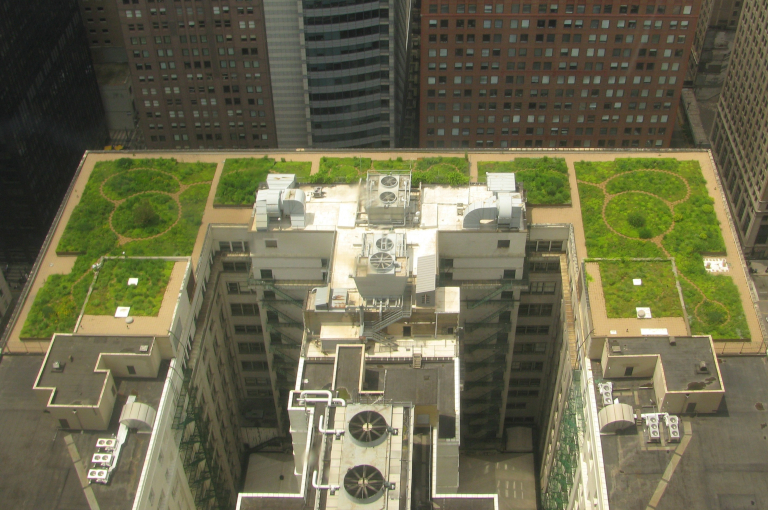
Above photo: Example of nature-based solution for an urban area: Chicago City Hall green roof. One of the benefits is that it mitigates the urban heat island effect. By TonyTheTiger derivative work.
We were supposed to have gone net zero by now: that was XR’s central demand, when we formed it, seven years ago. Can we all please at last acknowledge and take seriously the utter failure to do so? Only such acknowledgement will prevent us from continuing collectively to basically ignore the increasingly pressing need to actually focus resources on a strategy beginning with climate adaptation. We should admit that widely-mandated climate optimism has been actively harmful to the needful acknowledgement of reality – and to the active collective self-protection that we now desperately need to get serious about making happen.
Introduction: What If 2025 Had Already Been the Turning Point?
Allow yourself a very brief thought-experiment… What if 2025 had been the year the UK finally met its legally binding commitment to eliminate dangerous carbon emissions?… What if the mass climate mobilisations of the late 2010s had succeeded in forcing governments to act at the speed science demanded? In that alternate reality, life would almost certainly feel calmer, safer and more predictable than it does now.
As 2025 draws to a close, however, we are confronted by a harder truth. Britain is nowhere near zero carbon. (The CCC thinks we’re about half-way there; it has the figure at 50.4% for 2024 (https://www.theccc.org.uk/publication/progress-in-reducing-emissions-2025-report-to-parliament/ . But even this figure is a gross over-estimate; for instance, because it is not an equitability-based assessment; and because it does not take adequate account of ‘exported’ emissions such as those caused by us due to air travel. Nor does it take any account of the impacts of our climate-dire trade policies: see https://substack.com/home/post/p-181403901 ) The gaps between rationally-required activist hopes, political promises and physical reality remains vast.
When Extinction Rebellion emerged in 2018, its call for net zero by 2025 was deliberately bold: It reflected the urgency of the science and the moral weight of the UK’s historical emissions.
Obviously, Britain and the world have absolutely, categorically, and woefully failed to do this. Now, at the end of 2025, is the moment when we can finally, categorically, and very concerningly and concernedly, state this.
Seven years on, then, it is clear that decarbonisation at anything like the required scale and pace has not happened — and within our current political and economic structures, was always utterly unlikely to.
The Limits of the Old Climate Strategy
That failure leaves us with uncomfortable lessons. The climate crisis is no longer something affecting only distant places or future generations. Whether or not we feel engaged with it, it is shaping the conditions of our lives now.
One lesson stands out: we urgently need a climate movement that is broader, more inclusive and embedded in everyday life. One that reaches beyond ‘activism’ and engages businesses, professionals, local institutions and ordinary citizens alike. If we are to navigate the decades ahead, climate action must feel practical, shared and achievable. And it must feel like it is for everyone.
In short, we urgently need a mainstream climate more-than-movement, a wave of wider mainstreamed action. If we are to have a future. This emergence is what organisations such as the Climate Majority Project are aiming to midwife.
Why Adaptation Has to Move Centre Stage
A powerful way to enable this goal is by focusing far more seriously on adaptation — on preparing for the impacts that are already unfolding. When people can see tangible steps they can take to protect their homes, neighbourhoods and families, engagement is more likely to shift into gear.
This also requires letting go of the idea that decarbonisation alone will save us. Cutting climate-deadly emissions remains essential, obviously — but it is no longer sufficient. Alongside prevention, we must learn how to cope, adapt and prepare.
This is hard, but what I am saying is that it is time for climate activists and thought-leaders (and policy-makers, and diplomats, and on and on) to let go of fantasies of achieving full decarbonisation on what would have been a sane timetable. Instead, we need to pivot hard towards a strategy based in climate adaptation.
We are living now with the consequences of failure, and will do so ever more so for a very long time to come. We need to protect ourselves from and through this long emergency, and demand protection via the state too. Climate realists/pragmatists need to retain and in fact upgrade our ambitiousness: but we need to stop pretending that full decarbonisation is achievable within rational timetables, and switch to calling for the enacting now of protective deep, strategic and transformative adaptation to our terrifying emerging terra incognita. (This will also have the huge advantage of potentially making us popular again: by way of starting where people are, with climflation (i.e. climate-driven cost of living increases), with a rising tide of disasters and rising insurance premiums, etc.)
How does this start in practice?:
At a local level, communities can take part in retrofit programmes that make buildings safer in heatwaves and storms, as well as reducing energy bills. Households and neighbours can work together to reduce flood-risk by choosing planting over paving, or using permeable materials where hard surfaces are unavoidable. Community food-growing schemes, rewilded churchyards and shaded green spaces help cool neighbourhoods while supporting wildlife. Simple water-saving measures — from installing water butts to reusing household grey water — strengthen local water security.
When adaptation becomes the starting point, people understand it. Preparedness cuts through abstraction and turns climate decline into something real — and action-able.
Living With the Consequences of Delay
Here at the end of 2025, we are already living with the consequences of delay. Flooding, heatwaves, droughts and wildfires are no longer rare events; they are becoming features of normal life. And in some cases – look at California, or Sri Lanka, or (closer to home) at the many floodplains that have been and will be built on – the consequences of their not being taken seriously enough as our new never-normal have been deeply disastrous, or indeed very deadly. The idea that we can still prevent at source very serious damage is an illusion. What we can do is reduce harm, protect the most vulnerable and adapt in ways that for starters do not worsen the problem.
This is the moment to prioritise resilience at every level — from reinforcing critical infrastructure to strengthening the social fabric of communities on the frontline of climate impacts, from learning from how global South frontline communities have already been practising transformative adaptation to shared inner work turning climate despair into climate courage.
From Global Crisis to Local Action
The unfolding of disasters and responses over the past year has underlined a crucial truth: climate breakdown is a global more-than-emergency, but solutions must be rooted locally. That’s why, in 2025, the Climate Majority Project launched the #SAFER campaign — Strategic Adaptation For Emergency Resilience. Its aim is to be honest about risk without tipping into paralysis, and to show that meaningful action remains possible.
As we look ahead, this should be the beginning of a new phase of climate action grounded in preparedness. Start small. Talk to neighbours (and Councillors) about shared risks and shared responses: rising temperatures, more frequent heat extremes, higher sea levels and heavier rainfall.
Organise locally. Map risks together. Press councils and national government to invest properly in green infrastructure, flood defences and community-level preparedness.
And it’s not just climate
Tragically, as a result of the historic failure with which I opened this article, we are now moving far deeper into the climate more-than-emergency even than XR foresaw as possible/likely. The temperature acceleration over the past couple of years is horrendous, and likely to continue in the next couple of years. This is of course partly being driven, as my friend the ever-truthful climate scientist Kevin Anderson notes, by CO2 concentrations in the atmosphere that are still rising at unprecedented rates; we’ve already driven global temperatures up by 1.5C and if we carry on we’ll be at or over 2C by 2050 with a real risk of 4C by 2100, which will for sure mean systemic collapse. Also there’s evidence we are over-heating faster than we were previously, due to higher climate sensitivity (with the biosphere now not absorbing CO2 at the same level, among other factors).
Likewise witness the recent truly horrific flooding in east Asia. And so on with novel climate impacts ad nauseum.
But bad as all this sounds, it’s worse than that. Because it’s not just climate alone: there are other massive and in fact existential threats arising, which could be deadly by themselves, as well as degrading the climate prognosis. For meanwhile, at the very same time (and quite appallingly timed!) the rise of AI is drastically worsening the climate situation; as is the rise of Right ‘populism’.
And other planetary boundaries too are being deeply-worryingly crossed, boundaries that we had barely noticed in 2018. Seven of the nine planetary boundaries have now been breached:
Don’t double down on ‘optimism’
But I know what some will say in response to this litany of inconvenient truths. They will say that even now, halfway through the dismal failing of the ‘critical decade’, we must focus on being climate ‘optimists’.
This narrative ignores the very real downsides of misplaced optimism. Consider for instance the Polish officer class executed by the Soviets, at Katyn. The very few who survived were those who were most pessimistic about their chances when they were arrested; because they and they alone were sufficiently desperate to try to run away.
This example in the present context might seem overdramatic. But note this: being ‘overdramatic’ is exactly what some of those who fled before Katyn were accused of being.
Moreover: Within the lifetimes of most Resilience readers, the climate crisis will likely take many more lives than the Second World War did; it has already taken several million lives (not to mention the several million who die each year from air pollution, mostly a result of the burning of fossil fuels). If we are to survive what is coming, let alone to manage to flourish through it, then we desperately need the kinds of strategic climate adaptation indicated and outlined above: which false optimism leaves unfunded or even sneered-at. We need to actually prepare, in holistic ways that can work, for the unparalleled storms of our children. For ‘multi-breadbasket-failure’ (the technical term for the coming climate-induced famines). For temperatures that can kill. And for much more unpredictable effects.
False optimism is incredibly dangerous. It stops us taking climate/polycrisis adaptation sufficiently seriously; because it evokes the false impression that things are potentially still going to be more or less fine in the future.
Maladaptation is the failure to adapt properly to a new situation or environment. Maladaptation (or no adaptation at all) follows directly from false optimism.
A Necessary Shift in Thinking
It is, as will be obvious from the above, absolutely not too late to act in meaningful ways: we can seek to adapt, we can adapt strategically, and we can even in due course potentially restart the (in 2025 very badly-stalled) policy-momentum for decarbonisation – by way of the agential, close-at-hand, depolarising, energising effects of getting started effectively, i.e. by way of adapting and growing our resilience. Notching up some (local and larger) wins; …starting finally to turn the tide.
It is not too late – it is never too late – to act in ways that are meaningful to reduce harm and to maximise our chances of a ‘thrutopian’ future. But it is high time for a shift in mindset. The pursuit of a perfectly decarbonised future cannot be our only story. We must also become a society actually capable of withstanding shocks and adapting to a harsher climate reality. And that is a noble enterprise capable of bringing people together.
Again, the above does not at all mean abandoning emissions reduction. It means recalibrating our approach. By focusing on resilience, we may unlock deeper and more durable public engagement with climate action — strengthening communities while thereby building momentum for the emissions cuts still so badly needed. And we may successfully start to depolarise the climate question: which is essential to sustaining any such momentum.
Conclusion: Ending the beginning
Finally then: halfway through the so-called ‘critical decade’ for climate action’, with governments and corporations rolling back on their decarbonisation commitments, the climate-delaying far Right on the rise, the 1.5 degree planetary boundary in the rearview mirror, and energy-hungry AI about to let rip, let us take a breath and agree that this is a very good moment – a necessary moment – to get very real about just how much trouble we are in. The Government in this country [the UK, from where I write] completely lacks a ‘mission’ to actually move to protect its populace from climate impacts. False optimism about our climate future makes it impossible to change that dangerous situation. Whereas changing that situation – getting us protected against the rising tide of climate chaos – is exactly what more and more of us are determined to do.
We need to make the most of this failing Government’s climate agenda while it lasts, and look to give succour to the possibility of successor Governments that could have significantly better (including crucially more adaptation-centric) such agendas: notably, in the UK, a possible post-2029 constellation including a resurgent Green Party (and possibly an emergent Your Party too) in government. For the big political story of 2025 has been the rise of the Greens.
Recognising the extent to which we have failed so far, and the extent to which the mitigation/decarbonisation story is stalled, is a necessary prelude to starting anew. A new phase is upon us. New thinking – and new acting – could make all the difference. Post-optimism, pre-any-‘doom’.
Such exciting, essential change might even make it truly possible to envisage a happy New Year…
Thanks to Caroline Lucas, Kate Lock and Joe Eastoe for help with this piece; they should not however be held responsible for any of its arguments and conclusions. …To help make a start on a happier New Year, please sign and share our official petition calling for a serious, properly-funded, strategic National Resilience Plan, here: https://petition.parliament.uk/petitions/730062