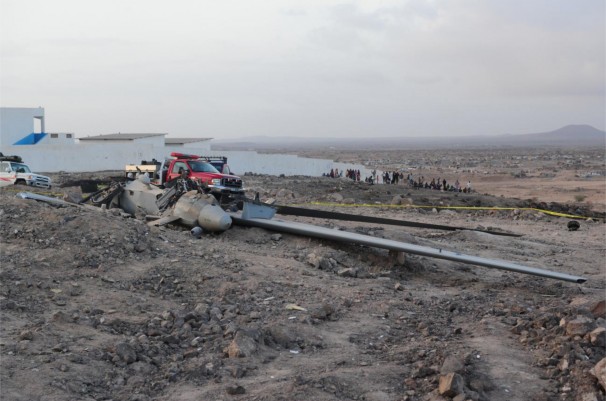
Above: A drone crash in Djibouti, Africa. Crash-prone Predator drone missions have escalated from Camp Lemonnier in Djibouti, so have the number of accidents. Since January 2011, five Predators have crashed while trying to return to the base.
U.S. moves drone fleet from Camp Lemonnier to ease Djibouti’s safety concerns
Air Force drones ceased flying this month from Camp Lemonnier, a U.S. installation in Djibouti, after local officials expressed alarm about several drone accidents and mishaps in recent years. The base serves as the combat hub for counterterrorism operations in Yemen and Somalia, playing a critical role in U.S. operations against al-Shabab, the Somali Islamist militia that has asserted responsibility for the Nairobi shopping mall attack, which killed more than 60 people.
The Djiboutian government’s growing unease over drone flights casts doubt on its commitment to host the aircraft over the long term. It is unclear whether the temporary drone base can be transformed into a permanent home or whether the U.S. military will have to hunt for another site in the region, according to previously undisclosed correspondence between the Defense Department and Congress.
That uncertainty raises fresh questions about the Pentagon’s plan to invest more than $1 billion to upgrade Camp Lemonnier into a major regional base, supporting operations throughout Africa, as well as in parts of the Arabian Peninsula and Indian Ocean. Those plans include a $228 million compound to house up to 700 personnel from the highly secretive Joint Special Operations Command.
More broadly, however, the concerns about drone safety present a strategic challenge for the Pentagon as it begins to shift more of the robot planes to new frontiers, where they must share congested airspace with commercial aircraft.
A rash of accidents
Unlike in the war zones in Afghanistan and Iraq, where the U.S. military essentially has ruled the skies, the drones in Djibouti and other foreign locations have flown from the same runways and relied on the same air traffic controllers as civilian pilots.
At least five drones based at Camp Lemonnier have crashed since January 2011, Air Force records show, including one that plowed into the ground next to a neighborhood in Djibouti’s capital, which goes by the same name as the country.
Last year, the Pentagon was forced to suspend drone operations in Seychelles, an island nation in the Indian Ocean, after two Reaper drones crashed on the runway at the main international airport, which serves half a million passengers a year.
The overseas accidents could have repercussions in the United States, where the military and the drone industry are pressing the federal government to open up the skies to remote-controlled aircraft.