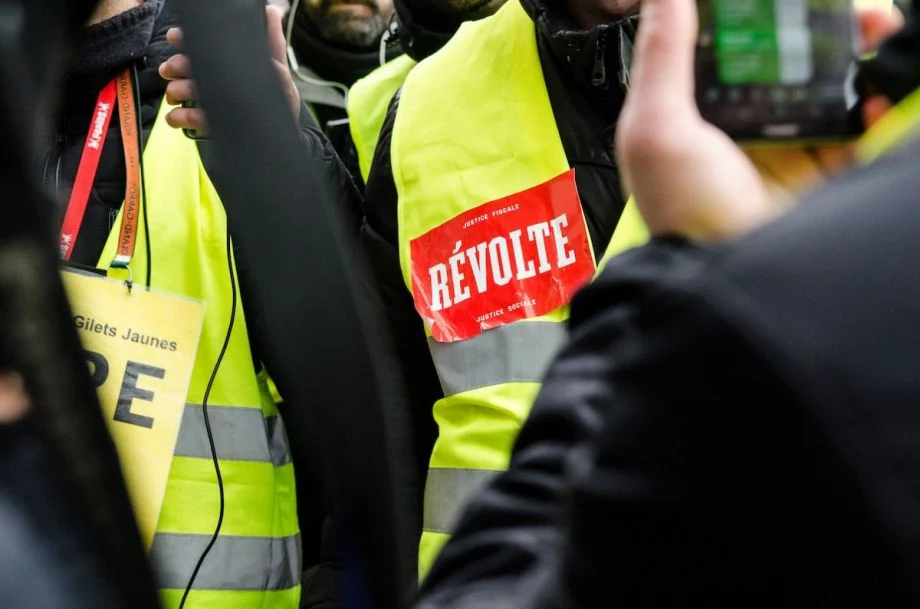
Above photo: In 2018, hundreds of thousands of protesters joined France’s yellow vest movement against French President Emmanuel Macron’s carbon tax hike. Christophe Leung.
To meet the scale of the climate crisis, the environmental movement must take up a new fight.
Defending and rebuilding local democratic power.
Few people outside of Memphis, Tennessee, have heard of Boxtown, a community of about 3,000 residents in the city’s southwest corner. Founded in 1863 by formerly enslaved Black Americans, Boxtown has a long history of resisting environmental injustices, from polluting industries to toxic infrastructure, that have worsened health outcomes and lowered life expectancy.
Today the community is at the center of a growing fight over the future of our democracy and the role of technology and technocrats in deciding for us what constitutes progress and good governance. When residents learned that xAI, a company led by Elon Musk, planned to install the “world’s largest” supercomputer in their neighborhood — without public input or transparency — they mobilized. Beyond the lack of community engagement, residents raised concerns about unjust utility burdens and environmental impact. While the municipal utility offers favorable energy use charge rates to industrial customers, residential customers are charged significantly more to maintain the grid.
The problem is bigger than xAI. It’s about democracy — and how easily it can be bypassed in decisions that affect the people most.
Our democracy is broken. To repair it, we must reinvent democratic practice so that people can be informed, active participants in the decisions that shape their lives. And the environmental movement must be central in that effort.
Our Democracy Is In Crisis
About 80% of Americans believe our country’s democracy is either “in crisis” or “facing serious challenges,” per a 2020 study. Many feel racism blocks civic participation. Cynicism is high. Polarization has deepened. And decades of dysfunction have made people willing to accept undemocratic actions as long as their side wins.
The system we rely on was designed in the 18th century by 17th-century thinkers. It has not kept pace with climate disruption, social conflict or a rising tech oligarchy. Social trust and solidarity have frayed, replaced by zero-sum thinking that undermines any incentives for more just and inclusive governance.
Despite widespread discontent with our current system, movements for reform remain small and isolated from mainstream political discourse as if imagining a system change is beyond our capacity. But this is where the environmental and climate movements can step in and play a critical role showing how these interconnected issues can inspire real change.
The Environmental Imperative
The world is warming. Last year was the hottest on record, with average daily temperatures 1.5 degrees Celsius above preindustrial levels. Millions of Americans have already been impacted by drought, wildfires, flooding, storms, and other extreme weather events due to rising average temperatures, with more severe impacts predicted as we continue to push past heat thresholds. The Intergovernmental Panel on Climate Change’s warnings about the risk of rising temperatures are becoming increasingly more desperate.
We know that we have the technological means to decarbonize the economy. What we lack is the political will to meet the scale we need to achieve a goal so immense. As climate writer Dave Roberts once summed up: “Think about the political will we need: to immediately cease fossil fuel exploration, start shutting down coal mines, and put in place a plan for managed decline of the fossil fuel industry; to double or triple the global budget for clean energy research, development, and deployment; to transfer billions of dollars from wealthy countries to poorer ones, to protect them from climate impacts they are most vulnerable to but least responsible for; and quite possibly, if it comes to it, to limit the consumptive choices of the globe’s wealthiest and most carbon-intensive citizens.”
A transition of that scale cannot be achieved without sustained support and participation from people, whose lives are being affected in multiple ways. And while rapid decarbonization is indeed an urgent need, many within the climate movement are convinced that deploying clean energy technologies as quickly and on as grand a scale as possible should take priority over ensuring an inclusive process or equitable benefits.
That will cannot be forged without people’s support. Yet many in the climate movement prioritize speed and scale over equity and inclusion. That approach is unsustainable.
France’s experience offers an alternative. After the “yellow vest” movement forced the government to pull back plans for a nationwide carbon tax, they entered into a two-year process of facilitated Climate Assemblies to develop solutions democratically. About 20% of the recommendations have already been implemented, with another 51% implemented in a modified form.
Deepening democratic engagement works. It creates better, more inclusive policy solutions that are more durable and resistant to political shifts because they are produced collectively and are popular. A more participatory relationship between governments and the communities they serve can accelerate the shift to clean energy and reduce greenhouse gas emissions by reducing misinformation, improving decisions, maintaining public confidence and legitimacy by ensuring an inclusive, equitable transition.
We need to be more ambitious and take action to ensure that climate policies and the interventions they enable are developed in an open and inclusive manner, and implemented with the public’s support and understanding. To accomplish that, environmental advocates must recognize the reciprocal relationship between having effective climate policy and a healthy, inclusive democracy, and devote resources to ensuring a functioning and fair democratic system within which to advocate.
While the larger environmental movement questions its role in advocating for a stronger democracy; environmental justice advocates and frontline communities have long demanded more equitable participation in policymaking. However, those demands often lack real operational and organizational clarity, with no a strategic focus on transforming the levers of democracy. We also need to acknowledge the challenges environmental justice groups face, including limited capacities of both community-based advocates and local governments. That’s in addition to the political difficulties of supporting communities when their interests are in opposition to the interest of large financial investors.
This only becomes more complicated when democratic systems fail to hold powerful actors accountable to the communities most at risk, as in the Flint water crisis. The roots of this crisis were in the gerrymandered state legislative districts that allowed Republicans to control the State House, despite Democratic House candidates winning the majority of the vote. Republican control at the state level allowed the removal of local control of water from the people of Flint, by installing the “emergency manager” that created the water crisis.
Bridging environmental justice and participatory democracy movements can offer needed invigoration of both, while movements for localized reforms can establish the democratic cultures that drive greater reform at national levels.
To avoid future Flints, the environmental movement must invest in democratic reforms. That means supporting participatory budgeting, ranked choice voting and inclusive local planning. It means backing efforts that shift power to communities, especially those on the front lines of climate and environmental risk.
Strategies aimed at increasing participatory democracy are only beginning to be applied to solutions for environmental sustainability and the climate crisis. But examples are emerging. This month, 20 U.S. cities are gathering through the All America City Awards to explore how inclusive engagement can strengthen environmental sustainability. Around the world, cities are experimenting with Climate Assemblies, energy co-ops and other democratic innovations.
Across Europe, cities are using Climate Assemblies to help break political deadlocks on climate action. In the U.K., community groups like People Powered Retrofit and Retrofit for All are organizing communities into energy co-ops to manage local energy planning and target retrofitting resources to homes and businesses. In March, six European cities came together as part of the Climate Democracy Lab to explore how participatory democracy can strengthen local climate action.
We need to build on that momentum. Pro-democracy advocacy in the U.S. is still relatively small, and siloed between conversations focused on national-level electoral reforms and those working on participatory democracy at the local level. We need a movement that unites the two, ultimately targeting federal reforms but recognizing that the democratic culture and civic infrastructure we need must first be built from the ground up.
Stronger democratic institutions go hand in hand with stronger environmental policy. The climate crisis is a governance crisis, and there can be no just transition without democratic renewal.
Khalil Shahyd is a Senior Strategist with the Natural Resources Defense Council in Washington, D.C. He focuses on federal policy and national strategies that create just solutions for environmental and climate crises —specifically by integrating clean energy and energy efficiency with affordable housing and community development. He has more than 20 years of experience in community and economic justice organizing, planning, and policy advocacy. He has worked on just, sustainable development in urban and rural settings domestically and abroad in Mexico, India, and Brazil.
Shahyd holds a bachelor’s degree in history from Tulane University, a master’s degree in sustainable international development from Brandeis University, and a PhD in energy and environmental policy with a specialization in urban political ecology from the University of Delaware.