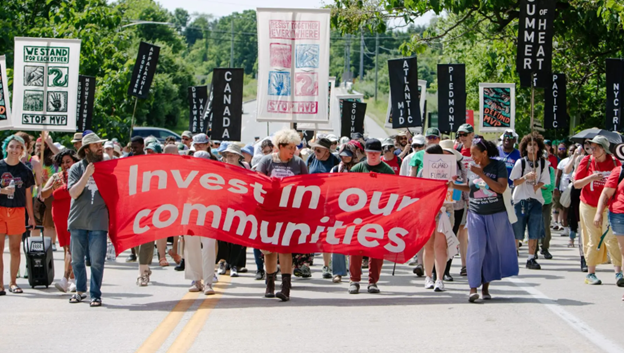
Above photo: An EQAT action at Vanguard headquarters outside Philadelphia in July 2024 included Quakers from across the U.S., as well as several frontline communities fighting the Mountain Valley Pipeline, the East African Crude Oil Pipeline and an incinerator in Chester, Pennsylvania. EQAT/Rachael Warrine.
In “Common Ground,” author Eileen Flanagan takes readers inside hard-fought climate victories.
While exploring the importance of acting in solidarity.
One route to enhancing an activist’s power is to sign up for training sessions, where you can receive coaching on how to improve your organizing skills. There’s only one problem: Sometimes there aren’t enough trainers to meet the growing demand.
We learned this in the early 1960s, when the U.S. civil rights movement expanded too rapidly for available coaches to fill the need. As a result, Marty Oppenheimer and I published “A Manual for Direct Action.” When we ran out of copies, all we had to do was print more.
The current level of environmental crisis is no doubt increasing the need and demand for more activist coaching. Thankfully, Eileen Flanagan’s new book — “Common Ground: How the Crisis of the Earth Is Saving Us from our Illusion of Separation” — has arrived just in time to help out. (Flanagan is a longtime Waging Nonviolence contributor.)
Throughout the book, Flanagan’s knack for vivid description helps readers feel as though they are gaining first-hand experience. When, for example, a New Orleans environmentalist leader drives Flanagan around to see points of conflict, we readers seem to be in the car with her. We not only gain lessons drawn from powerful environmental activism, but we also feel a sense of personal comradeship with the people she interviewed and worked alongside.
Because Flanagan is a veteran activist and writer (and someone I have worked closely with over the years), she knows the questions readers want to ask — as well as the reassurance we might need at moments when the struggles we face feel overwhelming. What’s more, her writing style is more conversational and subtle than the typical activist manual, while also going quite a bit deeper in its analysis.
Anyone who digs into an issue for the years it takes to see progress made — or even a win — can feel that we know a whole lot about that particular fight. In the process, though, we may lose track of other important struggles the movement is waging, along with the associated lessons learned. One merit of Flanagan’s book is that she knows the questions we’d want to ask about the campaigns she describes — campaigns that vary widely in location and circumstance.
I didn’t know, for example, that Vietnamese youth in Louisiana were doing climate actions alongside Latinos, as well as Black and white people. Nor was I aware that Ojibwe people in Minnesota fought the installation of an oil pipeline that would damage ancestral lands.
Flanagan doesn’t restrict herself to the U.S. either: In far-away India, she learned that activists succeeded in getting coal mining banned in a major forest — and through her interviews, we get the first-hand story of how they went about it. She also manages to link the story of a small rural settlement fighting pollution to the international climate treaty negotiations held in the Netherlands. The overall effect is one of feeling deeply connected to the victories of environmentalists all over the world, perhaps most particularly in places Americans rarely visit.
It’s not surprising that Flanagan succeeds in this way, having spent countless hours on far-away picket lines, in meetings and at organizers’ homes. Her writing skills show up in her ability to maintain the larger narrative wherever she goes: What’s working in this campaign? What are the challenges? How are activists meeting them?
Digging into victories — and challenges
Although this book offers the usefulness of a traditional activist manual, it offers so much more than that due to Flanagan’s remarkably personal style. For example, she shares the revealing moments when her own internalized racism was acted out. She then shares results of experiments she tried while working to unlearn that racism.
Flanagan obviously enjoys describing victories, as when the Earth Quaker Action Team, or EQAT — a Philadelphia-based group she’s a member of — forced one of America’s largest banks to stop financing mountaintop removal coal mining. That victory, which made it harder for struggling coal companies to secure financing, helped to inspire more climate finance campaigns, resulting in more than 1,600 institutions committing to $40 trillion-plus worth of fossil fuel divestment.
In describing the campaign, Flanagan shares a strategy tool that helped guide it: the spectrum of allies. She then connects that tool to an environmental campaign she observes in Louisiana, offering enough detail so that readers can pick up the tool and use it themselves.
As with any environmental book, “Common Ground” has plenty of information about facts and trends that may influence our strategic thinking. However, I was struck by Flanagan’s low-key way of relating environmental facts. She knows her readers: Most of us don’t need more motivation to act — we want to know how to act more effectively.
Importantly, Flanagan shares lessons from previous movements where grassroots campaigns won against seemingly overwhelming odds. In one example, she shows how the Baton Rouge bus boycott’s partial victory in 1953 in turn spurred the Montgomery campaign’s big win a couple of years later. It’s helpful to see environmental struggles in that larger context and know that we, too, can learn from and inspire each other.
Race, class and the value of coalition
Flanagan’s combination of big-picture skills and personal journalistic details show up over and over when describing activist coalition-building challenges. She’s unusually class- and race-aware, offering an example to activists of how to extend ourselves in such ways. She tells the story of her own ancestry (working-class Irish American) and describes how that was incorporated historically into U.S. white supremacy. She then uses that example to offer suggestions to readers for whom it might be relevant.
Basing her discussion on her own experience, as well as an interview with campaign strategist Daniel Hunter, Flanagan describes four models of campaign organizing in relation to race. She then passes along what works for building common ground within the group.
One of her most profound learnings came from an Indigenous confrontation in Minnesota over the installation of a $4 billion oil pipeline project threatening to damage ancestral lands. She describes the confrontation:
In the long skirt I had been taught to wear for ceremonies, I prayed fiercely, holding one of six thin wooden shields that were covered with reflective metal, so that the police would see themselves if they looked at us. I was one of six white allies asked to stand as a safety barrier between the police and several Indigenous youths who climbed the corporation’s structure to sing and drum through the chain link fence. A young Indigenous man with long thin braids told me that when he was asked to sing a song, he consulted the Creator for guidance, and the words that came to him were a prayer for those doing the harm.
“They don’t know any better,” he said quietly.
That reply struck me. What do we make of this difference she sometimes found between Indigenous protesters and white protesters who distance themselves from police? Are Indigenous activists more likely to honor the humanity of the enforcers by acknowledging the limitations of knowledge and conscience that seem to handicap white police?
This was new to me. In my many activist decades of dealing with police — including being beaten by them — it never occurred to me to acknowledge their limitations of knowledge and conscience as their handicap!
Ultimately, I found “Common Ground” to be both an enjoyable and fast read. I can also imagine its “manual dimension,” lending itself to being read in a group of activists. The many practical tips could easily come alive and fuel both the strategy and creativity needed for new winning campaigns.