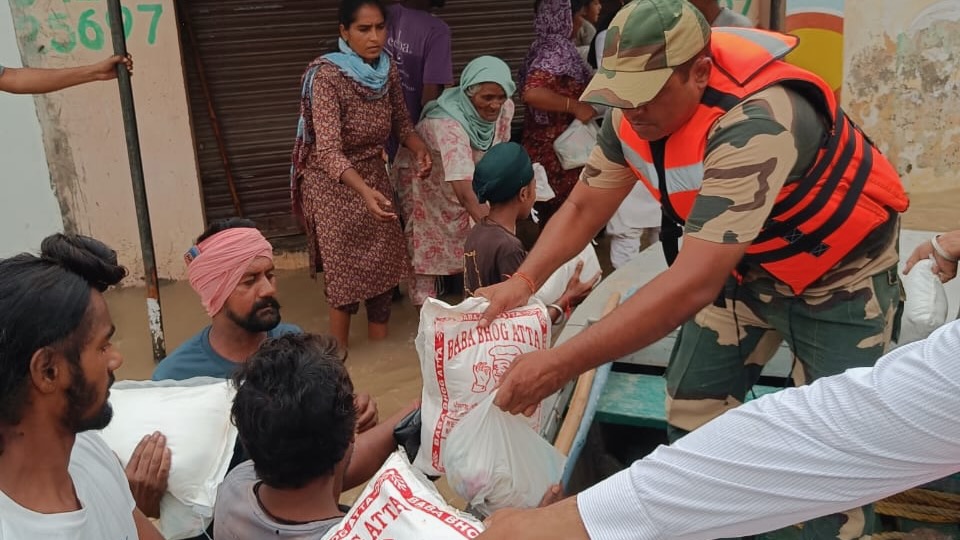
Above photo: In Ferozepur, its teams distributed dry ration packets to the stranded villagers, fodder to cattle and rescued weak and sick people in its speed boats. BSF Punjab Frontier.
To Face The Effects Of Climate Change.
Incessant and unprecedented rains in the last month have caused havoc in the region with hundreds killed, millions displaced, standing crops destroyed, and cities in chaos.
Hundreds of people have lost their lives and millions their livelihoods and homes due to persistent flooding in India and Pakistan. The unprecedented rains in the last month have caused the rivers in the northern parts of both countries to flood most of the province of Punjab on either side of the border.
Several other areas in both countries have been badly affected by the floods, such as Sindh and Khyber Pakhtunkhwa (KP) in Pakistan and Himachal Pradesh, Jammu and Kashmir, and Haryana in India.
Both countries have deployed their armed forces to evacuate thousands of people trapped in areas submerged in water and to run other forms of relief work, due to ineffective disaster management bodies.
The floods have caused massive damage to the agriculture sector in particular. Both sides of Punjab and Haryana in India are the major food producing regions. The overflowing rivers have flooded the fields and destroyed hundreds of thousands of acres of standing crops in both countries.
In addition to the fact that farmers in both countries have lost millions of dollars in the floods, the massive destruction caused to the standing food crops has raised the alarm of a possible food crisis in both countries.
The hundreds of thousands of people living in low lying areas or in the hills in both the countries have lost their homes in rains, floods, or landslides and are now forced to live in relief camps.
There is a growing fear that the flood water in the Indus river system, from even across the border in India, now moving to lower riparian regions in Pakistan’s Sindh, will cause further damage to life and livelihoods.
Pakistan has faced flood situations regularly over the last few years. This has been largely attributed to changing climate patterns caused by global warming.
Pakistan has repeatedly claimed that it is a victim of the climate disaster created largely by first-world countries and demanded compensation for the same.
State’s Criminal Negligence Causing Larger Damages
Expressing solidarity with the flood-affected region and people, left and progressive forces in both India and Pakistan have, however, questioned the failure of the states to take effective measures on time to address the damage, calling it a criminal negligence.
Claiming that the disaster was preventable, Mazdoor Kisan Party (MKP) released a statement blaming the country’s ruling classes for failing to do “essential public works” due to their greed and inefficiency.
“They have allowed our historic canals and flood defenses to crumble. They have enabled land mafias and capitalist developers to destroy our forests and choke our natural floodplains,” MKP claimed in the statement, demanding – aside from extensive relief and rehabilitation work – that the state take long-term measures such as investment in people-centric water management, restoring and expanding the traditional irrigation and drainage systems, reclaiming natural defenses such as floodplains and wetlands, massive reforestation, and building urban resilience networks such as storm drains.
MKP called for an “organized struggle of workers, peasants, and all oppressed people to demand a state that prioritizes their lives and livelihoods.”
It noted that “the global climate crisis is not of our making, but we can and must build a resilient Pakistan capable of withstanding its impacts,” which can only be achieved if we break from the current capitalist and feudal system and work for a socialist one.
In India, All India Kisan Sabha (AIKS), India’s largest organized farmers’ union, demanded a comprehensive relief package from the government for the people affected, apart from mobilizing popular donations.
AIKS has already mobilized its cadres in Punjab and Haryana to carry out relief work.
However, it noted that “anything short of a large monetary aid will accentuate the extreme distress being faced by farmers and workers of the affected areas.”