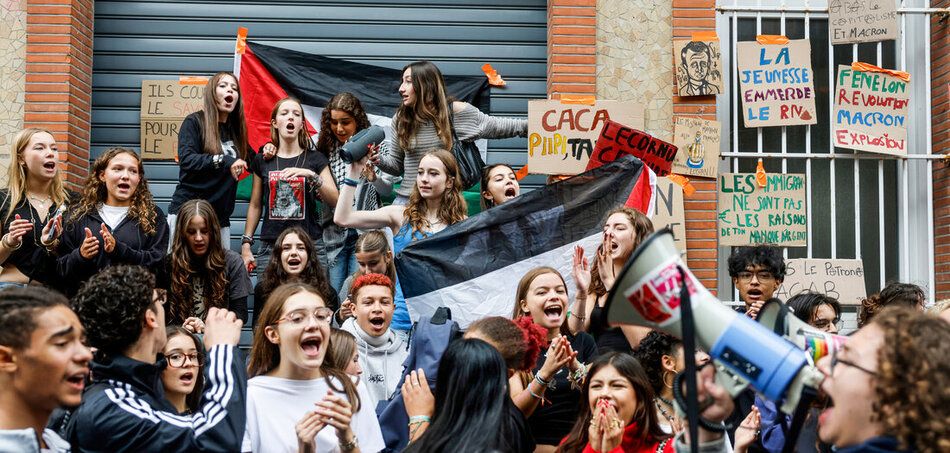
Above photo: High school pupils join Sept. 18, 2025, protests in France. Some slogans read: “Down with the capitalists and Macron” and “The youth are pissing off the [far right] National Rally.”
A million people joined the Sept. 18 protest action aimed at stopping the French regime’s war on the workers. Besides street demonstrations and some traffic disruptions, tens of thousands of workers held strikes that closed schools and shut down significant public transportation.
The French government mobilized 80,000 police and gendarmes to repress the demonstrators and attack any people who attempted civil disobedience or direct action. In the early morning, police attacked high school students with tear gas and batons.
Strikes cut the metro traffic in Paris in half. It only ran during rush hours.
Behind the eruption of class struggle on Sept. 10 and 18 is the continuous decline in the quality of life for working people in cities and in rural areas. This decline includes the 2023 legal rise in retirement age — a de facto cut in pensions — and the current regime’s attempt to cut social services that mainly aid the working class.
President Emmanuel Macron’s plans to increase the military budget by 150 billion euros in preparation for war with Russia. Macron’s war-mongering has created more tension and cost him additional popular support. Some polls show his approval rating dropping below 20%.
The military budget increase has created a deficit of 44 billion euros ($52 billion) in the 2026 national budget. Union members and leaders say the 2026 budget will make cuts to retirement pensions, labor rights and access to public services.
The same challenges that workers in France face exist throughout the European Union. Some EU governments, supported by the EU bureaucracy and NATO, have increased their military budgets by double what it was. They cut spending on social services and benefits for workers, claiming it was to balance the budget. Like in France, those pro-capitalist governments don’t plan to make the rich pay more taxes.
That means the drive to militarization adds up to cuts in workers’ benefits and a threat to their lives.
Unilateralism
The day of blockades on Sept. 10 was organized using social media. All the national labor union federations joined forces to organize the September 18 action. The inter-union group is made up of the three largest federations, of which the CGT and CFDT each have more than 600,000 members, while the FO has about 325,000. The CFE-CGC, CFTC, Unsa, FSU, and Solidaires federations are much smaller.
In France, less than 10% of workers are union members. But unions can still sometimes stop education, travel and production. They can also organize big demonstrations. Most people quoted in the media have said that the participation of the union federations was responsible for the increase in participation on Sept. 18 compared to the week before.
When it came to politics, however, the leaders of the different unions tried to avoid conflict. They focused their messages and demands on the economic impact, rather than on the war threat.
But that didn’t stop the conflict. The police started a lot of fights and were very violent with the high school kids. The authorities reported that they had arrested 309 people during the day.
While the leaders of the different unions did not support anti-imperialist slogans, many protesters carried Palestinian flags to show their solidarity, especially against the genocide in Gaza. In Marseille, France’s second largest city, hundreds of demonstrators blocked the military factory owned by Eurolinks. This factory provides military equipment to Israel, and protesters charged it as being complicit with genocide.
There were some new protest tactics used. In Cherbourg, a coastal town in western France across the English Channel, protesters continuously and slowly walked in pedestrian crossings on roads leading to the city center. Traffic slowed to a crawl.
There were mobilizations in hundreds of cities and towns in France on Sept. 18. Even before the march in Paris began in the afternoon, Sophie Binet, secretary general of the CGT, said, “We have counted 260 demonstrations across France.” She said there were “thousands and thousands of strikes in the workplace,” with schools, daycare centers, libraries and swimming pools “largely closed.” The union organizers estimated total participation at 1 million. (publicsenat.fr, Sept. 18)
The anti-imperialist left organizations, which are a small minority of the protesters, participated enthusiastically in the demonstrations wherever they had forces. For example, the Pole of Communist Revival in France (PRCF) encouraged its members and friends to participate and draw attention to the danger of war regarding Ukraine and campaign in solidarity with Palestine. They connected these issues to the class struggle against the Macron regime.
The PRCF’s articles and talks highlighted the urgent need to challenge the capitalist system itself. The group’s slogan was, “On Sept. 10, the struggle was in the streets, and on Sept. 18 and after, it will continue in the streets.”