Those supporting a new railroad monopoly include paid-off politicians, business partners, and… an anti-monopoly group?
The power of railroad monopolies was one of most fraught political issues in America during the late 19th and early 20th centuries. Rampant political corruption, fraud, violations of workers’ rights, inefficiencies, and inflated prices were an endemic feature of monopolistic control over our national transportation system. So bad was the rail companies’ behavior that the first ever regulatory agency in US history was created specifically to monitor their abuses. At the center of many of these controversies was Union Pacific (UP), a company whose actions played an important role in shaping early antitrust policy.
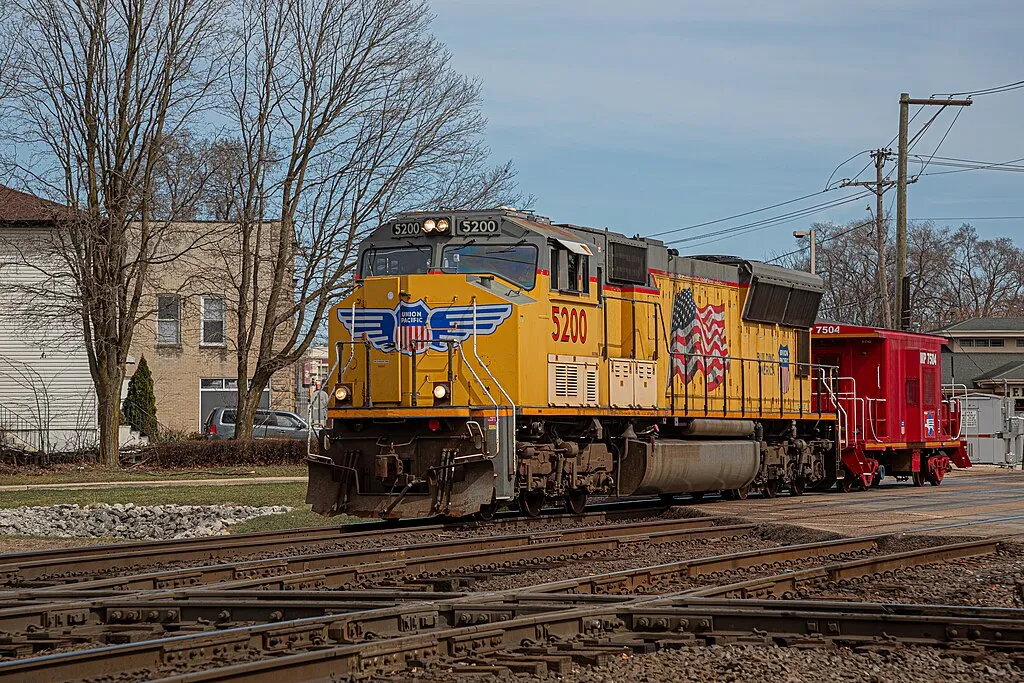
Flash forward to today, and that same company is back at it again. In June, Union Pacific announced its intention to merge with Norfolk Southern (NS), thus combining two of the nation’s largest rail companies. If approved, the deal would be “the largest buyout ever in the rail sector.” The merger would shrink the number of Class I freight rail companies operating in the US and dramatically reduce competition in the market, pressuring other Class I companies to pursue their own mergers.
The proposed merger deal is not popular among the companies who rely on railroads to transport their goods. A coalition of industry trade groups representing American agricultural, chemical, and construction material companies wrote in opposition to the merger on the grounds that it would raise prices and worsen service in the already-uncompetitive freight rail industry. “Today, just four U.S. Class I railroads control over 90% of all freight traffic,” the coalition notes. They believe that the merger would leave “captive shippers with even fewer Class I rail companies and competitive joint line options to choose from.”
The merger proposal has also drawn criticism from anti-monopoly groups, Senators from both parties, and unions like the Transport Workers Union and the BMWED. Another railworkers union, SMART-TD, initially approached the deal with “measured skepticism,” but came out in support of the merger after it had secured guarantees for its workers.
Despite opposition from some of the people most impacted by the mega-merger, UP and NS want to give the impression that the deal has popular support. To that end, the companies have created a webpage showcasing a wide range of “Supporters” from the government, the private sector, and civil society. There’s just one problem: as of October 3rd, 2025, at least 25 of the 47 listed supporters have conflicts of interest that bias them in favor of the rail monopoly.
The Anatomy of an Astroturf Campaign
Union Pacific and Norfolk Southern have been hard at work making the case for their merger, hiring a slew of new lobbyists to push the deal through. UP CEO Jim Vena has been particularly active, pitching the merger to President Trump directly (while also encouraging him to deploy the National Guard to occupy more American cities). This outreach has already borne some fruit, as Trump said that the merger “sounds good” soon after their meeting. Still, the companies seem to be betting that direct appeals won’t be enough on their own.
The two rail giants are also engaged in “influence laundering,” a practice in which one organization hides behind other organizations while promoting a self-serving cause. For example, when Union Pacific puts out a statement arguing in favor of its own merger, readers understand that this is only because the merger will be profitable for the company. But if UP can get other organizations they’re affiliated with to argue for the UP-NS merger on their behalf, readers can be deceived into the belief that they’re reading endorsements from neutral third parties.
As a case in point, UP-NS lists an endorsement from the head of the Omaha Chamber of Commerce on its “Supporters” page. A fact hidden from the reader is that the Omaha Chamber of Commerce’s board of directors is led by Beth Whited, the current president of Union Pacific. Because it is overseen by a top executive who stands to profit from the rail merger, the Chamber is clearly not a neutral analyst of said merger.
The “Supporters” page for the mega-merger is packed with this sort of astroturfed trickery in the form of celebratory quotes from supposedly independent organizations which are, in reality, closely connected to the companies proposing the merger. The President of the North Iowa Corridor Economic Development Corp. is listed as a supporter without any disclosure of the fact that the vice chair of the group’s board of directors has worked at Union Pacific for the last 14 years. The Platte Institute is listed as an endorser while Union Pacific’s Vice President of Public Affairs sits on their board. The President of the Nebraska Chamber of Commerce is counted as a supporter of the UP deal without any disclosure of the fact that the Chamber accepts at least $5,000 a year in contributions from the company.
Similarly, seven of the nine elected officials counted amongst the mega-merger’s supporters are politicians who have accepted funding from the two rail companies via political action committees and employee contributions. It should come as little surprise that Nebraska Senator Deb Fischer had kind words to say about UP and its merger—the company has been her second-largest financial contributor throughout her entire career. Another supporter is Nebraska’s other Senator, Pete Ricketts, who counted Union Pacific as his third-largest benefactor throughout his career.
Other politicians supporting the merger include Nebraska Governor Jim Pillen, who accepted at least $55,000 from UP between 2021-2023; Georgia Lt. Governor Burt Jones, who accepted $7,500 from NS between 2020-2024; Nebraska State Senator Mike Moser, who accepted $3,750 from UP; and Georgia Agriculture Commissioner Tyler Harper, who accepted $3,000 from NS. Another endorsee is the current mayor of Omaha, John Ewing Jr., who received $9,200 from UP employees during his 2012 congressional campaign.
It is not just the politicians with conflicts of interest. Many of the companies listed as mega-merger supporters have close relationships with UP and/or NS, thus making them poor representations of how the average firm would fare under a UP-NS monopoly. In his comments on the matter, the President of Martin Marietta Materials noted that “we probably send more [freight] on UP than any other railroad… So we don’t look at [the merger] and feel that there’s any peril to our business. They are good business partners.” As UP itself has noted: “…Martin Marietta is one of Union Pacific’s largest volume customers, [and] Martin Marietta also is Union Pacific’s largest supplier of ballast, which is used to form the bed of railroad tracks…” Is it any surprise that Martin Marietta would give its blessing to a monopoly led by a close ally?
Jim Finley, the founder of Wildcat Midstream, endorsed the merger by noting that his company has “worked with Union Pacific’s management for many years.” The firm has also received awards from UP for five years in a row. Another endorser, Ironhorse Resources, Inc., notes that it “has long benefited from our strong connections with Union Pacific.” Still another, Hub Group, says that they are “exclusive rail partners” with both companies and have been working together for “decades.” In total, publicly available materials show that at least 13 of the 19 companies listed as “Supporters” have pre-existing partnerships with the two rail companies seeking to merge. Neither Union Pacific nor Norfolk Southern responded to a request for comment.
Railroaded
The UP-NS merger requires approval by the Surface Transportation Board (STB), a bipartisan government agency. President Trump’s firing of one of the Board’s Democratic members has opened up a second vacancy on the five-member board. More recently, Trump nominated Republican Richard Kloster to fill one of these vacancies. Union Pacific and Norfolk Southern have thus sought to create an appearance of support from the conservative movement in hopes of swaying Trump and his Republican board appointees.
The companies’ effort to recruit conservative activists to their cause is in plain view on the companies’ “Supporters” page. The list features endorsements from two small conservative media outlets in Louisiana—Cajun Conservatism and the Louisiana Policy Review. The basis of both websites’ supposed endorsement, however, is the fact that both published identical copies of the same pro-merger op-ed within several days of one another. UP-NS are thus able to claim that one article written in their favor actually counts as two “supporters.” Neither outlet responded to a request for comment.
It’s unsurprising that organizations with a monetary interest and paid-off politicians would voice support for a harmful merger. Yet the real oddity among the merger’s supporters is a political organization known for its opposition to monopolies: the Bull Moose Project (BMP). The group was founded as an effort to revitalize the ideology of former President Theodore Roosevelt within the modern conservative movement. Roosevelt, who once ran for President as a member of the “Bull Moose Party,” is remembered in part for his dedication to “trust-busting,” a process of selectively breaking up some of the most problematic for-profit monopolies.
In general, BMP embodies Teddy Roosevelt’s trust-busting spirit well. The organization and its staff have called to “Smash anti-competitive monopolies,” criticized the monopolistic practices of major companies like Amazon and Apple, and specifically positioned themselves as opponents of “mega-merger[s]” that harm “workers, small businesses, and citizens.” They have even been critical of Norfolk Southern in the past, calling for an investigation into its disastrous 2023 train derailment in Ohio.
Yet when the news of the UP-NS merger broke, the Bull Moose Project offered a full-throated defense of the proposal. In fact, the organization first praised the merger on the very same day that it was originally announced. The organization’s founder, Aiden Buzzetti, wrote an article on the popular right-wing news site Daily Caller praising the merger. This article, which at times uses language identical to that in the official UP-NS press release, was then promoted as a paid advertisement on X in August. During Buzzetti’s subsequent spree of appearances on political radio shows to promote this monopolistic merger, his organization continued to share separate anti-monopoly messages online. The Bull Moose Project did not respond to a request for comment.
There is rich irony in a group inspired by Teddy Roosevelt giving praise to a Union Pacific merger. President Roosevelt frequently clashed with Union Pacific’s then-President Edward H. Harriman. In 1904, the Roosevelt administration sought to break up the company through which Harriman held monopoly control over Union Pacific and other rail companies. The court case which followed “established [Roosevelt’s] reputation as a ‘trust buster,’” according to the Theodore Roosevelt Center. The Bull Moose Project now finds itself perverting Roosevelt’s antitrust legacy to advocate for a mega-merger of one of the very same companies that he once broke up.
If the point of Union Pacific and Norfolk Southern’s supporters list is to convince the public that there is widespread support for their proposed merger, it seems unlikely to succeed. Perhaps they’re hoping that Trump-appointed regulators will be more credulous, but any serious arbiter can see the list for what it is: a collection of politicians the companies funded, businesses they worked with, organizations they had partial control over, and a political group whose advocacy contradicts its purported mission.
While past rail mergers have been financially lucrative for the companies involved, they have often resulted in worse service, inadequate maintenance, greater safety risks, fewer good union jobs, and reduced competition that allows the rail companies to squeeze consumers and small businesses. And if the UP-NS “supporters” page tells us anything about this latest merger proposal, it’s that many of the merger’s most prominent advocates are those with something to gain.