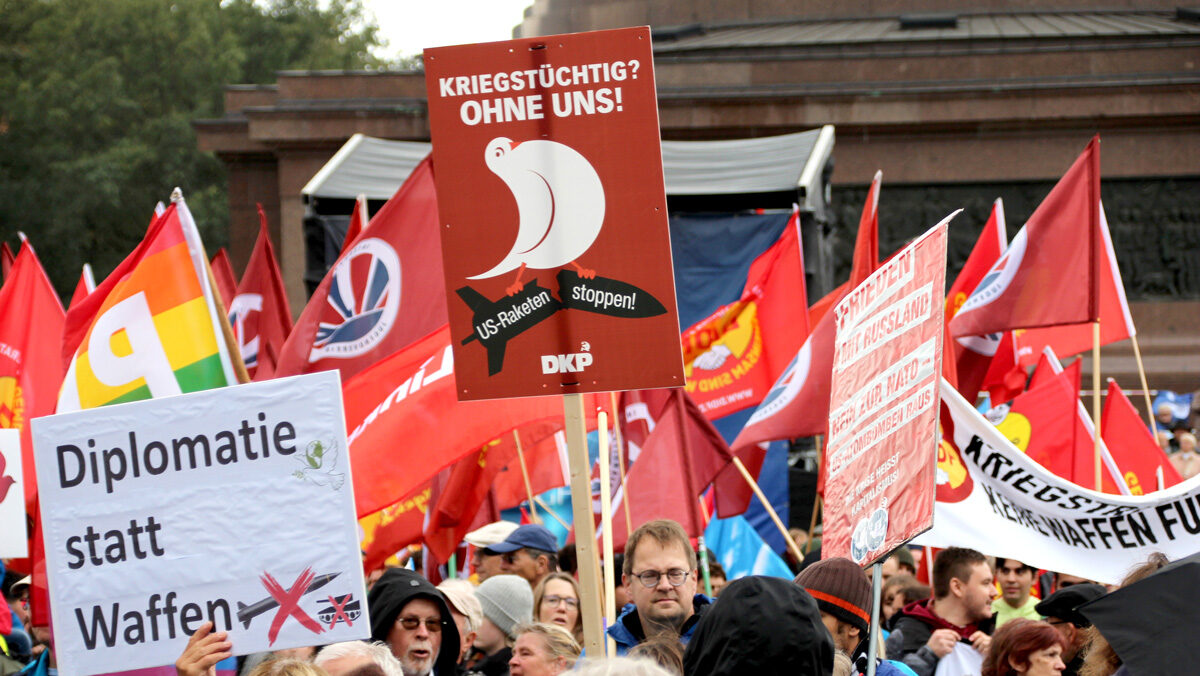
Above photo: German Communist Party (DKP)/Facebook.
Dominated by war spending.
European governments are prioritizing military and arms spending in their 2026 budgets while grassroots resistance to rearmament continues to grow.
It’s the peak of the 2026 budget season in Europe, and military and arms spending are dominating the debate. Under the European Union’s militarization drive and national commitments to meet higher NATO contributions, draft budgets circulating across the bloc allocate billions of euros to so-called defense at the expense of public services and workers’ rights. While trade unions and social movements in some countries are already mobilizing against this trend, others are still working to make clear that rearmament plans will only worsen the social and economic crises faced by Europe’s working class.
In Germany, left organizations such as the German Communist Party (DKP) are organizing to highlight the devastating impact of the government’s multibillion-euro arms spending plans inside trade unions and social movements as well as to the public. According to Mark Ellmann, responsible for peace work in the DKP, the current and previous governments’ success in pushing the massive war budget stems largely from how they framed the conflict in Ukraine. While officials claim that strengthening Germany’s military capabilities is a response to perceived threats from Russia, plans for the increase in defense expenditure were drafted months before the conflict began, he points out. The current budget, therefore, is largely based on misleading the public.
“The war budget in Germany is actually an expression of the interests of the ruling class against the People’s Republic of China and Russia, not a reaction to a concrete event,” Ellmann told Peoples Dispatch. “It not only affects the budget but also threatens people’s political freedom. It’s a reactionary reform, a military transformation of society, and it’s essential for the working class and the labor movement to break away from the discourse that normalizes it.”
The DKP is currently working to expose the false premises underlying the armament campaign and illustrate how it will impact workers. “Many progressive groups failed to grasp this at the beginning, but the truth is simple: if they really spend all this money on the military, there will be nothing left for social expenditure,” Ellmann emphasizes. The consequences are already visible in the government’s rhetoric, he adds, as officials no longer debate whether to cut social spending, but what to cut first. “The spectrum of what will remain is shrinking by the day.”
Meloni’s “reasonable and serious” war budget
Similar scenarios are unfolding elsewhere in the region. In Italy, Prime Minister Giorgia Meloni’s government has tabled a budget proposal that includes tens of billions in arms spending over the next few years, describing it as a “reasonable and serious” plan. Local trade unions and left movements, still galvanized by the spirit of recent general strikes and solidarity actions for Palestine, have rejected this argument, warning that nothing about a proposal that foresees over €20 billion going to so-called defense over the next three years can be called reasonable.
“On the contrary, it reflects the idea that the social model must be totally sacrificed on the altar of war,” the trade union Unione Sindacale di Base (USB) stated, “and that military spending must rise to 5% of GDP in order to bow down to NATO and the Euro-Atlantic arms lobbies.”
Instead of channeling billions into an already flourishing arms industry, USB insists the government should focus on living standards and inequality, tackling poverty wages and the erosion of essential public services. “The rearmament policy jeopardizes our future and shapes everything, from industry to education, from research to the media, from freedoms to public services, according to the logic of war,” warned USB, Potere al Popolo, and allied organizations. “They don’t just want to buy and build new weapons, they want to militarize and regiment the whole of society. A comprehensive process of reorganizing our lives is underway, one that is authoritarian, suffocating, and liberty-crushing.”
The EU’s new “defense” program: industrial in name, anti-worker in practice
The same logic of war extends to the EU level, where new steps are being taken to institutionalize rearmament. Among these is the recently announced European Defense Industrial Program (EDIP), which left parliamentarians warn might have serious implications for labor policy. In a recent article, Members of the European Parliament Marc Botenga and Özlem Demirel emphasized the “crisis mechanism” within the EDIP that would allow employers in arms manufacturing – but potentially also those producing dual-use materials – to bypass existing working time protections. Such measures, the MEPs warn, represent a direct attack not only on hard-won labor rights, but also on workplace health and safety standards.
“The multibillion-euro investments planned by the EU for the next decade form the cornerstone of a warmongering policy destined to drag the continent into a nightmarish future,” USB and allies wrote, responding to the direction taken by the EU. “And support for Israel confirms that this is the path and the master plan to which they want to bend us.”
Botenga added on social media: “The new EU industrial program EDIP ties our economy’s future to war. Public money and less rules for the militarization of industry, sacrificing workers’ rights, the environment and public health without basic transparency. We will continue to refuse and oppose this.”
Resistance is growing across the continent. In Italy, USB and allies have announced a month of anti-armament events throughout November, culminating in a general strike on November 28 against the war economy. In Germany, the DKP continues to build alliances between trade unions, social movements, and peace networks, emphasizing the need to integrate social demands into peace campaigns and vice versa. They view upcoming events, including the peace conference in Kassel on November 8-9, as crucial opportunities to unite anti-war and labor struggles.
“The left must continue to bring out the interconnections between these movements,” Ellmann concludes. “Peace movements must include social demands, and social movements must speak plainly about issues of peace and war if we are to resist this growing wave of militarization.”