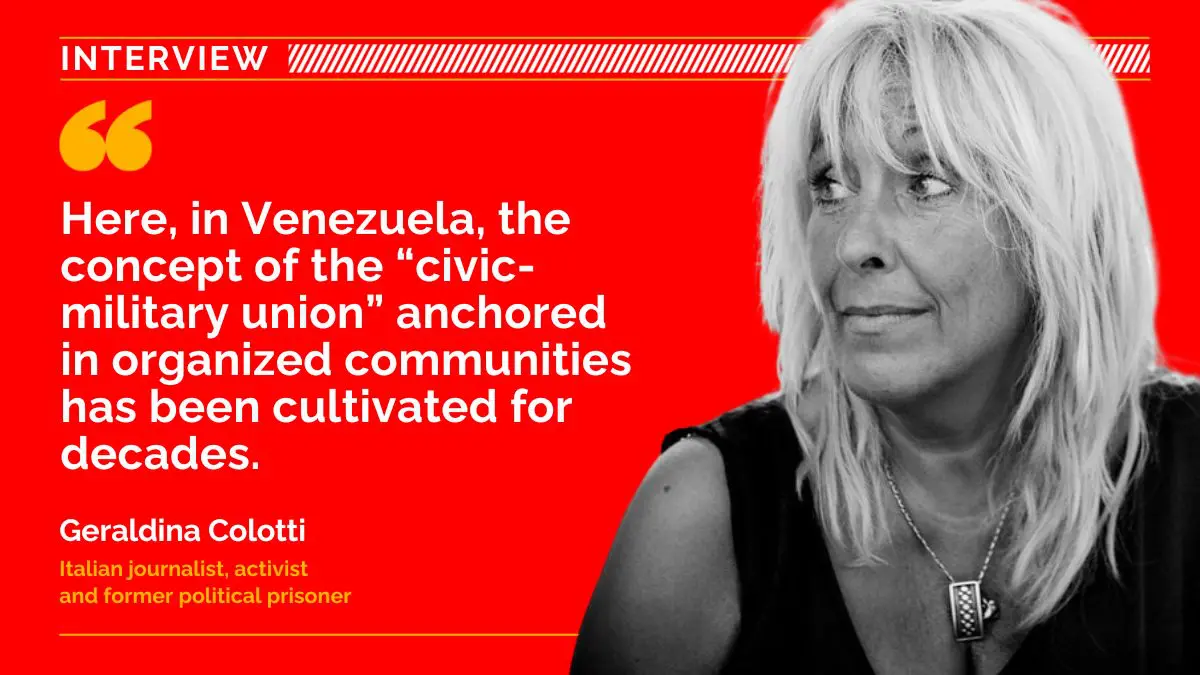
A Conversation with Geraldina Colotti.
In a world turned upside down, Italian revolutionary activist Geraldina Colotti argues that no good deed and no sovereign project goes unpunished.
As Washington intensifies its hybrid war against Venezuela—combining sanctions, lawfare, psychological operations, and military threats—the South American country once again finds itself in the headlines. To understand this moment, Cira Pascual Marquina spoke with Geraldina Colotti, an Italian journalist, revolutionary militant, and former political prisoner who has engaged with Venezuela for decades. Colotti argues that the current offensive against the Caribbean nation is part of a broader imperial strategy to reassert US hegemony amid a terminal crisis of global capitalism. Drawing parallels with Iraq, Libya, Palestine, and Vietnam, she explains how the Bolivarian Revolution represents the “threat of a good example” and why, despite suffocating sanctions and relentless destabilization, Venezuela continues to be a living paradigm of popular resistance.
There is a new imperialist military escalation against Venezuela going on right now. Why is it happening and why now?
To understand this moment, we have to go to the root of the problem. Capitalism is in a structural, multifaceted crisis—a systemic crisis that is terminal. Historically, whenever capitalism faces a crisis, it turns to the military-industrial complex to extend its life. That is happening once again.
Some people believed that Donald Trump would end interventionist foreign policy, because he claimed he wouldn’t invade countries like the Democrats do. But during his first presidency, Trump was the number one promoter of economic warfare, which operates alongside Fifth Generation warfare.
Venezuela is a clear example. The unilateral coercive measures—the so-called “sanctions”—are silent bombs that kill in the shadows, enabled by the Western media and its ideological machinery. We see the same logic most starkly in the genocide in Palestine: the erasure of historical memory paves the way for impunity. And that operation is far from unique.
For decades, Western powers have relied on blackmail, criminalization, and ideological manipulation to dismantle radical imaginaries. They have demonized resistance in all its forms, from workers’ struggles in industrial centers to the armed liberation movements in the Global South.
The result is an inevitable contradiction between the legitimacy of peoples’ rights and the fiction of bourgeois legality: a legality that kills with clean hands while demanding that the oppressed revere it. And when that legality no longer serves the interests of the dominating class, it is discarded without hesitation, as we see in Palestine and in the broader manipulation of international law.
The UN Charter itself recognizes the right of oppressed peoples to resist, including with arms. Yet Palestinians are branded “terrorists,” while Netanyahu, a genocidal criminal, is upheld as the defender of “democracy.” It is a world turned upside down.
At the same time, the rulers of this world—an ever-shrinking elite that hoards wealth as inequality deepens—are showing their true selves. Trump’s inauguration made this spectacle unmistakable: he took office surrounded by the richest men on the planet, openly aligning the US presidency with the power of a few. From day one, he made it clear that, for this ruling class, the poor and the working people don’t count at all. You either submit, or you are discarded.
Venezuela, with its modest population of around 30 million, contrasts with the winner-take-all world norm. Let’s take one example: before the US-led blockade, Venezuela had practically achieved the Millennium Goals—a fact recognized by the UN. And so Venezuela became an example. That is why Obama, the “democrat,” declared Venezuela an “unusual and extraordinary threat.” Venezuela represents the threat of the good example.
The present military escalation is not just against Venezuela. Washington seems to be moving aggressively to reassert its dominance over the whole Latin American and Caribbean region. Why do you think that is?
The same strategy applies to Latin America and the Caribbean: bring governments to their knees, including those that are progressive without being radical. The US succeeded in blackmailing timid progressive governments—Peru being a dramatic example. Pedro Castillo, a rural teacher, was condemned to eleven years in prison. After being elected, he was forced to “distance himself” from the country’s historical class struggle, from the memory of the popular war, and then he was overthrown and jailed.
This mirrors what happened in Italy: any attempt at resistance was (and is) demonized. After we [the Italian Red Brigades] kidnapped the highest NATO commander in 1981, Washington ordered the institutionalization of torture in Italy. Not random torture but state-sanctioned torture, and the government did what the US told it to do.
The overall result has been a systematic erasure of historical memory. Younger generations often don’t even know what happened in the history of Italy, Peru or for that matter, across Latin America. Today, whenever people rise up—against exploitation, defending public services, etc.—they are met with the same old blackmail: distance yourself from the history of struggle. Socialism is made to be synonymous with dictatorship, and every progressive candidate in Latin America is required to renounce “the dictator Maduro.”
Meanwhile, Washington is rebuilding its military presence in the region. Honduras, Ecuador, Argentina, and others are once again hosting US bases. Guyana, backed by multinational corporations, is being used to seize Venezuela’s oil. The goal is to return Venezuela to the conditions of the Fourth Republic [1958-1999], which was that of total subordination.
Many have described what Venezuela and Cuba endure as “exemplary punishment.” Meanwhile, in an eerie echo of old settler-colonial practices, the US has put a 50 million dollar bounty on President Maduro’s head. What is going on?
The new element is that international capital is once again relying openly on fascism to resolve its crisis. The empire demands total submission.
However, Venezuela continues to be an example: despite facing suffocating sanctions, it is now supplying 90% of its own food. Imperialism responds by making Venezuela into a laboratory for Fourth and Fifth Generation warfare, including a sophisticated propaganda war, or what we now call cognitive warfare.
It hasn’t worked here [in Venezuela], but it’s worked elsewhere. Decades ago, Frantz Fanon described how the colonized can end up identifying with the colonizer. Today, we see how in many countries, people are either abstaining or casting their ballots for figures marketed as “anti-system,” even though these politicians are the purest products of the system, and some of them are outright fascists.
Yet, as we know, participation in bourgeois elections itself requires oligarchic backing, and the idea of a true “anti-system candidate” emerging from that arena is a farce. Even so, fear and propaganda make the lie believable, so people end up voting for Trump, Bolsonaro, or Milei.
Internal colonialism’s mechanism is fear, which Malcolm X explained brilliantly: the demonization of migrants and racialized populations. In Europe and in the US, the poorest—migrants, Blacks, and Indigenous peoples—become scapegoats.
In this context, Venezuela becomes intolerable to imperialism. Maduro is an “obrero,” a worker. What greater offense could there be than a working-class president leading a country with immense oil and gold reserves that is an ally of China and Russia? For imperialism, that is unforgivable.
What the US is doing today follows a well-known formula. Before invading Iraq—a non-aligned country with vast oil reserves—Washington applied brutal sanctions, fabricated a story about weapons of mass destruction, and imposed a no-fly zone. Today, instead of WMDs, Venezuela is accused of “narcoterrorism,” and while there is no official no-fly zone, Trump declared Venezuela’s airspace “closed in its entirety.” The result has been that many airlines have stopped operating here, for example making it difficult for you to return to Italy. Doesn’t it all seem very familiar?
There are parallels with past wars, but the United States has also learned from its own defeats—above all from Vietnam—and later from the debacle in Iraq. Washington understands that occupying Venezuela would become its graveyard. Here, the concept of the “civic-military union” anchored in organized communities has been cultivated for decades. That is why, up to now, the US has preferred other kinds of aggression against Venezuela: economic war, proxy actors, mercenaries, and the deployment of new technological tools.
Today, destruction is carried out through highly technological means, including artificial intelligence. Recall how in Afghanistan, war was converted into a video game. The person launching a missile from thousands of kilometers away never saw blood; the distance made war palatable for the public.
Since then, the imperial playbook has continued to evolve—leading to today’s televised yet denied genocide in Palestine. We see the bodies, yet the media manufactures another narrative in which the victim is a “terrorist.” This emotional dislocation is deliberate. When Libya was torn apart, images of chaos and suffering were broadcast nonstop, but the blame was placed on Gaddafi, not on the NATO forces that carried out the destruction.
Returning to Venezuela, Washington has spent years distorting Maduro’s image to condition public opinion for aggression. As with Saddam Hussein and Gaddafi, the goal is to turn him into an object of fear, so that the public eventually accepts intervention with the thought: “At least they got rid of the tyrant.”
Meanwhile, much of the Global North’s population is kept inside a “quiet zone,” a bubble of privileges and curated narratives. The world is being Balkanized—geographically, economically, and cognitively. The perpetrators call it “humanitarian war,” “responsibility to protect,” but it is simply conquest with a new name.
Thus, the latest “no-fly zone” narrative functions as part of the broader psychological operation. Yet this phase may give way to a far more dangerous escalation, including targeted strikes. This is the biggest concern at the moment.
If these attacks continue to escalate, how do you see Venezuela’s capacity to confront imperialism?
I have witnessed the heroism of the Venezuelan people up close. From the moment I was allowed to travel [after leaving prison], I have visited the country many times. I have witnessed the fascist guarimbas [2014 and 2017] that included lynchings and burning human beings alive, the sabotage of the electrical grid, coup and magnicide attempts, and an all-out economic war against the people.
Venezuela has been through everything except a successful overthrow of its government! They have even used “legal” warfare—lawfare—to take Venezuela’s assets, as in the Citgo heist. Of course, lawfare is used in other countries as well—from France to Brazil, to name just a few. However, in Venezuela, lawfare did not succeed in removing or keeping the Left out of power.
Venezuelans are extraordinary. I’m poor in Italy, I struggle daily, but even at my most difficult moments, I am not living in a permanent state of war. Venezuelans are in a state of war daily: unable to brush their teeth because there was no water at one point, queuing for hours to get basic food staples, and enduring shortages for years. And, of course, women are the main targets. That shouldn’t surprise anybody.
I will never forget a woman I met on my first trip here in 2011. When the revolution began, she had no ID documents—she literally didn’t “exist” in the system. When I first saw her, she was a proud cédula [ID] holder, yet she had lost all her teeth. Still, she was leading her community with authority, like the women of the Paris Commune.
A year later, when I returned, she was still at the forefront—and now her teeth had been fixed, something in Italy that would cost as much as an apartment. That transformation that I witnessed was political: a powerful sign of what the revolution made possible. These are the things imperialism wants to hide. They are the reasons Venezuela remains standing.
Venezuela is responding to the economic warfare it’s facing with creativity: alternative currencies backed by rice or coffee, communal initiatives, collective solutions. As people say here: if they push us out the door, we come back through the window.
What we are witnessing is the spirit of the Vietnamese people reborn in Venezuela. And that is why Venezuela is a paradigm of resistance.