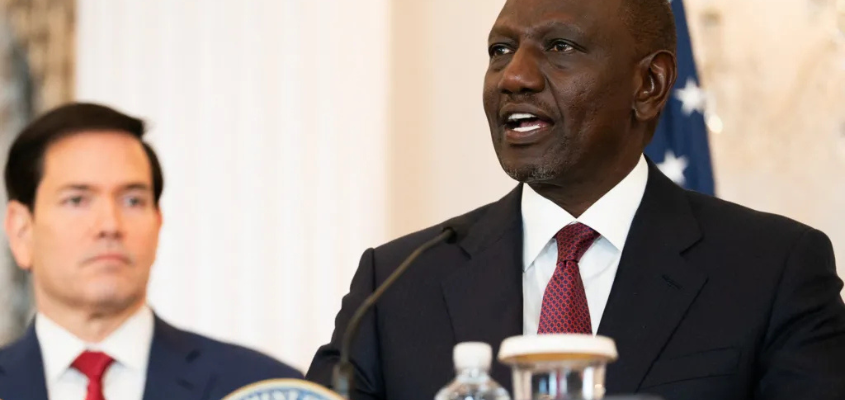
Above photo: President William Ruto has tried to reassure Kenyans over the deal. AFP via Getty Images.
Kenya is auctioning its sovereignty to foreign powers.
The final item on the block is the genetic data of its own people.
Nairobi — It is hardly uncommon to hear Kenyans complain that their President, William Ruto, is not a head of state so much as a comprador auctioneer of the state’s assets to foreign capitalists. Since taking the oath of office in September, 2022 here is a partial list of state-owned assets or enterprises that Ruto has either sold, is selling, or has proposed selling to foreign investors: the national telecommunications company, Safaricom; Jomo Kenyatta International Airport; the Kenya Seed Company; the National Oil Company; the Kenya Literature Bureau; the Kenya Pipeline Company; the Consolidated Bank of Kenya; Agro-Chemical and Food Company; Kenya Wine Agencies; the Development Bank of Kenya; East African Portland Cement; and the Nairobi Securities Exchange.
In total, Ruto’s administration plans to privatize 45 publicly owned enterprises in what government officials describe as the first phase of their privatization effort. The fire sale has sparked a nationwide outcry from Kenya’s media, opposition parties and ordinary citizens, both young and old. The Parliamentarian Julius Mawathe, told Kenya’s National Assembly last week:
“Eventually we will end up selling the entire country to foreigners.”
But if one transaction represents Kenyans’ tipping point it is the government’s agreement to effectively sell their private medical records—including biological samples and genetic data—to the Trump administration in exchange for $1.6 billion in healthcare funding over a seven-year-period.
In signing the deal December 4, Kenya was the first of five African countries—followed by Rwanda, Lesotho, Uganda and Liberia—to agree to the United States’ overhaul of its system of delivering international health assistance in the aftermath of the Trump administration’s decision last summer to shutter the U.S. Agency for International Development. A State Department spokesman, Thomas Pigott, said the agreements with Kenya and the quartet of African nations “advance the America First Global Health Strategy and build resilient, self-reliant, and durable health systems,” with recipient nations assuming increasing responsibilities for their own health care needs, ultimately phasing out the need for bilateral aid.
The Kenyan High Court last week suspended implementation of key provisions of the framework agreement after opposition politicians and a watchdog organization, The Consumers Federation of Kenya, filed a petition for an injunction.
Following the court hearing, a Kenyan Senator, Okiyah Omtatah, told reporters that the framework agreement violated Kenya’s constitution:
“Sovereign power resides in the people. At the heart of this petition is the question to whom does health data belong? And the answer emphatically (is) that they belong to each individual and if health data has to be harvested for any reason to be shared beyond the medical facility, there needs to be a proper mechanism where every individual gives their consent to have their data shared. We are not subjects. We are citizens. We’re not subjects of the president, we are citizens of the Republic of Kenya and our data belongs to each one of us individually.”
In a statement, the Consumers’ Federation wrote:
“Decision-making informed by Kenyan health data must be public, auditable and jointly supervised, with consumer representatives involved in data processing, monitoring and evaluation, and independent oversight.”
The case will be heard in February.
Despite reassurances from President Ruto and his health minister, Kenyan civil society groups have written an open letter to African heads of state urging them to demand fair terms from the Trump administration and to protect their countries’ sovereignty. Kenyan journalists and pundits note that the U.S. withdrew from the World Health Organization earlier this year, accusing the body of institutional bias favoring China. Many openly speculate that among myriad possible scenarios, Big Pharma may be plotting to exploit health care pacts with African nations to get a head start in monopolizing the global vaccine market should another pandemic, such as Covid, occur. The framework agreement requires Kenyan health authorities to provide biological samples and genetic evidence of epidemic pathogens within five days of detection.
Senator Omtatah told reporters that neither Ruto’s administration nor the Trump White House is to be trusted, invoking the infamous Tuskegee experiment as evidence of the United States’ bad faith towards people of African descent.
“You go back to issues of sovereignty of this Republic, you find that the instrument is coached in a language that makes Kenya a client state of the United States of America. So …you know health data is very important. Those of you who remember in …America about what happened to Black people that had syphilis …when they subjected Black people to syphilis trials and stuff like that. …We’re not opening up Kenya to be a laboratory of guinea pigs…we cannot just sit back and say that we’re going to share our information with the Americans without the guarantees that the laws of Kenya provide.”
With a population of 58 million, Kenya continues to grapple with high levels of poverty and extreme levels of wealth inequality 62 years after the east African nation won its independence from the United Kingdom. Many Kenyans say that Ruto is the latest in a long line of failed and ineffective political leaders dating back to the country’s first post-independence leader, Jomo Kenyatta, who, unlike his peers—Robert Mugabe in Zimbabwe, Kenneth Kaunda in Zambia and Julius Nyere in Tanzania—failed to articulate a vision of an independent African state.
Similarly, many Kenyans say that Ruto compares unfavorably to Burkina Faso’s youthful President, Ibrahim Traore, who is nationalizing the country’s resources and industrializing its commercial sector. Coming up on an election year, Ruto promises to turn Kenya into a developed nation but he has little to show for his fire sale strategy other than a growing divide between rich and poor. The investment bankers and politically connected lawyers who handled the sale of a 15 percent stake in the national telecommunications company, Safaricom, pocketed nearly $18 million, as one example. Conversely, Kenyan taxpayers are burdened with higher and higher income taxes to cover a growing budget deficit.
The idea that Kenya can sell its way to prosperity is simply magical thinking, critics here say. The only ones prospering are the foreign corporations which now own assets that should be in the hands of the Kenyan people. Ruto and his ilk promise nothing but poverty and underdevelopment for the African masses and riches for themselves and their cronies. Selling off medical records and genetic data is literally selling the Kenyan people themselves to the Donald Trump administration.
Jon Jeter is a former foreign correspondent for the Washington Post. He is the author of Flat Broke in the Free Market: How Globalization Fleeced Working People and the co-author of A Day Late and a Dollar Short: Dark Days and Bright Nights in Obama’s Postracial America. His work can be found on Patreon as well as Black Republic Media.