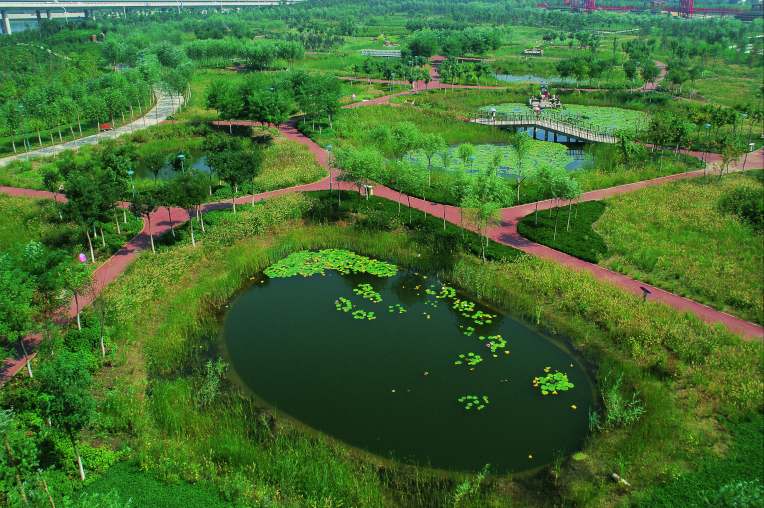
Above photo: Retaining water at the source: One of the early sponge city project designed by Turenscape to retain urban stormwater, remediate soil and restore native habitat, and creating a public space. Mydogistiaotiaohu.
What if, in Algeria, water were no longer seen solely as a scarce resource to exploit or a threat to control, but as an ecological and economic capital to preserve and develop?
Across the country, the same paradox is emerging: prolonged droughts and declining groundwater levels, punctuated by sudden, devastating floods. In a matter of hours, entire neighborhoods in Algiers, Oran, Béjaïa, or Skikda can be submerged, while a few weeks later, water restrictions are imposed. This contradiction is not merely a climate problem—it reveals a deep disruption between Algerian territories and their natural water cycles.
Coastal cities: impermeable surfaces and vulnerability
Along the coast, where the majority of the population and economic activity is concentrated, rapid urbanization has drastically transformed landscapes. Soils have been sealed with concrete, rivers and streams buried or diverted, and floodplains built over. As a result, rainfall no longer infiltrates, but rushes to the lower areas, overwhelming drainage networks and causing sudden floods. Each heavy rain is a stark reminder: cities drown when it rains, yet dry out when it doesn’t.
Meanwhile, these cities rely on distant dams, costly transfers, and increasingly energy-intensive desalination. Much of the rainfall, which could be harnessed locally, is lost to the sea.
High Plateaus: erosion, runoff, and stressed agriculture
Between the Tell Mountains and the Sahara, the High Plateaus are fragile and strategic. Rainfall is irregular but often intense, while degraded soils struggle to retain water. Runoff carries fertile soil away, silts up dams, and limits aquifer recharge.
Agriculture consumes most of the available water, often with practices ill-suited to arid conditions. Overpumping further depletes groundwater while productivity remains low. Without major landscape and agricultural transformations, the High Plateaus risk becoming mere runoff corridors from the mountains to the sea.
Sahara: fragile oases and illusory abundance
Farther south, the Sahara sometimes gives the illusion of abundant water thanks to vast fossil aquifers. Yet these resources, almost non-renewable at a human timescale, are being extracted faster than they recharge, threatening the sustainability of oases and local ecosystems.
Sponge landscapes: a strategy for Algeria
To address these imbalances, the concept of a sponge landscape offers a coherent and contextually relevant approach. It envisions the entire territory—from urban rooftops in Algiers and Oran, to the High Plateaus, to desert oases—as a living system capable of slowing, storing, infiltrating, and redistributing water.
In cities, this means permeable surfaces, infiltration parks, rainwater harvesting, and restoring urban streams. In agricultural and steppe areas, it involves hedges, soil cover, agroforestry, stone bunds, half-moons, and terraces to retain water and regenerate soils. In the Sahara, it entails rehabilitating oases, protecting palm groves, modernizing traditional water systems, and capturing every drop of rainfall.
Together, these measures create a “breathing” system capable of reducing floods, limiting erosion, replenishing shallow aquifers, and securing water reserves for dry periods.
Beyond technical solutions: national water solidarity
Sponge landscapes rely on a fundamental principle: territorial solidarity. Slowing water in the High Plateaus reduces downstream floods; restoring agricultural soils extends dam lifespans; protecting oases preserves ecological and social balance.
The benefits go beyond water management: cooler cities during heat waves, more resilient agriculture, restored biodiversity, reduced material damage, and improved adaptation to climatic shocks.
As climate change amplifies hydrological extremes in Algeria, the question is no longer whether this transition is desirable—it has become urgent. The challenge is to embed it in public policy: urban planning, agriculture, river management, desertification control, and water governance. In short, designing territories that no longer repel or waste water, but retain it and build the country’s future with it.