A GOP-controlled Congress is convening in January with Donald Trump as the next president. This means Paul Ryan’s Medicare plan may become law.
Since Republicans took over the senate in 2014, the only check on House Speaker Paul Ryan’s agenda has been President Obama. But as January 20 approaches, it’s important to understand the details of the Ryan plan and how it would affect the Great Society program that’s loved by millions of retirees across the country.
Speaker Ryan first unearthed his plan to permanently privatize Medicare in 2011, and each new bill he introduces is a variation on the original plan. Essentially, those who qualify for Medicare would instead be provided a voucher to be used as a subsidy for a private health insurance — which is ironically very similar to the Affordable Care Act’s health insurance subsidies (Ryan has voted for the ACA’s repeal on numerous occasions).
The Kaiser Family Foundation reviewed Ryan’s original proposal and made several assessments that should be alarming to Medicare patients. Among proposals like raising the Medicare eligibility age to 67 instead of 65, it asks seniors to contribute a much larger share of their fixed incomes toward healthcare. It also repeals the section of the Affordable Care Act that allows the federal government to negotiate prescription drug prices for Medicare patients.
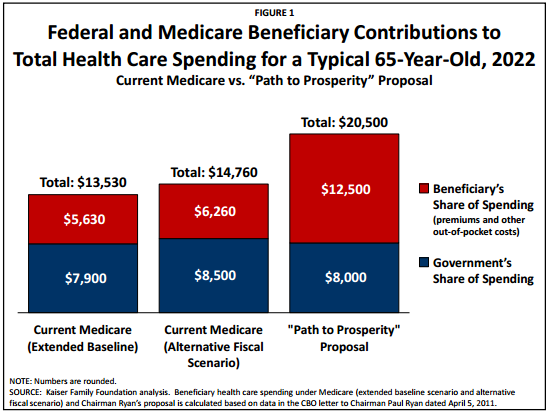
“Under the proposal, a typical 65-year-old retiring in 2022 would be expected to devote nearly half their monthly Social Security checks toward health care costs, more than double what they would spend under current Medicare law,” Kaiser wrote in its summary of the report. Kaiser also cited a Congressional Budget Office (CBO) review of Ryan’s proposal, citing how much seniors would be expected to pay for healthcare costs in a private health insurance plan as opposed to Medicare:
According to the CBO analysis, the total cost of providing health care benefits (premium and other costs) to a typical 65-year old in a private plan would be about $20,500 in 2022. The government would contribute $8,000 or 39 percent toward the total cost, and the remaining $12,500 would be paid by the beneficiary. The CBO projects that out-of-pocket costs for the typical 65-year old would be more than twice as large under the proposal than under traditional Medicare ($5,630) in 2022, because the cost of providing benefits is greater under private plans than under traditional Medicare.
Out-of-pocket costs for seniors under Medicare vs. Paul Ryan’s proposal (Kaiser Family Foundation)
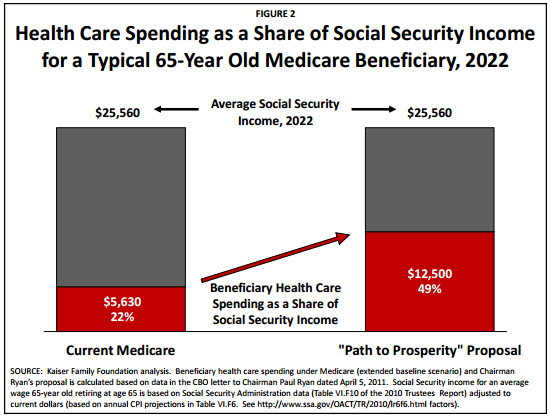
The higher out-of-pocket costs under the Ryan plan is particularly problematic under the current payment structure for seniors who depend on their earned Social Security benefits as their sole source of income. In their analysis, Kaiser found that for the average senior who receives just $2,130 per month in Social Security benefits (using 2022 figures, which is when the Ryan plan would take effect), a retiree would have to pay $1041.66 of that income for their healthcare.
[A] typical retiring 65-year old in 2022, with average earnings, would have out-of-pocket expenses for their health care that consumed nearly half of their Social Security income that year under Chairman Ryan’s proposal, double the amount they would pay under traditional Medicare. Beneficiaries who receive lower Social Security checks (e.g., people who retire and start receiving Social Security benefits before the age of 65) would devote a larger share of their Social Security income towards their health care expenses.
Healthcare costs under the Ryan in comparison to Social Security benefits for the average retiree (Kaiser Family Foundation)
While Speaker Ryan argues that the motivation behind his proposal to privatize Medicare is done to save federal money over the long term, Kaiser pointed out that the Congressional Budget Office’s math paints a different picture. According to the CBO’s analysis, private health insurance subsidies would actually be far more costly than simply continuing the Medicare program as is:
While private plans may be able to achieve lower utilization through tighter cost and care management practices, the CBO believes the total costs of providing a similar benefit package would be higher under private plans than Medicare, and that the differential between the costs under traditional Medicare and the costs under private plans would widen over time.
In a 2012 analysis of Ryan’s Medicare plan, Senator Bernie Sanders (I-Vermont) blasted the proposal for gouging seniors living on fixed incomes.
“The Ryan plan will increase out-of-pocket health care costs for a typical 65 year-old senior by more than $6,000 in 2022 – more than double the cost under current law,” Sanders’ senate website states. “The problem gets worse and worse over time, so that by 2030, the out-of-pocket health care costs paid by seniors will climb to about $11,000.”
During his campaign, Donald Trump vowed to not alter Medicare or Social Security. According to Forbes, Trump has vowed to “[S]ave Medicare, Medicaid and Social Security without cuts.” However, at least one member of Trump’s team has stated the opposite, making the President-elect’s position on the longstanding healthcare program ambiguous.
“After the administration has been in place, then we will start to look at all of the programs, including entitlement programs like Social Security and Medicare,” said Trump advisor Sam Clovis at a summit hosted by the Pete Peterson Foundation (which openly calls for cutting Social Security and Medicare).
Trump’s ambiguity on changing Medicare into a privatized system may be the one check on Paul Ryan as the new Congress prepares to gavel in next year. Ryan has stated he plans to write his Medicare privatization plan into a budget reconciliation bill — a procedure that circumvents any potential Democratic filibuster.
The 115th Congress will gavel in on January 3, 2017. Donald Trump will be inaugurated on January 20.
Online donations are back! Keep independent media alive.
Due to the attacks on our fiscal sponsor, we were unable to raise funds online for nearly two years. As the bills pile up, your help is needed now to cover the monthly costs of operating Popular Resistance.
Due to the attacks on our fiscal sponsor, we were unable to raise funds online for nearly two years. As the bills pile up, your help is needed now to cover the monthly costs of operating Popular Resistance.
Independent media outlets are being suppressed and dropped by corporations like Google, Facebook and Twitter. Sign up for our daily email digest before it’s too late so you don’t miss the latest movement news.