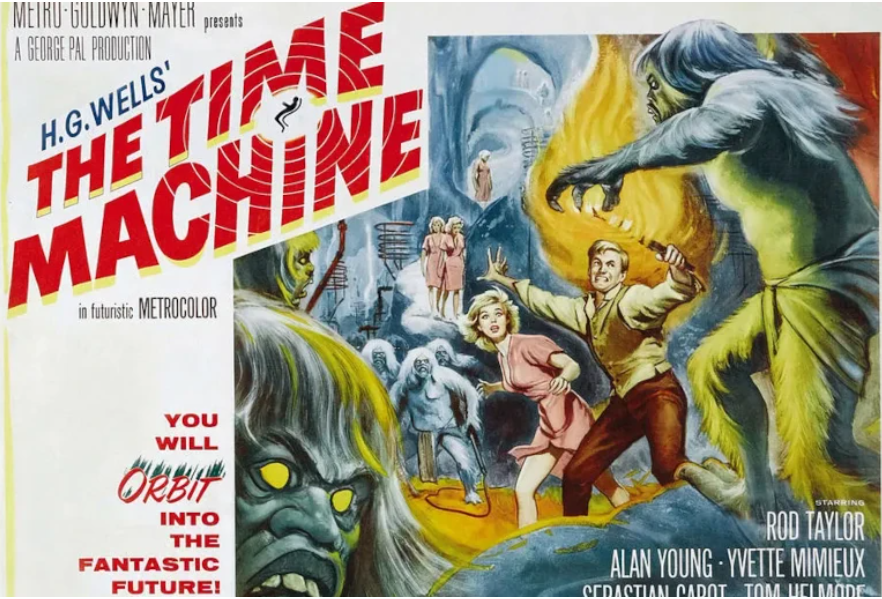
Above photo: The Time Machine movie poster. Public Domain.
I don’t need to tell you the scale and urgency of the crisis unfolding around us right now. You can see it. You can feel it. It’s unimaginable that it might have somehow passed you by. It almost certainly gives you regular sleepless nights. One could be forgiven for thinking that what some call the ‘polycrisis’, which draws us seemingly inexorably towards the Sixth Great Extinction, is viewed by many of those in charge as some kind of a desirable outcome. The movements around the world standing up for life, for the future, for the flourishing of life on Earth, have been incredible, vibrant and creative, but make no mistake, we are losing, and losing, as climate-destroyer-in-chief Donald Trump might put it, ‘bigly’.
At the same time, as the creators of the ‘Outrage and Optimism’ podcast put it, we can reframe the polycrisis as also offering us a ‘poly-opportunity’. If we can bring joined up, systemic thinking to this, and a mindset that seeks solutions and possibilities, the potential of what we could create if we embrace those possibilities remains extraordinary. When we live in a time in which the future is being cancelled and colonised, the very act of reconnecting people to the future, helping them to fall in love with its possibilities, is one of the most important and radical things we can do. As bell hooks once observed, “what we cannot imagine cannot come into being”.
For the last couple of years I’ve been experimenting with different ways to answer the question “what might our activism look like if its primary objective was the cultivation of longing?” It’s a very different approach than imagining we can make change at scale by focusing on telling people about collapse and extinction. As novelist Don Delillo once put it, “longing, on a large scale, is what makes history”. We forget this at our peril. As someone who has been a climate activist for many years, all of this leads me to the uncomfortable realisation that climate activists aren’t actually very good at cultivating longing. Nor are climate scientists. The people who are great at that are writers, poets, street artists, novelists, screenwriters, designers, creators of immersive digital experiences. The reality is we need everyone, and new ways of working together, if we’re to get this right.
I’ve been working with ambient music artist Mr Kit on a project called ‘Field Recordings from the Future’, an immersive light projection and music show which combines music we’ve made that uses field recordings from places that already sound like the future needs to sound like (car-free neighbourhoods, regenerative farms, landscapes being rewilded by beavers, bicycle rush hours etc) with beautiful, impressionistic videos of each place. We project them around audiences, and tell stories of our time travelling adventures into the future to join these diverse stories together. It’s surprisingly moving and motivating. It’s a beautiful embodiment of Rilke’s statement that “the future must enter into you a long time before it happens”.
It’s part of what I imagine as an emerging ‘Positive Futurism’ movement, a movement that plays with time in intriguing ways. Once you start looking, you can already see glimpses of what this could look like in the work of activist and artists like Black Quantum Futurism, Moral Imaginations’ ‘Imagination Activism’, in the work of artists like Camille Turner and Cauleen Smith, in movements like Afrofuturism, Muslim Futures and Black Utopias, in artists like Sun Ra who talked of being an angel from Saturn who travelled through space with “both unshakable certainty and deadpan humour”, in Aisha Shillingford’s writing on the Black Imagination, in local authorities and schools building time machines, in activists crewing imaginary spacecraft, Thrutopian storytelling such as Manda Scott’s novel ‘Any Human Power’, in community organisations creating and holding powerful ‘What If’ spaces. A positive futurism movement is emerging, and at pace. I already get people sending me photos of time machines they’d building.
And if you succeed in creating tears in the fabric of time, immersive events where people come together to step through time, one might imagine that at the same time, elements from that future come back through time and start appearing around us in the present, escapees from the future. We might imagine actors in public spaces, acting out scenarios from the future that turned out OK (a bit like the wizards on street corners at the beginning of Harry Potter, ‘pop up tomorrows’ that touch people emotionally, creating ‘utopian moments’ in which, as Ben Anderson puts it, the present “overflows with what is not-yet”, providing tastes, glimpses, infusions of utopias in the present, through music, art, activist events…all manner of creative expressions that show us how our future could be so much better than anything we’re living through now.
Street art might be one of the things that brings that future into the present. Street artists like Sophie Mess, ATM and Mona Caron, to name just three, use large, vibrant, beautiful murals to create images that give us a taste of a different future in the here and now. As the great Sun Ra put it, ‘The future is obvious, but the potential impossible is calling softly and knocking gently.’
More recently I’ve started working with the idea that interactive devices could also help us to fall in love with the future. I worked with designed Tony Elkington and futurist Gaelle le Gelard to create our ‘Fortune Telling Machine’, a beautiful device modelled on fortune telling devices I remember from seaside piers as a child, but which in this updated version is actually downloading your future from the 2030 that turned out the best it possibly could have done. Fortunes include:
- Your neighbours just hosted a street party to celebrate the first harvest of pears from the trees you planted in your street in those spots where, 4 years ago, you removed the concrete and tarmac.
- You had no energy bills this year! Indeed, after installing 10kW of solar on your roof with a battery, you now sell more energy back to the grid than you buy in. It feels fantastic.
- This is the first year that the number of trips taken by bicycle exceeds the number of trips taken by car. As a result, the air smells fresher, and people are fitter and healthier than a few years ago.
- Thanks to an ambitious programme started 5 years ago, everyone in your city can now see at least one tree from their house. The psychological benefits have been enormous.
- This year, 2030, is the first year when there are more trees than people in the city. It is starting to feel more like a forest with houses in than like a city. It feels fresher, cooler, more alive.
- Women and girls can now walk freely and safely through the city at any time of day or night.
- When we finally, this year, succeeded in using AI to decipher whale song, the first message we got was “give up your pointless job and become a seaweed farmer”.
It is always fascinating seeing the sense of anticipation that people have when they queue to press the button, and how often the future they are given resonates with something they are already doing, or are planning to do.
Once this device was complete, Tony shared with some maker groups he’s part of on WhatsApp and it took off. We have an emerging group of hackers, coders, AI artists, designers, engineers and others forming around this idea of creating an arcade of devices that help people to fall in love with the future. One of them, Dom, asked me early on where, in my most fevered imaginings, this might end up. I told him that I’d love to create a version of Banksy’s ‘Dismaland’ which one leaves feeling exhilarated about the possibilities of the future, inspired, full of ideas of the role one could play in making it a reality. How would that be?
We are imagining devices that are:
- Transporting: things that can take you out of the present and into the future, that help you suspend disbelief
- Temporally fluid: they break people out of just focusing on the present and allow people to wander to the future and to the past, and to feel a greater fluidity in terms of time
- Educational: they give you a sense of how the future actually could be, using what Damon Gameau, Director of the film 2040, calls ‘evidence-based dreaming’. They fill you with viable, scaleable possibilities
- Inspirational: we want interaction with these devices to fill people with possibility and a renewed sense of agency
- Awesome and Wonder-full: these devices need to take people’s breath away, fill them with a sense of deep excitement about what could be
Devices need to be portable, low energy, made with recycled materials, shared as Open Source so that people can make their own. They need to be beautiful and well-designed. We can take inspiration from the work of Lindsay Braman, the wonderful Obraphone, using holograms in cool ways, the work of Breakfast Studio, a View from a Bridge, and many others. Perhaps we can build a community of people around it who contribute to the building of devices, via Patreon or similar, where they follow the creation of new devices. Perhaps we bring in amazing storytellers and build devices that emerge from their stories?
Ray Bradbury once wrote that “It’s part of the nature of man to start with romance and build to a reality.” Few things can build romance like the coming together of tech, art and storytelling in the way I’ve loosely sketched out above. You in?