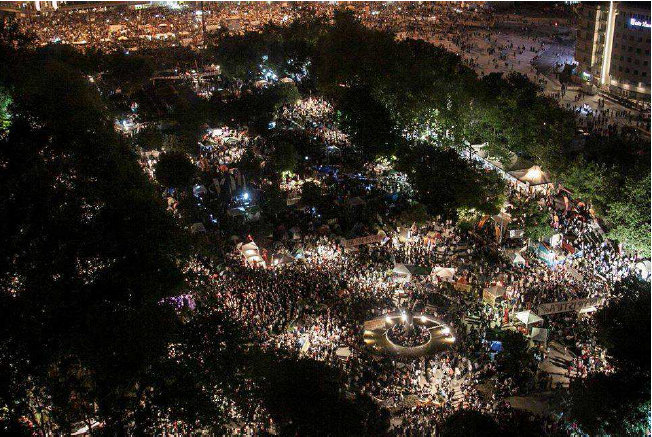
Above photo: Gezi Park, Istanbul on June 13, 2013 (Source: http://everywheretaksim.net)
Discovering the Commons: New Media, Social Movements and Social Cohesion
In her article on Opendemocracy.net, researcher Britta Ohm describes ‘Gezi’ events not as a solidarity movement or as something within the confines of an anti-government protest that international media have insisted on seeing, but as the tentative discovery of commonness through the very defense of commons.
We have previously mentioned the central role of post-materialist values, collective identity construction and the commons in new social movements in Part II; and in Gezi case, these seemed to have converged bringing about a new societal awareness, by uniting many different and opposing groups in the society and transforming former misperceptions and prejudices. Starting with a global common, ‘the environment’, with a protest against an imposed life style centered around consumerism as symbolized by trees versus shopping malls, the movement evolved into a crossroads, where people coming from different backgrounds and struggles came together, lived together and acted together that nurtured a novel understanding of societal ethics and co-existence.
In fact, Turkish politics and underlying power struggles have long been shaped on ideological, ethnical and religious fragmentations based on pragmatic aims and symbols. This resulted in a conversion of innate differences or cultural and ethnic identities, which actually form the cultural richness of the country, into political instruments that caused counter-positioning and labeling of societal segments and actors, which were structurally or sometimes artificially constructed: the socialist, the nationalist, the liberal, the conservative, the religious, the anarchist, the marginal; the elite, the intellectual, the worker, the peasant; the Turkish, the Kurdish, the Christian, the Jewish, the Muslim, the Secularist, followed by the sub-divisions: communitarians, ultra-nationalists, Kemalists, Kurdish Democrats, Kurdish nationalists, Sunnis, Alevis and so on.. These fragmentations and counter-positionings also caused an emergence of a more restricted political arena in terms of rights and freedoms, as the attitudes and behavior of social actors were shaped rather reactively, according to the symbolic material position of ‘counter’ parties 24 and with an attempt to confine this position at the cost of fundamental rights and equality.
Here, it would be worthwhile to note that Turkey is not an exception in this regard: the situation has been quite similar in the entire world, though the nature and intensity of conflicts based on these fragmentations and the associated politics may vary in line with the specific contexts of individual countries and their levels of democratic development.
Since the World War II, nationality-based fragmentations started to give their way to ideological divides (capitalism vs. communism / right vs. left) turning the ‘hot’ conflicts to ‘cold’ wars; with increased globalization these grew into increasing ethnical divides; and finally after 9/11, into religious divides and rising conservatism, which became the central focus of world politics. In fact, this is very much related with the modern and postmodern constructions of identity and the priority given to the instrumental reason in conceiving and defining the ‘other’.
In the context of Turkey, it should also be acknowledged that the accession talks with the European Union, which officially started in 2004 after a long process of economic and strategic partnership dating back to 1960s, and the seemingly selective approach undertaken in this process –i.e. granting of accession to many Eastern European states despite evident shortcomings in their democratic and economic development- also resulted in a more conservative approach in Turkish politics, turning its face to the East. Though the conservative approach of the government and its reliance on cult-based Gulen community was no secret from the start of the 10-year ruling of Justice and Development Party, the repression formed by the government’s policies on the non-conservative and secularist segments of the society and the reflections of these on rights and freedoms became more evident with the start of organized crime litigations targeting officials of armed forces and all other opponent persons and groups. As government policies and measures became more and more restrictive, the more devastating consequences these created on the freedom of expression, freedom of assembly and freedom of media, with many authors, thinkers and more than 100 journalists detained and jailed since 2007, not to mention the self censorships and growing number of pro-government media institutions. This repressing approach has also been reflected in new law proposals, policies and statements which could be viewed as interventions in private and public space and personal life, such as restrictions in alcohol advertising and sales, the proposed ban on abortion, closing of city centers to demonstrations, and continuing harsh attacks towards any kind of protests or opposing views. These could be interpreted as continuing the traditional repressive state legacy in Turkey, this time, under the masks of democracy. Any case, the result has been higher oppression of those societal segments being already oppressed, rising oppression towards non-conservative and secularist segments of the society, and serious damages to the rule of law.
In recent years, the discomfort has grown further with the government’s contested policies in many other fields, from urban development to environment, culture and health, from energy to neighborhood relations. On the other front, labour unions and student organizations were having their share from the government’s restrictive policies on the freedom of expression and assembly. In fact, the smaller scale protests by labour unions and opposition groups having started on May 1, with the closure of Taksim area to Labour Day celebrations, as well as the anti-war demonstrations following the bombing in Reyhanli, Hatay at the Syrian border on May 11, all targeted by heavy police attacks, have been the final straws.
Nevertheless, the process started with Gezi park resistance, has significantly shaken up the traditional patterns in Turkish politics. As political scientist Zafer Yilmaz note in his above cited article, citizen movements build political struggle not on stable subjectivities such as culture, ethnicity or religion, therefore avoid the two basic mistakes of modern politics: essentialism based on sublimating the subjects and reactivity. By producing axioms that enable conception of politics based on rights and equality, they rule out the battle of (counter) positions based on power struggle. With their civilian character, their call for recognition does not target the state (as it may be sometimes misperceived as the state and government represent the status quo), but the society where a right-based consensus is sought. Therefore citizen movements exhibit a progressive and democratic character as much as they can construct a rich-pluralist chain of demands, that is distant from hierarchical dichotomies and that can equally relate to other right demands.
Gezi protests, having positioned itself as a common struggle of various diverse groups representing different ideological, political, religious, social and cultural backgrounds, were quite successful in orienting public towards this end. Bringing together the socialists with businessmen, (anti-capitalist) Muslims with Atheists, nationalists with Kurds, and other previously divided segments of society in a platform of joint action and a shared living space, Gezi Park became a symbolic place providing the entire public an example of peaceful coexistence, sharing and solidarity based on commons. People from all backgrounds, who hardly knew each other, stood up together for their freedom and rights and acted jointly against police violence on the streets.
For around two weeks, the entire city center was closed to traffic and protected from police attacks with barricades, and the Park witnessed a communal life where there was no need for accommodation or money as people slept in the park inside tents and citizens showed their solidarity with ever increasing donations of food and other basic needs, which were shared with the residents and tens of thousands of people visiting the Park. In this self-sufficient environment without the presence of police, there were no security issues at all, which was quite surprising for a metropol famous with smash and grab. In fact, the ongoing announcements made to the public for leaving their doors open during heavy police attacks as an injured protestor may need a shelter to hide, transformed the understanding of security itself. This environment inevitably created a common spirit based on dialogue, understanding and respect, and directed the public to get to know each other, rather than categorizing the ‘other’.
The inclusiveness of this co-existence and the shared grieves was also reflected in the slogan, ‘Everywhere is Taksim, Everywhere is Resistance’, which triggered a wide scale support from almost each city across the country. With this common slogan, the title and aim of the nationwide movement was also mentioned the first time: ‘Resistance’. In addition to the involvement of political groups, worker unions and various left-wing organizations, the groups that were at the forefront of protests included Carsi, the supporter group of wellknown Turkish football team Besiktas, which managed to bring together the supporters of its two big rivals (Fenerbahce and Galatasaray football teams) in the protests; The Redhack, which is a Turkish computer hacker group known with its oppositional attitude; and civil society actors such as Lgbt (the lesbian, gay, bisexual and transexual solidarity movement), and Anti-Capitalist Muslims, which define themselves as an organization of Muslims aiming to struggle against capitalism.
Accordingly, the Resistance has been a turning point in enabling the society to develop a new understanding of itself: as a society that is open to all. It was not the representatives of various classes or ideologies on the streets; it was the people –even those without an established ideology- who marched down the streets with their “citizen” identity.
Speaking about the new societal awareness that have risen with Gezi events, we should first note that the Resistance provided a brand-new potential for dialogue in the long-term Kurdish conflict, which resulted in hundreds and thousands of deaths, countless unsolved casualties and displaced persons on both sides, and heavy societal wounds in Turkey in the last 30 years.
Emrah Ucar from Otekilerin Postasi (Mail from the ‘Other’), an emerging alternative media platform, explains this transformation process by giving an example from Gezi Park during its occupation by citizens. He draws attention that during the 18 days of civilian occupation, the group representing BDP, Kurdish Democrat Party officially existing in Turkey, hanged a poster of Abdullah Ocalan, the leader of PKK, who has been regarded as the chief of terrorists in Turkey, at their stand at the entrance of the park. Though many people and groups raised their discomfort and made warnings about this poster (mainly the nationalist groups and other groups that wanted to maintain the peaceful atmosphere in the park), this did not evolve into a major problem that could divide the protestors.
Ucar gives this example to emphasize how the people living in the park, as well as those supporting them by actively joining in the protests or solely visiting the park, learnt the importance of welcoming and co-existing with differences and viewing these differences as a plurality of views. For Ucar, these all point at the empathy and new ethics having emerged out of the Resistance, which is providing for a major transformation not only in the minds, but also in practice. This also holds true for religious and non-religious groups, which had become more distant, almost fragmented due to recent official policies. This is as well true for oppressed or marginal groups in the society; Alevis, non-Muslims, artists, gays and transsexuals, vegans and so on. In addition, although the core group of protestors was comprised of non-political activists, the political groups’ sharing of their experiences of protest, of police attacks, of organization and actions methods has many times been vital and brought different groups much closer. Ucar stresses that the result is the potential for a real societal peace, where consensus emerges from the streets, from real world encounters rather than negotiations made at official meetings; making a reference to the recent Peace Process undertaken by government with Kurdish officials, and the resulting Wise Men Council which was widely contested and proved to be meaningless after the real peace process initiated by citizens themselves during Gezi events.
In this regard, Lice protests were also a turning point. Following the civil protests in Lice, Diyarbakir on June 28 initiated by Kurdish villagers against a planned construction of a new military guard post, which was brutally attacked by gendarmerie with the use of arms and resulted in one death, several protests were organized in many cities across Turkey, where people from all societal segments provided their solidarity with Kurds and raised their voice against the killing. This event, which could stay as a minor event with a manipulated coverage in media one month before, has become a source of a nationwide discomfort and a symbolic solidarity with Kurdish people. This newly attained sensitivity towards the situation of Kurds, followed by the solidarity protests and campaigns 25 for Rojava in northern Syria, where Syria’s civilian Kurds are becoming the targets of mass crimes by Al-Nusra Front, hint at important transformations in the peace process between Turkish and Kurdish communities.
In their statements, the Kurdish side also report that they welcome Gezi movement with hope and trust, noting that the process started with Gezi events opened a space for democratic discourse and contributed to the solution process for all the communities living in Turkey, which requires a joint struggle for democracy.
Certainly, no protest can or is meant to last forever. So how to maintain this hardly won spirit? The public forums, which initially started in Gezi Park and then spread to local parks in central districts of many cities, act as one of the major tools in nurturing this process of social cohesion. In fact, the forums well represent the bottom-up, participatory, pluralist and decentralized approach of the movement. As one of the representatives of Abbasaga Forum in Istanbul notes, the open dialogue environment in forums enables the practice of direct democracy and healthy discussions, where the established mindsets go under deep transformations.
Pointing that enabling dialogue among the previously fragmented even antagonized segments of society –in particular the ultra-nationalists and Kurds, the nationalists and socialists, Islamists and secularists- was not easy at the start, forum representatives state that after a process of self-expression, empathy and self-criticization, it was possible to transcend the old misperceptions for a large part of these people. They emphasize that citizens became aware of the realities as well as the ‘constructed realities’ through communication. As the resistance grew out of commons and of acting together despite diverse backgrounds, those continuing their presence at the forums are now thinking and discussing how they can grow the resistance, how they can construct the future, and how they can act jointly on common aims in order to create the common life they desire for, where their demands are visible, voiceable and equally treated, instead of the life provided to them. Here, the emphasis is not on the result but the process, and how this movement may contribute to societal peace in a tangible manner would become evident in practice, in the long term.
The Community Houses, which have been actively involved in Gezi movement, also share these views. Representatives note that the process initiated in Gezi Park has gone far beyond the park and spread to the neighborhoods, local parks and houses all around the country, which brought about a genuine transformation in the mindsets, causing deep changes in the culture of thinking and living, where the differences have started to disappear.26
‘The key to social cohesion and peace is to avoid ‘othering’ the populaces and organize actions to address the common grievances of public, where people from all social segments come and act together without bringing political or institutional identities to the forefront’, says the spokesperson of Anti-Capitalist Muslims, one of the leading constituents of Gezi.
‘The identity of the oppressed is not important. We do not discriminate people according to identity, language, religion, colour, culture, or personal choices. We are interested in social justice and would step in when there is a violation of rights’. According to him, Gezi spirit has 5 main concepts: love, freedom, respect, pluralism and solidarity. The Lgbt movement, another important constituent of Gezi, also emphasize that they act against all kinds of discrimination and violence without any exceptions: ‘Democracy is for all, not for a specific segment of public’.
In summary, the opportunity of democratic participation and the experience of direct democracy in Gezi Park and in the forums thereafter presented brand new avenues for dialogue and a bottom-up peace process in the society, and showed that a broad scale citizen consensus and social cohesion could be realized by these kinds of movements, instead of peacebuilding attempts that are carried out behind the scenes, failing to include the citizens themselves.
So, how all these are related to new media?
First of all, without new media this kind of a nationwide organization of citizens would not be possible to attain or maintain, at least in the context of Turkey as it was experienced in previous revolutionary movements of 70s and 80s. In consideration of various examples and statistics provided throughout this case study, the power of new media in informing, organizing and bringing together people is quite evident. While Facebook posts, groups, events help to spread the word in one’s own social network.
Second, the new media have been, and seemingly, continue to be the major means of communication and information in Gezi movement. The protestors showed their independence from traditional media and the capability of forming their own information channels, not only through social media but also through alternative media sites, and perhaps more importantly, through internet livestreams that continue to cover public forums going on in the parks and other city spots.
Not only the protestors, but many people both from inside and outside the country –even the mainstream media- increasingly started to rely on new media channels for getting information and news. This hints at the breakdown of the traditional hegemonies over information and signifies a more democratic information flow, where new media may act as a watchdog of not only the right violations but also the process of social cohesion. The role of new media in enabling free and continuous communication among different societal segments, about their peculiar issues and grieves may not be disregarded.
Third, the new media contribute to the maintenance and sustainability of encounters made and relationships built during the protests and forums, whereby supporting the progress made towards social cohesion. Network connections have largely extended with the integration of various social media and face-to-face contacts (i.e. new encounters were added to social network contacts, Facebook users included twitter contacts in their network and many people started using twitter as well). It is also possible for forum participants and non-participants to follow the discussions and decisions from internet, at the general forum web site. In the future, these may even evolve into local sites for each forum27, meaning a communication medium for each local community in a larger network structure. Any case, citizens continue to receive updates and information, post comments and enter in discussions on new media channels.
This largely free and participatory environment provides yet another platform for promoting dialogue and understanding.
Considering the social media, the members of each related Facebook event, announcement or group, the followers of Twitter accounts of movement constituents, alternative media organizations, citizen journalists, activist groups and other participants -though they may not know each other personally- acknowledge that they are acting together on commons. This makes spontaneous re-organization quite easier.
The ease of organization would any case have political consequences as our information sources suggest: henceforward, when there is a protest, a meeting, a supporting event, a solidarity event or another type of action, people will join without much hesitation acknowledging their common aims and knowing that others would join. Latest experiences also confirm this point. In the case of Turkey, the protests started in late August, 2013 at the Middle East Technical University in Ankara to contest the construction of a highway passing through the forestland of this public university, have triggered nationwide protests as of September 6, which was continuing at the time of presentation of this study.
These all suggest that new social movements and new media are embedded in each other not only as a result of the ineffectiveness of traditional channels of communication, but also due to their inherent characteristics as participatory, pluralist and decentralized networks. While new media act as the basic medium of communication within and among social movements, the social movements fill the gap between online and face-to-face communication, eliminating the perceived dichotomies by bridging the social media and ‘the streets’. All the groups involved in Gezi protests agree on the benefits of using social media as an organizing field for real world events that would facilitate face-to-face interactions.
In general, what Gezi events showed is that new social movements, fostered by new and alternative media channels and networks, has a significant potential to act as a forum for dialogue and unite different segments of the society under the commons. It has demonstrated how a conflict itself, may actually be a means for transcending the societal divides and moving towards social cohesion.
See the full report here: NewMedia_and_SocialMovements_An_Analysis_of_Gezi Movement_DYuksek
Notes:
24 Yilmaz, Z. (2013), ‘Sivil Ha(l)k Hareketleri Niçin Yenilmezler? (Why Civil Movements Never Get Defeated?)’, Birikim, see at: http://www.birikimdergisi.com/birikim/makale.aspx?mid=987
25 http://bianet.org/english/world/149054-campaign-launched-in-yogurtcu-to-support-rojava downloaded on August 20, 2013
26 http://www.radikal.com.tr/turkiye/halkevleri_baskani_lgbt_ile_iliskimiz_gezi_ile_basladi-1146306
27 http://direnisforumu.org/