Above Photo: Jeffrey Smith
He may well try to govern as an authoritarian. Whether he succeeds depends less on what he does than on how civil society responds.
Whatever his intellectual and political gifts, Richard Nixon, the 37th president of the United States, was a cunning and dangerous criminal. For him, issuing illegal orders was literally just another day at the office.
One such day, in July of 1971 (nearly a year before the Watergate break-in), found him ordering his chief of staff, H. R. Haldeman, to execute a burglary. The president was exercised about politically damaging documents that he imagined were possessed by scholars at the Brookings Institution, a respected Washington think tank, where I now work. “We’re up against an enemy, a conspiracy,” Nixon railed, banging on the desk for emphasis. “They’re using any means. We are going to use any means. Is that clear? Did they get the Brookings Institute raided last night?”
Haldeman: “No, sir, they didn’t.”
Nixon: “No. Get it done. I want it done! I want the Brookings Institute safe cleaned out!”
Anyone who wants to hear the president of the United States sounding like a B-movie mobster will find dozens of examples on the Nixon presidential library’s website. Nixon compiled lists of enemies, tried to suborn the IRS and the CIA, demanded that Jews be investigated and fired (“You can’t trust the bastards”), created a personal black-ops team (the Plumbers), raised hush money and established slush funds, suggested engaging thugs to beat up protesters, proposed selling ambassadorships, spied on political activists, and orchestrated cover-ups. He remained in office for nearly six years, ultimately being forced out only because he made the astonishing mistake of recording himself breaking the law. Until the Supreme Court ordered the tapes turned over to a special prosecutor in July of 1974, Nixon still had enough support to survive a removal vote in the Senate.
If we get Strongman Trump or Infantile Trump, how would we protect our democratic institutions and norms? “Don’t be complacent,” warns Timothy Naftali, a New York University historian who was the founding director of the Nixon presidential library. “Don’t assume the system is so strong that a bad president will be sent packing. We have someone now saying things that imply unconstitutional impulses. If he acts on those impulses, we’re going to be in the political struggle of our lifetimes.” Meeting that challenge, I think, hinges on whether civil society can mobilize to contain and channel Trump. Fortunately, that’s happening already.
It’s tempting to think of Trump as a fluke, and to believe that at the end of his administration everything will return to normal. Many people hold a darker view, though—among them Yascha Mounk, the co-founder of a new watchdog group called After Trump. A lecturer on government at Harvard and a fellow at the New America Foundation, Mounk thinks the stakes are high. “Most people,” he told me, “are thinking about Trump as a policy problem: how he will lead to the deportation of undocumented immigrants or lead the U.S. to pull out of the Paris climate agreement. But I think Trump is also potentially an authoritarian threat to the survival of liberal democracy.”
Mounk is a 35-year-old German who studied in the United Kingdom before coming to the United States. He’s Jewish, and in Germany his Judaism made him an object of curiosity. “They thought of me as an outsider,” he told me. When we first spoke, he was waiting for his final immigration interview before taking the oath of U.S. citizenship. In America, he says, “It doesn’t matter what ethnicity you are, what religion you are. That’s where I want to live.” He sees America as the world’s preeminent example of multiethnic liberalism, a model he believes is under attack.
Mounk’s work first came to my attention this past summer, when he and Roberto Stefan Foa, of the University of Melbourne, published an article in the Journal of Democracy showing a decline in support for democracy in the West. The decline is alarming. In the U.S., the proportion of people saying it would be good or very good for the “Army to rule” rose from one in 16 in 1995 to one in six in 2014. Ominously, the trend was strongest among the young. When asked to rate on a scale of one to 10 how essential it was for them to live in a democracy, 75 percent of Americans born in the 1930s chose 10, but the proportion dropped with each succeeding decade, falling to only about 30 percent for people born in the 1980s.
The trends were similar in Europe. “I started looking at developments in Europe and also in the United States,” Mounk told me, “and started thinking that democracy was much less stable than people assumed.” In Hungary, the Philippines, Poland, Turkey, Venezuela, and other new and emerging democracies, authoritarian-minded populists had adopted versions of what Viktor Orbán, the prime minister of Hungary, has called illiberal democracy, which Mounk defines as democracy without rights. In Austria, Britain, France, Germany, Italy, the Netherlands, Sweden, and other mature democracies, authoritarian populists were gaining in popularity and clout.
Why? Mounk suspects the mutually reinforcing effects of three different but related social vectors. The first is economic anxiety. “In a lot of countries,” he says, “you’ve always had a very rapid increase in living standards from one generation to the next. That’s no longer the case in many countries in Europe and in North America.” Some of what always looked like unconditional support for democracy may actually have been conditioned on rising prosperity. The second vector is ethnic and racial anxiety: historically dominant groups’ perception (frequently accurate) that they are losing majority standing and the cultural status that goes with it. The third vector, Mounk believes, is growing economic inequality between urban centers and rural hinterlands. The United States in 2016 offered a particularly vivid example: Hillary Clinton carried only 472 counties, out of more than 3,000, but those 472 were predominantly urban and accounted for nearly two-thirds of the country’s total economic output. “No election in decades has revealed as sharp a political divide between the densest economic centers and the rest of the country,” write Brookings’s Mark Muro and Sifan Liu, who reported the data.
I’m a cautious optimist. After all, this isn’t the first time the U.S. has seen panic about an antidemocratic presidency. In 1828, many serious people believed that Andrew Jackson was an authoritarian who would impose military rule, and Jackson’s record provided real grounds for concern. “The phrase was that he was going to be an American Bonaparte,” says the Jackson biographer Jon Meacham. “He would become a dictator.” But the Constitution survived, and Jackson’s presidency, although controversial to this day, proved effective.
We have reason to hope that Trump will figure out how to be a modern-day Jackson. Anyone who over a five-decade career succeeds as a real-estate developer, an author, a television star, and now an insurgent politician clearly possesses adaptability and talent. But we also have reason to fear that he might use the powers of his office to violate court orders, encourage supporters to harass his political opponents, suborn the Justice Department or the IRS or other powerful agencies, circumvent Congress, or aggrandize and enrich himself. In an accompanying article in this issue (“How to Build an Autocracy”), David Frum imagines how a corrupt and corrupting Trump presidency might look. Just as important, however, is how it might not look: obvious.
What happened next, says Jack Goldsmith, a veteran of the Bush Justice Department, was unprecedented pushback from “giant distributed networks of lawyers, investigators, and auditors, both inside and outside the executive branch.” Goldsmith, now a professor at Harvard Law School, discusses the phenomenon in his 2012 book, Power and Constraint:
These forces swarmed the government with hundreds of critical reports and lawsuits that challenged every aspect of the President’s war powers. They also brought thousands of critical minds to bear on the government’s activities, resulting in bestselling books, reports, blog posts, and press tips that shaped the public’s view of presidential action and informed congressional responses, lawsuits, and mainstream media reporting.
In response, the Supreme Court and Congress weighed in to regulate and constrain Bush’s powers, and the result is a detention process that has its controversial aspects but fits comfortably within our constitutional norms.
The forces are already mobilizing. In the first five days after the election, the American Civil Liberties Union saw what it called the greatest outpouring of support in its history: more than $7 million from 120,000 contributors, a 25 percent increase in Facebook followers (to nearly 1 million), and 150,000 additions to its email list. By early January, the ACLU had raised an impressive $35 million online, from almost 400,000 contributors. Meanwhile, according to Politico, progressive donors were discussing “forming a liberal equivalent to the right’s Judicial Watch, which spent much of the past eight years as a thorn in the Obama administration’s side, filing legal petitions under the Freedom of Information Act.”
I have seen evidence of mobilization firsthand. Just days after the election, a friend told me that he and others were organizing a network of law firms willing to provide pro bono legal services to people fending off harassment or bullying by the new administration or its allies. Before November was out, the Niskanen Center, a center-right think tank in Washington, announced a project to bring together intellectuals and activists and politicians (especially Republicans) to make the case for liberal democracy, hold the line against incursions, and try to prevent Trump’s excesses from being normalized. “It’s important for people coming from the center and center-right to resist the forces and ideas coming out of the Donald Trump campaign,” Jerry Taylor, the center’s director, told me. “We’ll be keeping a very close eye on administration undertakings and events on Capitol Hill, and when things cross the line we will be energetically pushing back.”
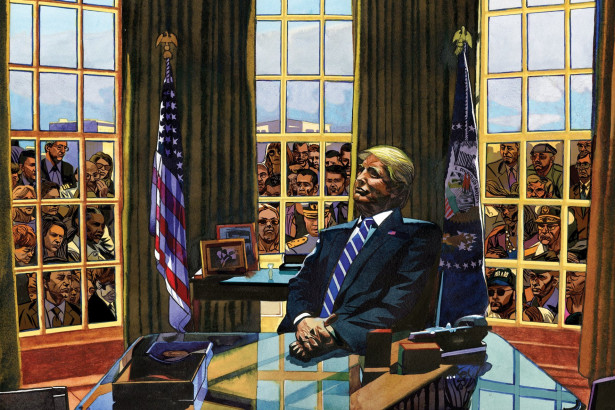
If you think it’s ridiculous to imagine that one nascent group, or even a handful of heavy hitters like the ACLU, could shift the orbit of Planet Trump, you’re right. The point is that a civil-society mobilization involves multitudes of groups and people forming a whole greater than the sum of its parts—the phenomenon that Goldsmith describes in Power and Constraint. Goldsmith calls the vast array of watchers focused on the president the “synopticon.” Today the synopticon is far bigger and more developed than it was in Nixon’s day. The White House and executive agencies are scrutinized by watchdog groups, mainstream media, bloggers, leakers, inspectors general, lawyers, and all sorts of others—sometimes to the point of impeding legitimate executive action, but also making abuses harder to hide or finesse than Nixon ever imagined.
But there’s a tougher problem we’ll have to confront: behavior by either the administration or its allies that is, in Goldsmith’s phrase, “lawful but awful.” As Benjamin Wittes, a Brookings Institution expert on legal affairs, told me, “The first thing you’re going to blow through is not the laws, it’s the norms.” By “norms,” he means such political and social customs as respecting the law, accepting the legitimacy of your political opponents, tolerating speech you disagree with, performing civic duties like voting and staying informed, treating public office with dignity, and not lying. Fervently and frequently, the Founders warned that the Constitution would stand or fall on the public’s commitment to high standards of behavior—what they called republican virtue. James Madison said “parchment barriers” could not withstand the corruption of democratic norms. George Washington, in his farewell address, said, “It is substantially true that virtue or morality is a necessary spring of popular government.” John Adams warned that “avarice, ambition, revenge, or gallantry would break the strongest cords of our constitution as a whale goes through a net.” When Benjamin Franklin was asked what kind of government the Constitution established, he replied: “A republic—if you can keep it.”
If Trump or his supporters (with his explicit or tacit approval) were to continue in the same vein as before he took office—by spreading disinformation, trolling or harassing opponents, mocking the intelligence agencies, and the like—outside groups couldn’t do much to stop them. Here is where a second aspect of Mounk’s effort, and that of Jerry Taylor and others, becomes relevant. Mounk’s most ambitious goal is to develop an appealing case for democratic institutions and open societies. “We need a positive vision of what politics can be after Trump,” Mounk says. “We need to build a new vision of how liberalism can improve people’s lives while pulling them together.”
Mounk acknowledges that he doesn’t yet know how to effect this mission. It’s likely to require revising the liberal-democratic social contract to meet the challenges of societies struggling with growing inequality, disappointing economic mobility, weakened institutions, and an angry, jaded public. It’s going to require a collective effort of activists and citizens and elites on several continents. Years will pass before we know whether liberal democracy can muster a new case for itself.
That said, Mounk’s core insight—that the work needs to get done—is sound. To help the body politic resist de-norming, you need to make an argument for the kind of government and society that the norms support. You have to explain why lying, bullying, and coarsening are the enemies of the kinds of lives people aspire to. Instead of pointing to Trump with shock and disgust—tactics that seem to help more than hurt him—you need to offer something better. In other words, you need to emulate what the Founders did so many years ago, when they offered, and then built, a more perfect union.