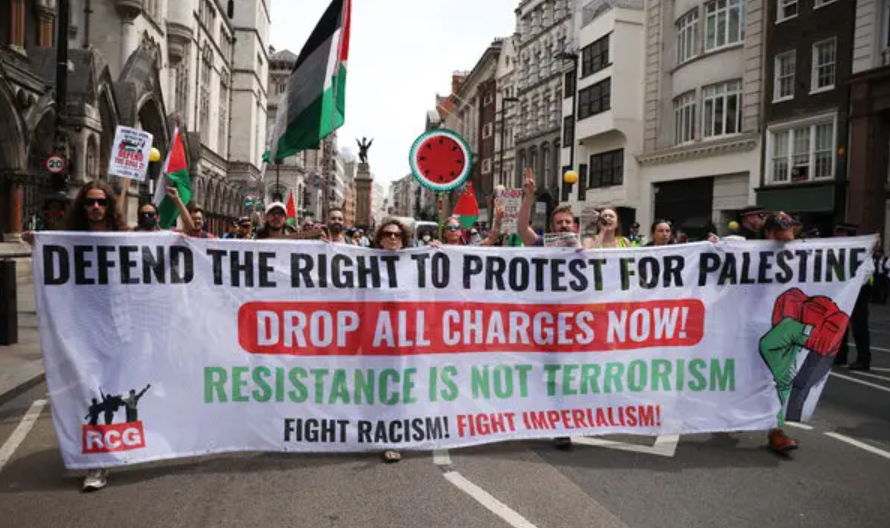
Above photo: New York Times.
Input for UN Thematic Report on Definitions of Terrorism.
The following was submitted by Chip Gibbons on behalf of Defending Rights & Dissent to Mr. Ben Saul, Special Rapporteur on counter-terrorism and human rights, in response to the UN’s call for input on definitions of “terrorism”, “terrorist organisation” and “violent extremism.”
Statement of Interest and Expertise
Defending Rights & Dissent is a U.S. based organization that defends the right to know and freedom to act in the domestic U.S. through grassroots mobilization, policy expertise, public education, and advocacy journalism. As we were founded during the McCarthy-era to oppose the House Un-American Activities Committee, the bulk of this work has entailed defending the right to engage in political expression in the United States. Political expression encompasses core civil and political rights recognized in international human rights law, including freedom to opinion, expression, assembly, and association.
Since the 1980s, defending the right to political expression has increasingly meant challenging the use of counterterrorism powers to stifle political speech. In 1999, we published Terrorism and the Constitution: Sacrificing Civil Liberties in the Name of National Security. Written by two eminent legal scholars, David Cole and James Dempsey, it analyzed how counterterrorism laws and mandates were being used to abridge core rights to political expression. This work was necessitated by continuous revelations throughout the 1980s and 1990s as to how in the U.S. counterterrorism authorities were used to monitor domestic political speech, as well as the dramatic implementation of new counterterrorism laws in the 1990s that criminalized speech and humanitarian activities formerly understood to be protected by core expressive rights. Following the September 11th, 2001 attack and subsequent War on Terror, this seminal work was expanded and republished in light of the further expansion of the U.S. counterterrorism bureaucracy. More recently in 2019, we published Still Spying on Dissent: The Enduring Legacy of FBI First Amendment Abuse. The report analyzed incidents taking place between 2010 and 2019 in which the Federal Bureau of Investigation (FBI) used a counterterrorism authority to monitor expressive activity. We are currently in the process of sponsoring a new work of scholarship, The Imperial Bureau: The FBI, Political Surveillance, and the Rise of the U.S. National Security State, which gives substantial focus to the use of counterterrorism frameworks to facilitate surveillance of political expression.
Although our experiences are limited to the U.S., we believe they provide important lessons about the threats to civil and political rights that counterterrorism enforcement poses. We also feel such lessons can be helpful when discussing how to define terrorism.
Terrorism Definitions in the United States and Problems for Civil and Political Rights
Traditionally, terrorism has been separated from other crimes by its political nature. Whether intentionally or unintentionally, this has opened the door for counterterrorism enforcement to be used to monitor or even prosecute political acts. The United States has not been immune. The United States has some of the strongest legal protections for political expression throughout the world. Conversely, it also has a long history of politically motivated surveillance carried out by domestic law enforcement and intelligence agencies. Concerns about the incompatible nature of such surveillance with the U.S. protections for free expression crescendoed in the 1970s, when limitations were proposed at all levels of the government to limit the gathering of intelligence on pure political speech. Since those human rights protections were proposed, purported concerns about terrorism have repeatedly been made to thwart them. Unsurprisingly, counterterrorism increasingly became the framework under which such surveillance was carried out. The fact that even in a country with protections for freedom of expression, opinion, assembly, and association as robust as the United States, those rights are threatened by counterterrorism enforcement shows the importance from a human rights perspective of taking care in defining terrorism.
In the United States, federal code defines both international and domestic terrorism as violent acts or acts dangerous to human life that violate criminal law, designed to intimidate or coerce a civilian population; influence the policy of a government by intimidation or coercion; and/or to affect the conduct of a government by mass destruction, assassination, or kidnapping. While these definitions are limited in scope, they are not reflective of wider U.S. counterterrorism policy.
For starters, neither definition is a criminal statute. Terrorism is prosecuted under a range of other statutes. Some of them specify that they are terrorism-related, but many of them do not. While these definitions limit terrorism to violent acts, many criminal statutes at “animal enterprise terrorism.” This offense is defined as “causing physical disruption to the functioning of an animal enterprise; and intentionally damag[ing] or caus[ing] the loss of any property (including animals or records) used by the animal enterprise.” Individuals prosecuted for terrorism under this statute have committed acts that fall far short of “violent acts or acts dangerous to human life.” They include animal rights activists who have removed animals destined to be slaughtered from private facilities or engaged in minor vandalism like graffiti.
Another U.S. law designates 57 preexisting crimes as “federal crimes of terrorism” and makes providing material support for their commission a felony. Some of these federal crimes of terrorism, like conspiracy to murder abroad, use of weapons of mass destruction, or hijacking, are crimes that involve acts dangerous to human life. However, other “federal crimes of terrorism” include nonviolent acts, like computer intrusion. Citing computer intrusion’s status as a federal crime of terrorism, U.S. prosecutors sought a terrorism enhancement against a public employee accused of giving information about CIA surveillance to the journalism organization WikiLeaks.
A second, unrelated U.S. law makes it a crime to provide material support to a “Foreign Terrorist Organization.” This law deliberately moves prosecuting terrorism away from acts that are dangerous to human life that violate criminal code to creating a guilt-by-association framework based on blacklists. Under this framework, the Secretary of State creates a list of designated Foreign Terrorist Organizations. After designation, it becomes a crime to provide any material support to a blacklisted entity. “Material support” includes more than just aiding, abetting, or providing the means to carry out criminal acts dangerous to human life. In fact, such actions were already illegal prior to this “material support” statute. The law also prohibits coordinated political advocacy, training in international humanitarian law or peaceful conflict resolution, and even provisions of humanitarian aid. All of these acts would be otherwise lawful if not for the fact they were dubbed material support for a blacklisted entity.
Traditionally, these blacklisted organizations are involved in acts of violence. However, recently the U.S. has moved away from limiting designation to groups who participate in mass casualty events or are combatants to armed conflicts, to designating groups who engage in nonlethal street brawling. Some of the blacklisted groups by the U.S. government’s own admission have not only armed wings, but political wings or even wings providing social welfare services. In some cases, these groups are a de facto governing party or have been elected to their nation’s legislature. Supporting the political or humanitarian programs of these organizations, or even just coordinating with them, is deemed criminal.
In addition to the Foreign Terrorist Organization designation, the U.S. also cites its International Emergency Economic Powers Act to sanction global terrorists. The sanctions regime imposes many of the same restrictions as the material support statute and similarly creates penalties. While all Foreign Terrorist Organizations are sanctioned under this scheme, it has also been applied to groups not involved in any violence. This includes humanitarian and human rights organizations.
In addition to prosecuting acts of terrorism, the United States maintains a vast surveillance structure predicated on counterterrorism. Many targets of this surveillance are never charged with any crime. This surveillance is nonetheless pernicious as it allows the government to gather information on political activities.
The lead agency for investigating both domestic and international terrorism in the United States is the Federal Bureau of Investigation (FBI). The FBI is a hybrid law enforcement and intelligence agency with responsibility for investigating violations of federal law, threats to national security, and collecting foreign intelligence. Both investigations of threats to national security and foreign intelligence collection are not limited to investigating violations of federal law. In both national security investigations and foreign intelligence collection, the FBI may investigate “international terrorism.”
Domestic terrorism investigations are in theory limited to violations of the law. However, when investigating domestic terrorism, the FBI defines an act of terrorism as a “criminal act which involves an individual(s) who seeks to further political and/or social goals wholly or in part through activities that involve the use of force or violence and violate federal law.” This definition does not limit its scope to acts dangerous for human life. For example, the FBI investigated members of a pacifist religious organization as terrorists after unknown individuals committed vandalism at a U.S. military recruitment center in protest of the U.S. invasion and occupation of Iraq. Although such vandalism was likely only a misdemeanor at most, the FBI considered it a “use of force.” Since that use of force was tied to a political statement, the FBI considered it an act of domestic terrorism. The Department of Justice’s Office of Inspected General, an internal U.S. government watchdog, expressed concerns “about whether the FBI has expanded the definition of domestic terrorism to people who engage in mainstream political activity, including nonviolent protest and civil disobedience.”
The problem isn’t just that the FBI investigates nonviolent crimes as terrorism. We at Defending Rights & Dissent have reviewed FBI files where the Bureau investigated as terrorism political activity without any plausible nexus to criminal activity. These investigations are enabled by terrorism’s (or “violent extremism’s”) definition of being in furtherance of political or social goals. Since the September 11th, 2001 attacks, the FBI has adopted a “preventative” approach to counterterrorism. While seeking to use intelligence gathering to prevent and disrupt terrorism before it occurs seems noble, the FBI treats political speech as inherently suspicious. Whereas international terrorism enforcement in the U.S. focuses on blacklisted Foreign Terrorist Organizations, domestic terrorism enforcement is focused on persistent extremist movements. FBI internal classifications categorize terrorism investigations by the political beliefs of the suspect, using such labels as “anarchist extremist,” “Black Separatist Extremists,” “Animal Rights and Environmental Extremists,” or “Puerto Rican Independence Extremists.” FBI agents are given definitions of extremists citing specific political views, like opposition to capitalism or police racism, and told to find potential terrorists before they strike.
Definitions of terrorism pose fundamental concerns for civil and political rights. Definitions that include minor property damage or vandalism open up the door for nonviolent crimes, including civil disobedience, to be investigated as terrorism. Acts that might otherwise be labeled small-time misdemeanors are elevated to terrorism. Other definitions of terrorism that focus on blacklisting organizations and banning support for them broadly turn otherwise lawful political speech or even humanitarian aid into serious terrorism felonies.
Even when terrorism is defined more narrowly, the inherent nature of defining crime based on its political intent poses serious problems. By making political intent a part of the offense, governments seeking to prevent terrorism treat political speech as a potential precursor to terrorism. It also creates a pretext that governments seeking to spy on political speech can easily manipulate in bad faith.
Recommendations
Separating out unlawful acts committed for political motivations from those committed for apolitical reasons always runs the risk of singling out political speech or ideas. As a result, we fundamentally question the wisdom of distinguishing between crimes committed for political reasons, as opposed to those committed for apolitical reasons. However, we propose that any definition of terrorism be limited to:
- an act of criminal violence
- that intentionally poses a substantial risk to human life
- not committed in an armed conflict zone by an actor who is part of an armed conflict
We believe these limitations are necessary in putting the focus on criminal violence, not on political speech or ideology. Terrorism must only apply to those carrying out the violent act in question, not those who may provide nonviolent political or humanitarian aid to a group otherwise engaged in terrorism. We have deliberately chosen a definition that excludes property damage that does not occur with the intent to harm human life or a substantial risk of such harm. This is based in large part on our experience as a domestic organization in the United States, where minor acts of vandalism that occur during political demonstrations or with political motivation are elevated to the level of terrorism.
The definition has two other important components as well. It excludes both state and nonstate actors who are parties to an armed conflict and are acting in an armed conflict zone. This is not because we think these are lesser offenses. To the contrary, as an organization that advocates for accountability for war crimes, we recognize that these are some of the most serious crimes imaginable. However, we believe international humanitarian law, or other applicable laws, like the Convention on the Prevention and Punishment of the Crime of Genocide, are the correct legal lens for prosecuting such crimes, not counterterrorism laws. Counterterrorism should be solely a matter for domestic, peacetime law enforcement.
While this definition excludes both state and nonstate actors in armed conflicts, it includes both state and nonstate actors outside of armed conflict zones. This specification is again borne of our experiences as a domestic U.S. group. On September 21, 1976, former Chilean diplomat Orlando Letelier and his colleague Ronni Moffitt were assassinated by a car bomb in Washington, DC. Letelier was a fellow at the Institute for Policy Studies and an advocate against the Chilean military dictatorship of Augusto Pinochet. The attack was carried out by agents of Chilean intelligence, as part of Operation Condor, a transnational campaign of state violence. Although this was a state act, the extrajudicial killing of a political opponent and noncombatant constitutes a quintessential act of terrorism.
Conclusion
Freedom of opinion, expression, and association are core civil and political rights recognized in international human rights law. Overly broad or imprecise criminal definitions have endangered these rights by transforming civil disobedience or minor crimes committed by political actors into terrorism. Counterterrorism schemes that rely on blacklisting organizations and prohibiting support for them have allowed governments to criminalize pure political speech, association, or even provisions of humanitarian aid by otherwise law-abiding individuals with no connection to violence.
While the threat of such imprecise definitions is self-evident, even narrower definitions can still imperil core civil and political rights to freedom of opinion, expression, and association. By separating out certain crimes for the label of terrorism from identical acts based on their political nature, governments open the door to treating political speech as a precursor to or even a key element of terrorism. As governments frequently treat terrorism as an extraordinary threat justifying exceptional powers, the use of political ideology to trigger the terrorism label is particularly troubling.
As a human rights organization predominantly defending the right of opinion, expression, assembly, and association in the U.S., we have witnessed firsthand how imprecise or overly broad definitions of terrorism can threaten even those rights, even in a country with a robust legal framework to protect them. Our experiences lead us to question the wisdom of distinguishing crimes based on a perceived political intent of the perpetrator. When responding to terrorism, governments must focus on violent criminal acts that substantially threaten human life, not political opinions or associations. While violent crime that threatens the right to life is deplorable, the correct framework to address violent crime, whether rooted in political or apolitical motivations, is normal, peacetime domestic law enforcement with robust protections for due process and privacy.
To accomplish these ends, we urge that any definition of terrorism be limited only to acts of criminal violence that intentionally pose a substantial risk to human life and are not committed in an armed conflict zone by an actor who is part of an armed conflict.