My guest today is Dr. Margaret Flowers, a Maryland pediatrician who left her practice to become a full-time advocate of the single-payer health care system. In her capacity as a spokesperson for PNHP [Physicians for a National Health Program], we’ve done three interviews on that topic. She is co-director ofPopularResistance.org.
JB: Welcome back to OpEdNews, Margaret. What is Popular Resistance and what are its goals?
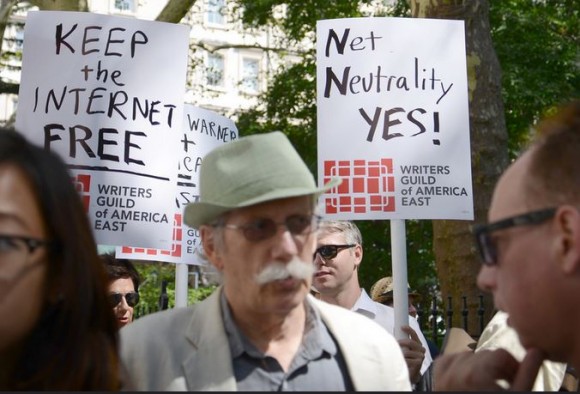
MF: Popular Resistance is a daily movement news and resource website that covers the broad movement for social, economic and environmental justice. We also provide tools and information to activists for organizing and developing strategy. And we run a number of campaigns, particularly on issues that connect people across issues. For example, our campaign to stop the Trans-Pacific Partnership includes groups that work on food and water, health care, worker rights, Internet freedom, the environment and more. Our campaign on Net Neutrality similarly unites people.
JB: Let’s turn to Net Neutrality now. What’s going on with that whole issue at the moment?
MF: This is a critical time for the future of the Internet as we know it. When the Internet was created, it was classified as a Common Carrier which meant that it was essentially a public utility like water or electricity. In 2002, Michael Powell, who was head of the Federal Communications Commission (FCC) and is now head of the industry lobbying group, changed it to an “information service” which meant that the government had less ability to regulate it.
Since then, there has been increasing consolidation of Internet service providers by the Big 3: Comcast, Verizon and AT&T. They have sued the FCC in order to gain greater ability to monetize and control Internet service.
The most recent case in January pushed the FCC to change its rules regarding the Internet. It was leaked in May that the current chairman Tom Wheeler was going to propose weak rules that favored the Big telecoms. The rules would open the door further to destroy net neutrality. Net neutrality essentially means that the service providers can’t control content and that all people have equal access to content on the Internet.
In response to Wheeler’s proposal in May, millions of people mobilized and pushed the FCC to reclassify the Internet as a common carrier using Title II of the Telecommunications Act. Wheeler added that to the agenda for public comment. Over the summer almost 4 million people submitted comments and more than 99% favored Title II reclassification.
Recently Wheeler hinted that he would propose what he called “hybrid” reclassification which means that he would call it reclassification but instead of full Title II, it would contain loopholes that the Big Telecoms could use to skirt net neutrality. Again, there was a large public outcry and even President Obama came out publicly for full Title II reclassification.
Wheeler still refuses to say that he will listen to the public and president and reclassify the Internet. We must remember that he is a former head of the telecommunications industry lobbying group. So, we must continue to pressure the FCC to represent the interests of the people, not those of the industry.
JB: So, the fact that Wheeler is a Democrat doesn’t really play into the equation here. His first loyalty seems to be to the telecom giants. Was he counting on public apathy or ignorance to pull this one over on us? And how much of a difference does it make that the president came out, finally, for full Title II reclassification?
MF: The President appointed all five of the FCC commissioners, three Democrats and two Republicans. Despite running on a platform that strongly favored net neutrality, the President appointed Wheeler to be the chair and even bragged that Wheeler was the Bo Jackson of the industry because he won awards from both the telecommunications and broadband industries. John Oliver made the analogy of having Wheeler in charge of the Internet was like having a dingo in charge of babysitting.
It is amazing that Wheeler can continue to ignore a clear mandate from the people, from tech companies and small businesses calling for Title II reclassification. If the FCC were representing the public and not the giant telecoms, we would be well on our way to Title II.
The FCC is currently stalling the process. They announced this week that there will be no vote on the issue at the next FCC meeting on December 11. The next meeting after that is January 30. This delay gives the telecoms more time to oppose net neutrality and means that we must keep the momentum going to pressure the FCC.
The President’s support for Title II was delayed and was probably a response to persistent public pressure including protests at his fundraisers and the poor performance by Democrats in the recent election. They can’t afford to lose the net neutrality base which is mainly young people and tech companies. However, his support is important because it gave permission for many others who support net neutrality to be public in their support and made the national consensus in favor of reclassification very visible. In the end though, the President and Wheeler have both made it clear that the FCC is an independent agency. The ball is in Wheeler’s court.
JB: Is this a case of the president abdicating responsibility? Could he play a bigger role here? If not, and we’re forced to rely on Wheeler, what more can the public do?
MF: Publicly the President is saying that it is up to the FCC to decide, but we do know that the White House has intervened in policy decisions made by agencies in the past. So, the President could play a bigger role behind the scenes and might be doing that. We can’t count on that, and so we must continue to pressure the FCC.
We have come farther than anyone could have imagined over the past 8 months. In May, it looked like weak rules would be the outcome but, with heavy pressure over a two week period which included an occupy encampment outside the FCC, Title II was put onto the agenda. A record number of public comments and consistent actions at every opportunity have made some form of Title II inevitable. Now it is our responsibility to make sure that we achieve full Title II.
If people want to get involved, we urge them to take the action pledge at PopularResistance.org so they can receive action updates. We’ve organized national days of action and protests at the FCC. We also have a campaign called “My Voice Matters” where we are asking people to submit photos of themselves calling for Title II net neutrality. It is particularly important that people of color submit photos because the NAACP and Reverend Jesse Jackson have taken money from and have sided with the industry on this issue, not with the people.
JB: That’s very disturbing.
MF: Yes it is.
JB: Can you explain exactly why and how the Big Telecoms skirting Net Neutrality could be so damaging to the rest of us? Lots of us get the idea in principle but the details are foggy.
MF: If we lose net neutrality, we will lose our freedom of expression and ability to communicate freely on the Internet. We’ll lose access to information about what is actually happening. The events in Ferguson, MO triggered a national response to police brutality because of the stories, photos and videos shared through social media. These important voices cannot be suppressed.
Losing net neutrality will begin a cascade that will turn the Internet into a platform like cable TV where the giant telecoms will control access to content. Those websites that have the money will have faster and fancier service that will dominate the Internet and the rest of us will be less visible. And telecoms will be able to sell packages like cable where people will only have access to the content they can afford.
The Internet has become an essential tool in our lives. We use it to communicate with friends and family, to find and share information, to get access to goods and services, to find jobs, to report news and to organize around important causes. It is used by small businesses to find customers and by tech companies to create new products. It is a place where people can work together to solve problems and it fosters creativity.
If we lose net neutrality, we will lose the Internet as we know it. And it will particularly hurt those who are most vulnerable and who won’t be able to afford access. That is why we see net neutrality as a fundamental issue.
Our goal is to win net neutrality by having the Internet be reclassified as a common carrier and then to go farther than that and push for universal and affordable access to high quality Internet. The US lags behind other countries in the quality of our Internet services. Just as we do in health care, we spend the most for Internet that is poor quality in comparison. The places in the US where there is universal access and the fastest service are areas where they created municipal Internet service providers. When you make access to the Internet a public utility and take the profit out, you have the best results.
JB: Great idea. I assume other countries must have a similar conflict between the telecoms and the people. How do they handle this issue, Margaret?
MF: Recently in Hungary, the government proposed an Internet tax that would decrease access to the Internet and thousands of people protested in the streets and even threw old computer parts at the headquarters of the major political party. When the government said it would lower the tax, tens of thousands protested and the government backed down.
We need to show a similar level of resistance here in the US.
If the US eliminates net neutrality, it may lower the standard globally because even though we often don’t merit it, the US is seen as an example for the rest of the world.
JB: Thanks so much for talking with me again, Margaret. It’s always an education. Okay, readers: you know what you have to do. So, go out and do it and let’s save the Internet before it’s too late!
***
PNHP website
My past interviews with Dr. Flowers for OpEdNews:
Dr. Margaret Flowers on the Upcoming Supreme Court Decision and the Future of American Health Care April 2, 2012
Update on Single Payer from Dr. Margaret Flowers, January 16, 2011
Interview with Dr. Margaret Flowers, Arrested Tuesday on Capital Hill, two parts, May 7-8, 2009