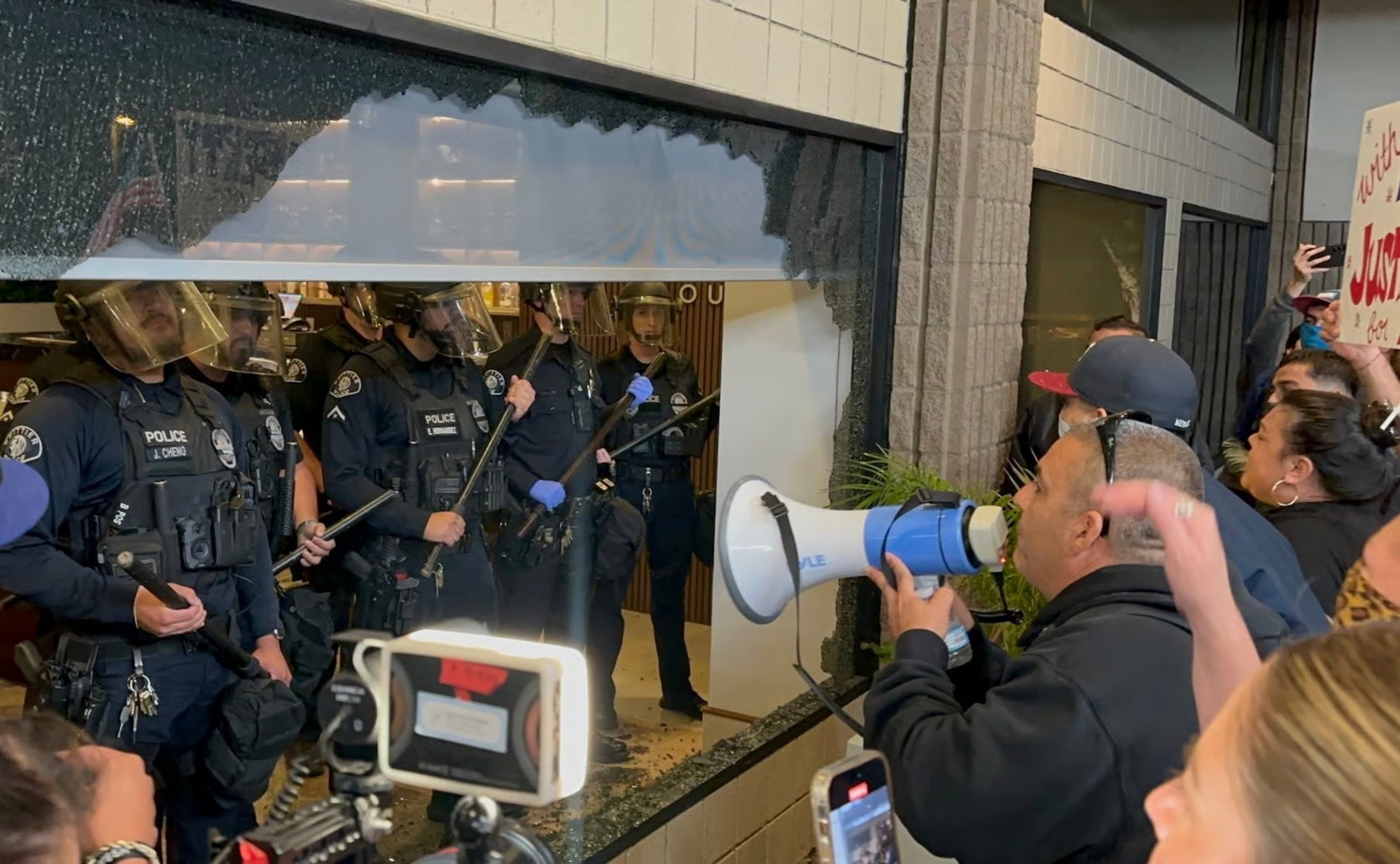
Above photo: Protesters confront police officers through a broken window during a demonstration at the DoubleTree by Hilton Whittier Los Angeles on June 11, 2025. Sean Beckner-Carmitchel.
Communities Are Trying To Make Sure They Can’t.
When federal agents checked into a Pasadena hotel, they didn’t expect hundreds of protesters and a day laborers’ band — now the tactic that kicked them out is spreading across LA.
It started as an “ICE sighting” on the morning of June 8. Someone had sent in a photo of federal immigration vehicles parked at the AC Hotel in Pasadena that circulated in rapid response group chats and on social media.
The community members, including day labor and faith-based organizers who first rushed to the hotel, found most of the workers had left out of fear. And those who remained were “pretty upset” that federal agents were asking people about their immigration status “in an aggressive way,” said Jose Madera, the director of the Pasadena Community Job Center, a day laborer center.
“And that’s how they put it, ‘in a very aggressive manner,’ asking for documentation and asking where they were from … the people that were cleaning their rooms, cooking their food,” said Madera, who talked to several people to corroborate what happened.
But the workers were not alone. In response to a surge in Immigration and Customs Enforcement operations that began in the Garment District nearly two weeks earlier, people felt drawn to rally around them. Slowly at first, and then quickly, people started turning up. By early afternoon, hundreds of people were there. They were noisy, buoyed by the sounds of a band born out of a 1995 ICE raid, Los Jornaleros Del Norte, singing “chinga la migra,” to a familiar pop tune, “La Del Moño Colorado.”
Among the earliest to arrive was Hector Rivera, who described himself as a community activist. He felt his presence was needed. “It seemed like it was important for people to be there … it felt like it mattered,” he said. Elected officials joined him, including Pasadena City Councilmember Rick Cole and state Senator Sasha Renée Perez.
The group that had gathered wanted to drive out the federal agents.The protest resulted in immigration enforcement vehicles driving out of the hotel that evening to the cheers of protesters yelling “fuera ICE.”The protest outside the AC Hotel to drive out ICE is likely the first of its kind and has opened a new front of resistance against the immigration raids that have roiled LA County since June 6.
People now frequently turn out in the evenings at hotels where ICE agents are believed to be staying, to bang on pots and pans and play sounds on bullhorns to prevent the agents from having a good night’s sleep. They also hope that the disruption will put pressure on hotel management to turn immigration officials away.
The rally at the AC Hotel kickstarted more protests the next day, in Monrovia, and then Arcadia after that. There were also rallies at a hotel near LAX and in Downey. Protests now happen daily across Los Angeles and its surrounding cities.
Hotel Protests Spread To Other Cities
On Monday, June 9, Danielle, a member of the Foothill Community Democrats club, was making her way to the marches in downtown LA when reports of federal authorities staying at a hotel in Monrovia started coming in. Danielle asked that her last name be withheld to avoid being doxxed.
Inspired by the AC Hotel protest, she said club members started chatting about organizing an action in Monrovia. An hour and a half later, at 11 a..m., they were in front of the Courtyard Marriott in Monrovia with signs.
“We did it because we saw it in Pasadena,” Danielle said. “It looked very impactful, what the protests have turned into.”
Danielle described the effort to get ICE out of hotels as “very strategic” compared to mass demonstrations and marches, which can be a good show of force but often don’t include a “call to action.”
She said that since the protest in Monrovia and another at the Hilton Garden Inn in Arcadia, Foothill Community Democrats have also spread the word about doing a calling campaign, in which volunteers call area hotels to ask if ICE is staying on site and to tell those hotels that ICE is not welcome. She said that while there is not always verification of whether ICE is staying there, the calls are meant to put pressure on hotels not to consider hosting them.
Protesters Say Commitments Are Needed
According to Teto Huezo, who helped organize a demonstration at the Glendale Hilton where federal authorities were believed to be staying, demonstrators want commitments on the record from hotels not to lodge ICE and federal agents. The community turned out for three days of protests from June 10 to 12.
After a delegation of protesters had gone to talk to hotel management on June 12, a hotel worker came out to tell demonstrators that they had decided not to have government workers staying at their hotel. Protesters recorded the interaction, though LA Public Press could not independently verify the hotel’s policy change with management.
“It’s important to get the commitments on video or in writing,” said Huezo, whose background is in labor and community organizing. “We… want to make sure they’re being held accountable. Wherever protests are happening, protesters actually need to get together and approach hotel management with a demand to stop. That needs to happen everywhere.”
Lizbeth, an organizer with the Harriet Tubman Center in South LA, said she and other center workers joined the Glendale Hilton protest on June 12 to support community members. They posted video of the protest, including a portion where someone who identified as hotel management said that government employees were no longer staying at the hotel and would not be allowed to do so.
LA Public Press reached out to Hilton, but did not get a response.
Another Instagram post shows Lizbeth calling on additional community members to make sure that ICE isn’t staying in area hotels. “We will not tolerate any harm to our community, and we are asking all communities to please stand in solidarity and ask hotels not to house ICE. It is not safe for our community to have ICE here,” she says in the video.
In an interview with the LA Public Press, Lizbeth said that communities are “being terrorized” by federal immigration agents.
“ A lot of people are afraid to even go out to buy groceries,” she said. “ We need to do everything that we can to get [ICE] out. And if our community does not have rest, they shouldn’t either.”
‘I’m Extremely Worried, But This Is Important’
Huezo says Los Angeles has a strong and proud history of organizing, but what is happening right now is scarier and, he said, it is important not to fight back alone.
“We used to be able to feel like we could count on laws and due process, and it doesn’t feel that way anymore,” Huezo said. “This is also much more militarized than what we’ve seen [under past administrations]. The president is calling all of these military branches to Los Angeles, and he’s not being responsive to court orders.”
“I’m extremely worried,” he said. “But this is important.”
Lizbeth said the protests are also bringing negative attention to the hotels as businesses. “I think that we as Angelenos are making the statement that you know, when I have family in town, I’m not going to choose those hotels that are housing ICE,” she said, adding that companies that rent hotels for conferences should pay attention to whether these hotels also welcome ICE agents “that are here to terrorize and kidnap our community members.”
Many of the claims about federal agents’ presence and interactions at hotels come from activist and community sources and local elected officials. Hotel management companies and federal agencies either did not respond to requests for comment or provided conflicting accounts, making independent verification of specific incidents difficult.
Local and federal officials have challenged these protests. City of Pasadena Public Information Officer Lisa Derderian told LA Public Press that management for the AC Hotel and the nearby Westin Hotel told the city that no ICE agents were staying with them. On June 17, the city posted this information on Instagram and asked the public to “please respect the rights and privacy of their guests and employees,” after protesters demonstrated outside the Westin Monday night.
Derderian said the federal agents staying at Pasadena hotels were “protective services for federal buildings and that was [clearly] written on their vehicles,” though she did not provide photos for verification.
Pasadena Mayor Victor Gordo, who reportedly attended the AC Hotel protests, told the LA Times that Homeland Security vehicles were parked at the hotel and that agents who were there to protect federal buildings in downtown Los Angeles had left because of the protest. Gordo did not respond to a request for comment from the LA Public Press.
In an emailed statement, DHS Assistant Secretary Tricia McLaughlin said, “Attacks and demonization of ICE have resulted in officers facing a 413% increase in assaults. DHS has the ability to trace phone numbers and track location information. Any individual who participates in the doxxing of our brave federal immigration agents will be identified and prosecuted to the fullest extent of the law.”
Neither McLaughlin nor other DHS officials elaborated on how that percentage was calculated.
Other public officials who came out in support of the AC Hotel protest backed up the accounts that federal agents were there. State Senator Sasha Renée Perez, who represents Pasadena, posted on Instagram on June 8 that her office had spoken to AC Hotel staff, who shared that “immigration officers questioned staff who were serving them, causing many to panic and leave.” She called the questioning “disgustingly shameful.” In a statement emailed to LA Public Press, Perez reiterated that the federal agents’ actions were “unacceptable.”
“I’m proud of the peaceful community protesters who showed up, exercised their First Amendment rights and sent a strong message to the federal government that Pasadena opposes these cruel and violent immigration raids,” she added. “We will continue to make our voices heard loud and clear.”
Neither the owners of the AC Hotel and the Westin Hotel Pasadena nor Marriott International, which owns both brands, responded to requests for comment.
Community Is ‘Stronger Than The Government,’ Activist Says
Adriana Bautista, an activist in the Pasadena and Altadena area, who took part in the AC Hotel protest on June 8, described what is happening as unusual, requiring a stepped up response.
“This level of authoritarianism demands more from the people themselves,” she said.
But Bautista said that this response might not be what many picture. What is powerful about the people, she said, is how much they care for each other.
“Many of us had just heard ICE was at that hotel,” she said. “Within the hour … already we were making arrangements, bringing water and refreshments,” Bautista said. “That is the level of care that doesn’t get reported [on] a lot.” Instead, when people do show up, these movements get sensationalized as being violent, she said.
According to Bautista, the foundations of the efforts around what happened at the AC Hotel are strong, and might be “stronger than the government.”
That was evident when the Pasadena Community Job Center, which has built its roots in the community for decades and was set up by the National Day Laborers Network (NDLON) to “amplify the voices of day laborers,” quickly came to their community’s aid when the fires broke out in Altadena in January, by organizing the community to remove trees and debris, she says.
The job center was able to do things “in a way that was not possible for the government to do,” she said.
Madera said NDLON has been trying to give people the tools and ability to effectively organize themselves through “mass committees” or “comités.”
They are “encouraging community folks to form a group or comité in their neighborhood or in their apartment complex or in their school or in their soccer league … to organize the people that are around them,” he said. And as federal authorities conduct multiple raids across LA County, including one in Pasadena on June 18 in which six people were taken, according to an NDLON press release, those tools are needed more than ever.
The rapid response network that first answered the call for help around an ICE sighting at the AC Hotel had sprung up through a comité, Madera said.
“One organization … one person can’t defend everyone,” he said.
‘Me Being Terrible Will Be Amazing’
Alex Quintero, a labor organizer who lives in the LA area, said she was inspired by the hotel protests to pick up an old trumpet she hadn’t played since she was in the sixth grade. She brought it with her as she went with two friends to a protest outside the Glendale Hilton at 11 p.m. on June 11, after a full day of work.
Quintero, who is the daughter of a custodian and is inspired by the janitors union that fought back against police, said brass instruments can be “annoying as hell,” especially when the person playing one is out of practice, like her.
The point was to make it too uncomfortable for the federal agents to stay in town: “Me being terrible will be amazing,” she recalled thinking.
She played her trumpet outside the Glendale Hilton for two hours straight until her lips blistered. She says she was trying to help emphasize people’s chants with her trumpet-playing by mimicking the beat of them. And she said she plans to keep going at the next protest.
The moment is dark, and she said she has been feeling a sense of “overwhelm” and depression about what is happening. But going to these actions has actually “uplifted my spirit,” Quintero said.
While Trump may be picking on people who seem vulnerable, Quintero said it is those with the least, in LA such as janitors, who have proven that LA can fight back.
“The one thing about anger is it mobilizes you to take action, and I think that’s a moment that we’re feeling,” Quintero said. “Obviously, there’s a lot of fear, but there’s also a lot of inspiration.”
Update: 5:15 p.m., June 20, 2025 This story has been updated to include additional comments from Pasadena Mayor Victor Gordo clarifying that the federal agents were part of the Department of Homeland Security’s Federal Protective Service.