The American passenger rail renaissance is well-under way! Sold out trains, highly successful new services, and (justifiable) frustration about high ticket prices because of it. This is only the beginning. FY2024 was Amtrak’s most successful year in history with record ridership and record revenue. Americans, loudly and clearly, want more passenger rail travel options. Our limited existing services are already oversubscribed. Now is the time we need to work to meet the moment and bring passenger trains to more people in more places as part of a truly interconnected transportation network. They are truly engines of economic growth.
A True National Vision
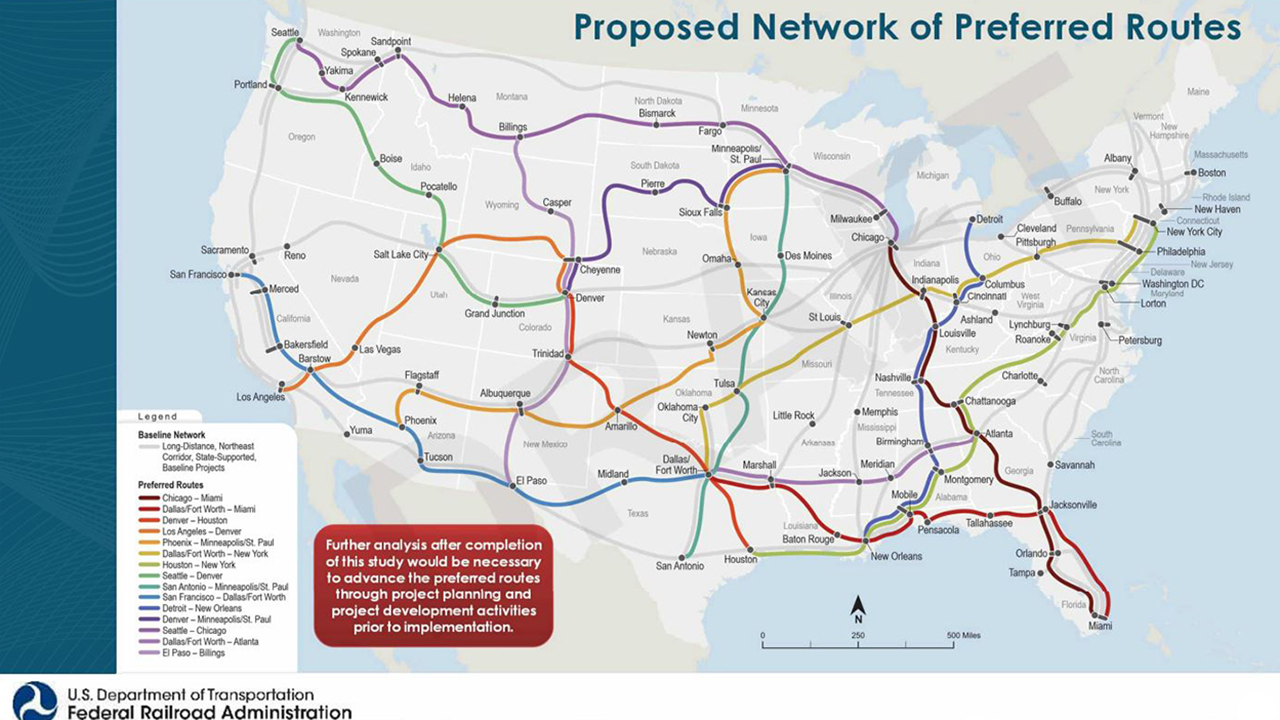
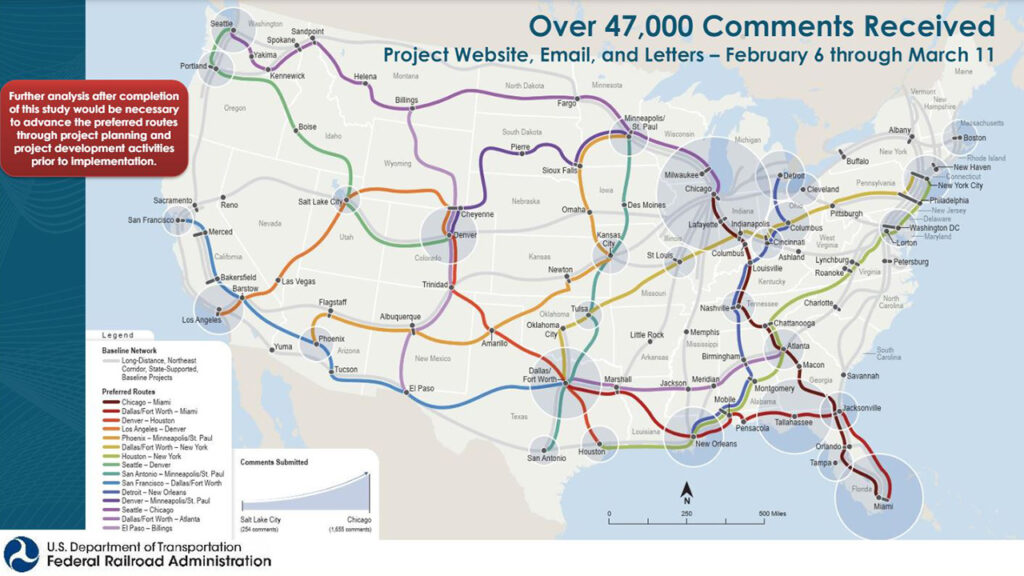
For the first time in the Amtrak era, we are close to a true nationwide vision that includes the entirety of the lower 48 states. The combined visions of the Amtrak ConnectsUS map, the Corridor ID Program and the FRA Amtrak Long-Distance Service Study provide a comprehensive vision of what passenger rail should look like. This is long-overdue, despite some gaps. Each route is critical to the success of the National Network. We must support all routes and connections.
Pitfalls of the Past
While we currently have much momentum, we must guard against the pitfalls of the past to ensure that these recommendations come to fruition.
In 1992, the FRA designated five high speed rail corridors nationally, but Congress didn’t fund them or develop them further. The “Floridian Passenger Rail Service Reestablishment Act of 1993” went nowhere. In 2009, the FRA again designated 10 high-speed rail corridors. The 2008 Passenger Rail Investment and Improvement Act (PRIIA) studies on the North Coast Hiawatha and Pioneer recommended both routes for reinstatement but neither were funded or implemented by Congress. Dozens of other routes have been well-studied across the country.
It is time for a different approach, one that not only embraces a comprehensive and coordinated national network but provides an organizational structure and funding to implement it. We need a new Federal National Passenger Rail Commission to coordinate the Corridor ID Program and enact the FRA Amtrak Long-Distance Service Study.
The argument that we must “fix Amtrak first” has resulted in stagnation and decline, not growth, of our passenger rail network. Congress has consistently failed to fund passenger rail at the level needed—a commensurate level to the federally subsidized highway, aviation and inland waterway networks—in order for passenger rail to grow and thrive. The recent layoffs announced by Amtrak are also highly concerning.
Actions for Congress
- Fully authorize the 15 new long-distance routes recommended by the FRA.
- Fully fund the infrastructure and equipment required.
- Enact the 15 routes ASAP! It took less than 10 years for the US to put a man on the moon, from concept to reality. For the benefit to our environment and society, we must make a commitment to complete the entire route structure recommended by FRA by a date certain, rather than on a piecemeal basis over an indefinite period and over multiple administrations.
A National Vision, A National Federal Commission
A new National Passenger Rail Commission, funded and empowered to act, is the fiscally-conservative small-government option. Rather than 48 (or 49) duplicative disjointed efforts of 48 individual (sometimes feuding) states, the Commission will be an efficient, better coordinated utilization of public funds to fast-track route development, construction, and implementation. It will be a single point of contact for host freight railroads rather than multiple (often uncoordinated) contacts over many different disparate projects and regions. We should establish a consistent methodology of collaboration and expectations with hosting railroads while recognizing varying traffic levels and other nuances route-to-route.
These routes are interstate routes serving interstate commerce and transportation, so we need an interstate federal mechanism to create and oversee them.
What Would Such a Federal Commission Look Like?
The new federally led National Passenger Rail Commission would be a new independent entity under the Department of Transportation and autonomous from the Federal Railroad Administration, Surface Transportation Board, Amtrak, and State DOTs/Governments. This new national entity should be modeled after the highly-successful United States Railway Association (USRA) that set up Conrail out of the bankrupt northeastern railroads in the 1970s. This was a railroad solution to a railroad problem.
In the words of the late Jim McClellan, who worked at the USRA at this pivotal time:
“I have worked with many boards in my career (most after my USRA days), and I remain impressed with the quality of those board members. Each and every person worked in an unbiased fashion and there was virtually no posturing. It was an honest and largely apolitical effort to get the right answer.”
Rush Loving Jr. describes the USRA in the book “The Men Who Loved Trains”:
“The bill also gave USRA more power than DOT or the ICC over the restructuring of sick railroads. This concept of giving more authority to an agency outside the executive branch collided head-on with [USDOT Secretary] Coleman’s belief in the way government was supposed to be structured. One key point he failed to take into account was Congress’s intent when it had created USRA. The agency had been set up as an independent authority to immunize it from political pressure by Congress or DOTwhen it carved apart the Northeast’s rail lines. The congressional leadership had never wavered from that concept and was not inclined to do so now.”
A Call to Action
The large-scale federal approaches of the past show us that comprehensive nation-wide visions are the way to garner congressional support. Every single route identified by the Long-Distance Service Study process is feasible and critical for inclusion. Every route is worthy of creation no matter how it scored in the ranking metric or how much it might cost to construct and implement it. The importance of one route to contribute to the network effect of the National Network cannot be underestimated. Efforts to undermine the long distance study or remove any routes will result in few, if any, new routes being implemented.
We cannot let the conversation devolve into a zero-sum mindset if we hope to move forward as a nation and deliver the world-class passenger rail services Americans deserve. The value of these so-called “long-distance” services isn’t for the largest of communities that can be served but for the smallest that can reasonably be served. These routes provide a single-seat ride in many overlapping city pairs. All current and new routes must be upgraded to twice-daily service to provide daylight departures to every station stop.
Side note: Alaska, Hawaii, Puerto Rico, and U.S. Territories—I don’t claim to know what their unique transportation needs are but want to give them a nod of support here, too, in addition to making a call for passenger rail across the full contiguous 48 states. They are our fellow Americans and deserve every bit of our support for their unique transportation considerations, whatever that may look like for their specific circumstances. Both Alaska and Hawaii have interstate highways and receive Federal highway funds.
Parting Words of Wisdom
- “It’s not rocket science” – Gene Skoropowski, Former California Capitol Corridor JPA Director
- “Build the Damn Train” – Eric Goldwyn (NYU Marron Institute) & Charles Marohn (Founder of Strong Towns)
- “Don’t let perfect drive out the good” – Jim Hagen, former Conrail Chairman, President and CEO and USRA Director
- “A National Passenger Rail Network or Nothing” – Senator Kay Bailey Hutchison (R-Tex.)
Enactment of the Long-Distance Study findings is the first crucial step to creating a truly national, National Passenger Rail Network. $9 Billion will go further for passenger rail across the Great Plains or Gulf Coast than it will for a beautification project in Washington D.C.
“People live here!”
Dan Bilka is Co-Founder and President, All Aboard Northwest; Coordinator, Greater Northwest Passenger Rail Coalition, South Dakota. The comments included here are his own and not any organization with which he is affiliated.