
Above photo: DC Central Kitchen in southwest Washington DC.
How Social Enterprises Can Make Your Work More Sustainable.
In 2022, my friend J. Howard (“Jim”) Kucher wrote a book with co-author Stephanie Raible called Social Entrepreneurship. I want to say a few things about the book but I should first explain how I learned why we (meaning especially, we people who hang out in the non-profit world) need more social enterprises.
About a year ago, Jim invited me to a group conversation and open house at a place called DC Central Kitchen in southwest DC. I really knew nothing about the place beyond the fact that they had found a great way to recycle waste food from area restaurants into a meals program for the homeless.
I figured we would be meeting in a cramped little room next to a noisy commercial kitchen at an area church.
But as we used to say in my Texas hometown, au contraire. In 2023, DC Central Kitchen relocated to the Klein Center for Jobs and Justice where its team found themselves with a 36,000 sq. ft. bi-level space hosting a large community kitchen, a training facility, and an urban food hub.
After having launched in 1989, DCCK has grown to $40 million in annual revenue, offering over 300 living wage jobs, and supported by 11,355 volunteers. The 2,200 graduates of their culinary training program have an 89% success rate in area job placements. With some 36 millions pound of food recovered so far, it’s not surprising their model has inspired 60 similar organizations around the U.S.
There’s another big factor in DCCK’s success—it’s not a conventional non-profit but a social enterprise. That means it is able to generate independent revenue (which is discretionary income, not tied to any grant guidelines, etc.) as a way of counter-balancing the revenue from local donors and foundations.
Here’s the DCCK’s revenue breakdown for 2024:
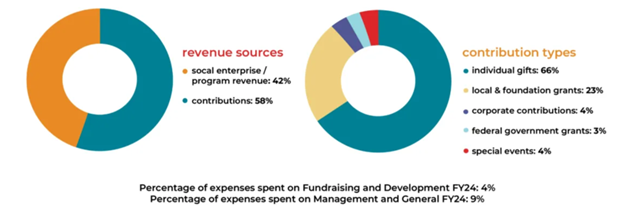
You’ll note that 42% of DCCK’s revenue last year was from programming—tbeir 3 cafe locations, catering services and contracted food services.
Jim Kucher has been preaching the need for non-profits to realize they are a uniquely American failed experiment in many respects. For all the good work they do, most nonprofits remain in a precarious financial condition because they do not choose to offer paid services, whether through misplaced fears of the IRS or a lack of familiarity with basic business practices.
Determined to understand this situation better, I picked up a paperback copy of Kucher and Raible’s Social Entrepreneurship. Its dull-looking cover screams “college textbook” but the well-written contents were quite a surprise.
The book is a small encyclopedia of both aspects of social enterprise, combining a history of social work with a short primer on business fundamentals. The authors discuss the history and special characteristics of social enterprises (the term arose in the 1980s), along with guidance on various kinds of tools (iteration, test markets, pivoting, etc.).
But their focus is on helping the reader understand we’re talking here about measuring outcomes rather than outputs. Thus the language and the business models for social enterprises differs from that of for-profit entities. We speak of “social ROI”, “social return”, “psychic income”, and stakeholders (rather than shareholders).
Kucher and Raible also offer insights into frameworks such as asset based community development and the social business model canvas.
Not that in these times the authors are the only proponents of moving beyond non-profits. Michael Shuman, editor and publisher of the Main Street Journal, recently posted on the topic “Non-Profits: the Least Effective Vehicles for Social Change.”
With the usual sources of nonprofit funding going away, time to get creative—and even become the good kind of entrepreneur—social entrepreneurs.
