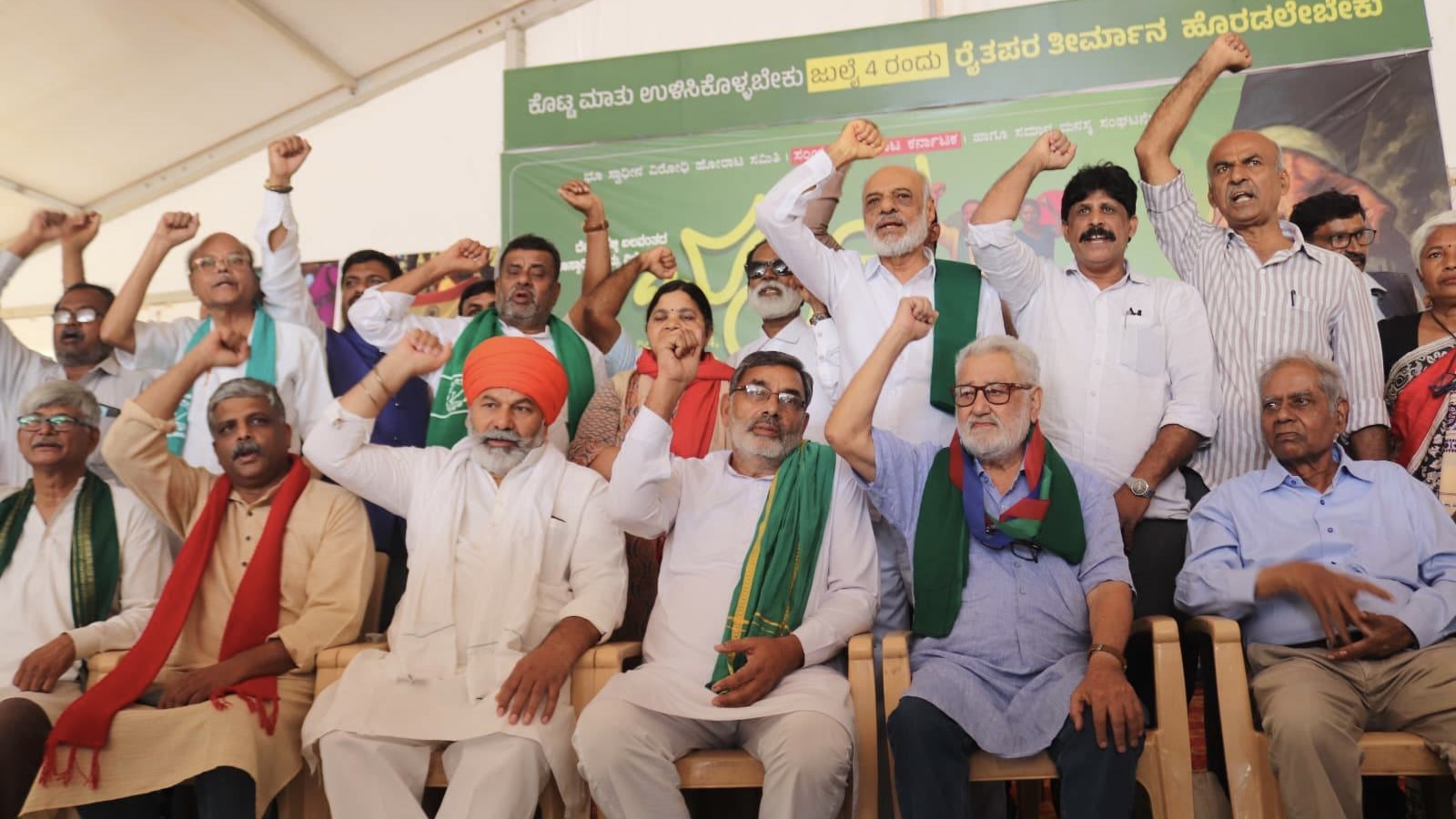
Above photo: Thousands of farmers and workers rallied at Freedom Park on July 4 along with AIKS leader Vijoo Krishnan against forcible acquisition of farmland. AIKS / X.
Against land acquisition in southern India.
Under the cover of industrial development, the Karnataka state government is forcibly acquiring thousands of fertile acres of farmland for real estate profiteering, farmer leader Yashavantha told Peoples Dispatch.
On the 1,188th consecutive day of protest against the forcible land acquisition from the farmers of 13 villages in the southern Indian state of Karnataka, its Chief Minister (CM) Siddaramaiah met with movement leaders on July 4.
As a “gift” to the CM, the delegates carried mangoes, flowers, and seasonal vegetables grown on their threatened land, highlighting the fertility of the 1,777 acres his government is acquiring, allegedly for real estate interests.
Hinting at his willingness to retreat, his office released a statement after the meeting, explaining that his government needed 10 days to examine the legal complexities involved in reversing the acquisition process for which his government had already issued the final notices this April.
“A meeting with farmers will be held” on July 15 “after resolving the legal hurdles,” Siddaramaiah said.
Resistance continues
Until then, the farmers will continue their protest, shifting its center from Freedom Park in the state capital, Bangalore, to the 13 notified villages of the Channarayapatna hobli (a cluster of villages grouped for revenue administration).
Located about 50 km northeast of Bangalore in the Devanahalli Taluk (sub-district), near the international airport, this hobli has remained mobilized since protests began on April 4, 2022, with a demonstration outside its Nada Kacheri (a citizen service center).
While sustaining the protest at this site, the farmers also marched on “each Independence Day since, held a convention every 100 days and a larger one on the 1000th day,” recollects T. Yashavantha, general secretary of the farmers’ union, Karnataka Prantha Raitha Sangha (KPRS).
In the course of this protracted struggle, farmers have endured several rounds of detentions, dozens of police cases, and injuries, he added. “Despite two surgeries, one farmer is yet to recover full sight after his eye was damaged in a baton charge under the previous far-right BJP-led state government”, which first issued the preliminary notification for this land acquisition in January 2022.
“80% of the farmers had refused their consent in writing at the time. Today, more than 95% are opposed,” he added.
Land Acquisition Act protections bypassed
The Land Acquisition Act, 2013 requires the consent of at least 70% of the landowners for projects under public-private partnership, and at least 80% for private projects, which is the case here.
To bypass this requirement, the state government instead issued the notification under the “draconian Karnataka Industrial Areas Development (KIAD) Act, 1966,” protests Yashavantha. “But what industrial development are they doing?”
Real estate profiteering under the cover of industrial development?
While the government claims it needs this land to facilitate the development of a defense and aerospace park, it has already acquired “6,000 acres in multiple stages for this purpose since 2014. However, 90% of this acquired land remains vacant, with no industrial development on it. It is being handed over to real estate interests under the cover of industrial development,” Yashavantha told Peoples Dispatch.
Most farmers who lost their land during this acquisition are left with no livelihood today, he added. While up to Rs 1.5 crore was promised as compensation per acre, “25-30% was siphoned by brokers for the paperwork. Revenue officers bagged another 10% as bribes to update land records. Another 60% had to be distributed among their legal heirs. What was left in the end for the farmer who lost his land was a pittance.”
“Five acres of my land were acquired in 2019. We could not resist at the time because we were not united,” Nanjappa from one of the affected 13 villages called Nallapanahalli, told Peoples Dispatch. “Except for three factories and a few empty godowns for rent, no industries have been built on the land acquired from us at the time.”
He remembers bitterly that over 100 acres of the acquired land were handed over at a throwaway price by the then BJP-ruled government to build Chanakya University, affiliated with its parent body, the Rashtriya Swayamsevak Sangh (RSS) – one of the world’s largest and longest-running fascist paramilitary organizations.
The current CM, Siddaramaiah – the state’s opposition leader at the time – had pointed out that this land, worth Rs 300-400 crore on the market, acquired earlier from farmers at Rs 175 crore, was handed over to this institution at a mere Rs 50 crore. He condemned this as a “highly criminal and corrupt” move by “the BJP government”.
Congress party’s betrayal
His subsequent Congress government handed over another portion of this acquired land to the real estate giant Brigade Group to construct luxury apartments. “Neither the Chanakya University nor the Brigade apartments are industries. Facilitating these projects is not the mandate of the Karnataka Industrial Areas Development Board (KIADB),” Yashavantha protested, insisting that “industrial development” is merely a cover for corrupt real estate profiteering.
Siddaramaiah had won the support of the farmers ahead of the state assembly elections in 2023 by assuring that, if elected, he would stop the acquisition of these 1,777 acres and protect the farmers’ land. Far from keeping the promise, his government went on to issue the final notification covering 10 of these 13 affected villages by this April.
The final notification under the KIAD Act effectively means that the land’s ownership has already been transferred to KIADB, Yashavantha explained.
This notified land includes the 20 acres Nanjappa was left with after losing five previously in 2019. “I will be landless if the government grabs this too,” he fears, explaining that land is the only source of livelihood for his large joint family, including brothers, cousins, grandparents, nieces, and nephews.
Highly productive farmers condemned to a future in slums?
“We don’t have degrees. Farming is the only work we know. But we are highly productive farmers,” he adds proudly. Unlike the thousands of acres the government has already acquired – lying vacant while inflating in its value on the real estate market – “not a patch of my 20 acres is empty. We grow mangoes, bananas, grapes, seasonal vegetables; operate a poultry farm, and raise cows on it.”
The government “thinks it can take away our land as if it were a charity they had handed out to us. It is not. This is my ancestral property. It has soaked the sweat of my grandfather and father. We will resist to the end. Will not give up our land.”
Apart from his 18 family members, who each contribute their share to the diversified labor requirements, his farm is also the source of livelihood for the landless agricultural workers he hires on a daily wage.
“While pruning, fertilizing, and harvesting, I hire 50 to 100 people. Other times, it could be as low as 5. On a yearly average, I pay wages to about 15 workers daily. This is a very fertile land. It sustains many families. It is a shame that the government wants to grab it from us and give it to their real estate friends.”
An even more dire situation than Nanjappa faces Thimmarayappa from one of his neighboring villages, called Pollanahalli. Unlike Nanjappa, he is a small peasant, like most others affected by the acquisition.
His family of 12 makes a living growing fruits and vegetables, and rearing goats and cows, on the mere one acre they are left with after three of his original four-acre plot was acquired in 2019. It pains him to see the land acquired from him lying barren, put to no use at all, even as the government maneuvers to grab his last remaining acre.
If the government succeeds in acquiring the 1,777 acres it is eyeing, it would be the death knell for these 13 villages, Yashavantha foretells.
Left with no livelihood, the villagers will be forced to join the millions migrating from rural India in distress to the cities – sleeping on its sidewalks, bus stops, and railway platforms until they find work and save enough from their daily wages to rent a shack in one of its many slums.
Retreat or jail us: farmers tell the government
Such were the stakes when the farmers wrote a letter to the CM on June 24, asking him to choose between reversing the acquisition or sending “us all to jail permanently along with our families”.
“The government has already issued a final notice to vacate the land. Through this letter, we now issue a final notice to the government,” it added, giving 24 hours for the CM’s reply, failing which, “We will besiege the Taluk office [in Devanahalli town]… That will give you a reason. You can [then] jail us and clear the way for your companies.”
A day earlier, the government had dropped 495 of the 1,777 acres, announcing that three of the ten villages that were yet to receive the final notice would be exempted from the acquisition. This “divide-and-conquer” strategy did not work, said Yashavantha. The farmers of the three exempted villages continue to participate in the protests, demanding that the remaining ten villages also be denotified.
Bringing mud from all 13 villages to the protest in Devanahalli town on June 25, the farmers planted a sapling in it as a symbolic assertion of their unity. Around 5,000 other farmers, mobilized from across the state, flocked to the demonstration in a show of strength and solidarity.
Workers, women, artists, and oppressed castes mobilize in support
Artists – including popular movie actors – writers, and public intellectuals also joined the protest, alongside trade unionists, leaders of women and youth organizations, and leaders of historically marginalized castes.
Addressing the protest, Meenakshi Sundaram, Karnataka State Secretary of the Centre of Indian Trade Unions (CITU), said “our workers have sent us” with this message: “If we go on a strike for two or three days, we often won’t have our jobs left when we go back to the factory. But if our farmers are antagonized, we will not hesitate to shut down our factories.”
Later, toward the evening, as the crowd began to thin, the police, who had refused permission for the protest, started aggressive maneuvers, demanding the farmers vacate the protest site because it was inconveniencing the citizens.
“Are the farmers not citizens? Are the workers and ordinary people who have come here in their support not citizens? Until we get an assurance from the CM that the acquisition of all 1,777 acres has been reversed, we will not retreat. We don’t fear your jails, batons, and bullets,” said CITU’s state president Varalakshmi.
Police action
Scores of cops later used physical force to drag Varalakshmi and other women activists off the ground as they held arms and resisted till they were hurled into buses along with all the other leaders detained from the stage of the demonstration they broke up.
In custody at a police ground in Bangalore, they sang songs of resistance, danced, and sloganeered, reiterating their unbroken will to fight in speeches that continued until their release at midnight.
For the farmers – who in late-2021 “successfully brought the fascist-minded Prime Minister Narendra Modi to his knees and forced him to withdraw the anti-farmer laws” he had “rammed through the parliament in 2020” – CM Siddaramaiah is no match, Yashavantha said in his address.
State-wide protests
Condemning the police action, the Communist Party of India-Marxist (CPIM) held protests in all 31 districts of Karnataka on June 26.
Saluting “farmers of the affected 13 villages” for putting up a “fitting fight against big corporate powers”, the Samyukt Kisan Morcha (SKM) also condemned the police action. The SKM is an umbrella under which hundreds of farmers organizations had united to successfully fight off the central government’s pro-corporate farm laws.
Under mounting pressure, the CM had announced in the meantime that he would meet the farmers’ delegation on July 4. By then, the farmers and the people’s movements supporting them had regrouped at the Freedom Park in Bangalore on June 27. Farmers from different regions of the state continued to arrive in a relay to hold fort until the meeting with the CM.
School-going children from the 13 villages joined the protest on Sunday, June 29. By July 3, leaders of the coordination committee of the nationwide protest movement, which had forced the BJP-led central government to withdraw the farm laws in 2021, arrived in Bangalore from northern India, extending their solidarity with the farmers of the 13 villages.
“A new model for the struggle to preserve land”
While there are over a thousand protests underway against forced land acquisitions in the country, “most of them are only demanding better compensation. But the farmers of Devanahalli are fighting to save their land,” said Vijoo Krishnan, politburo member of the CPI(M) and the General Secretary of the All India Kisan Sabha (AIKS), to which KPRS is affiliated.
The resistance they have put up “is a new model for the struggle to preserve land,” he added in his address to the demonstration at Freedom Park on July 4.
Following the meeting of farmers’ delegates with Siddaramaiah that day, the CM’s Office said in a statement: “The government cannot take any actions contrary to the law. As the final notification has already been issued, there is a need to review its legal aspects.”
In response to the government’s seeking 10-days time to finish this process, Gopala Gowda, a distinguished judge retired from the Supreme Court, offered the CM in his address at Freedom Park later that day: “Come to me – I will personally draft the legal advice needed to remove all such hurdles, so that you can denotify as early as tomorrow.”