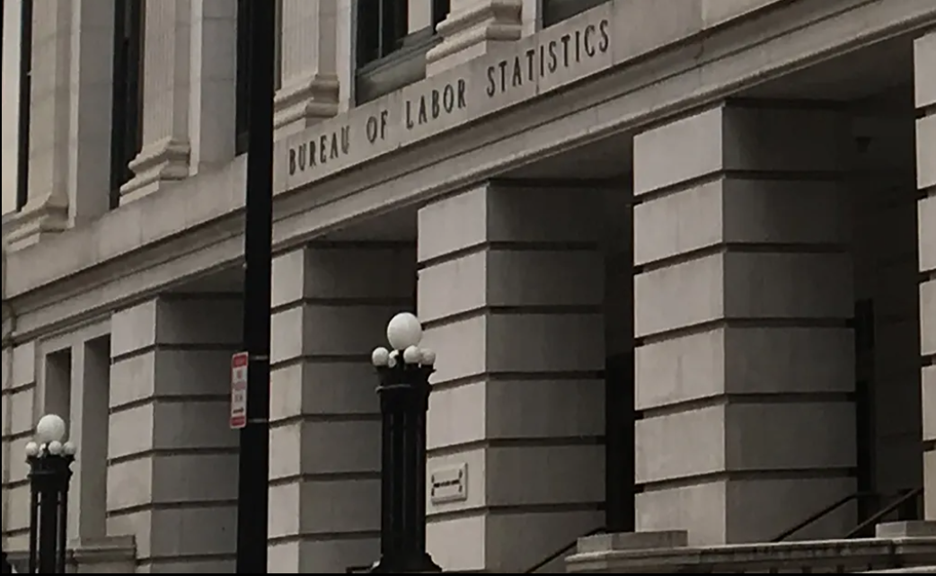
Above photo: Bureau of Labor Statistics building, Washington, D.C., February 1, 2018. Erica Fischer, CC/Flickr.
Monthly Jobs Report from the National Jobs for All Network.
In the Bureau of Labor Statistics’ Employment Situation for November, the official unemployment rate was 4.6%. That level is not particularly high by conventional standards. However, the rate has been creeping up. Furthermore, the National Jobs for All Network’s Full Count of this unemployment number, which includes more people who need and want jobs, is much, much higher at 10.9%.
Even the official numbers for specific categories, which are undercounts, are still quite high. The African-American rate was 6% not too long ago; in November it had risen to 8.3%. The official rate for black teens is now an incredibly high 31%. Many people are having a tough time finding jobs. Also, many people were laid off from the Federal work force, before the shutdown, during the shutdown, and after the shutdown. Blacks must have been especially hard hit.
The Full Count November 2025
Officially unemployed: 7.8 million (4.6%)
Hidden unemployment: 11.6 million
Total: 19.4 million (10.4% of the labor force)
[There are 2.5 job-wanters for each available job.]
Whites have an unemployment rate of 3.9%, which is about the mainstream level for full employment. But such a number seems out of touch with what is really happening. At times in recent months the media that I follow have been bursting with news about layoffs or shrinking job openings. Is it now a “low-fire/low-hire” economy? But aren’t firings increasing even while there is less hiring? Are workers reluctant to leave their jobs in search of better positions? Official quit rates don’t seem to have fallen much, but we have a new phrase: “Job Hugging.” Are phrases and feelings now more important than government numbers?
Some numbers are very negative, and not just for a month or two. Changes in the number of non-farm jobs, which the Bureau of Labor Statistics gets from employer reports, strongly support the view that job markets are deteriorating. Job additions were weak in some months of 2024, but at least there were six months when job adds were 200,000 or almost 200,000. In 2025 job growth has been a flop: Not a single month in which the total increased by at least 200,000. In three or four months, job totals actually declined or stagnated. And some of these cannot be attributed to the government shutdown or the way it messed up the collection of the data. Even some technicians in the government believe that the numbers may be worse than the official reports show. Fed Chair Jerome Powell believes the official non-farm job numbers grossly exaggerate job growth. He thinks job totals have been falling by 20,000 a month. That’s a shocker. Does Powell know something we do not? Is he just searching for a justification for the next interest-rate cut?
There has been positive economic news recently: overall economic growth for the third quarter was strong at 4.3%. Also, initial unemployment claims through the week ending on December 20 have been steady or falling a little over the last ten weeks. These two facts do not match what some of us are feeling about the state of the economy. Some commentators believe that the GDP growth indicators are an exaggeration. Others predict that even the official count of economic growth for the whole year might be well under 2%, which is not a recession, but it is not much prosperity either.
In any case, average and low-income households are not getting much help out of general economic growth. Ours is an extremely unequal economy. On Christmas Eve, MSNBC’s Ron Asana pointed out that the top 20% of the households account for 63% of consumption spending; the bottom 80% for 37%. Merry Christmas.
Manufacturing Jobs
In one particular area that was supposed to improve as President Trump’s tariffs took hold, there is nothing good to report. If you are a voter who wanted more factory jobs, you must be disappointed. If you promised the voters that there would be many more factory positions, you failed. This year factory jobs are down by 58,000. Nothing new. In Trump’s first term they fell by about 200,000 between January of 2017 and January of 2021. Seems like there is a lesson in here somewhere.
And look at the long-term trends. Although the non-farm labor force has grown by more than 20,000,000 since January of 2014, the total number of jobs in the manufacturing sector has not moved much. In 143 months beginning in January of 2014, total jobs in the factory sector have always been between 12,000,000 and 13,000,000 except for five months in the spring and summer of 2020 when they fell below 12,000,000 for a while. Overall, no long-term increases even though the economy is much bigger today.
Should we start telling the truth about manufacturing and give up the dream of going back to the good old days of ever-expanding job numbers in American factories.? Factory jobs sometimes pay well, especially if unionized, but they constitute a relatively small sector, and the number won’t get much larger. Imports and rising productivity will take care of that.
Shouldn’t we demand that politicians and big business leaders get on board for much higher minimum wages and enriched social programs? If the rich and powerful do not want to help raise the shamefully low federal minimum wage from $7.25 to a new starting point of $20 or so, they are obviously not serious about lifting the working class or about loving America, except as parasites love their hosts. Time to end the fantasies about “bringing back” the factories and also such insulting diversions and gimmicks as no tax on tips. The latter would help only a small number of workers, and it would not help the working poor at all. How about really using government for good rather than bad? Lift wages and benefits for the lower half, and directly create more good new jobs, as NJFAN has urged for years.
Aggressive positive federal action to get more good jobs will become even more important as millions of jobs are given over to AI. Here’s a swell headline. “Amazon Plans to Replace More Than a Half Million Jobs with Robots.” (Karen Weise, New York Times, October 21, 2025). Is there any way this can be good news for American workers? Many of us have a hate-love relationship with Amazon. Many of its current workers are not well-compensated. But where are the alternative jobs for them? Job-killing business and tech leaders may tell us that AI will free people up for better jobs—jobs that offer personal involvement and good compensation. Blah, blah, blah. Haven’t we heard this before? But it is my impression that they haven’t even bothered to try to fake us out. They know many of us are enamored of the new technologies.
Note: A useful and provocative article on many government numbers is Michael Hiltzik, “The Latest Inflation, GDP Data Are Worthless,” Los Angeles Times, December 29, 2025, A12. Another note: someone can investigate why more evidence of the dramatic weaknesses in monthly job growth in 2025 does not show up in the BLS’s JOLT tallies of job openings, quit rates, and layoffs.
Frank Stricker is a member of the National Jobs for All Network and he also writes for Dollars and Sense. He is the author of American Unemployment: Past, Present, and Future (2020).