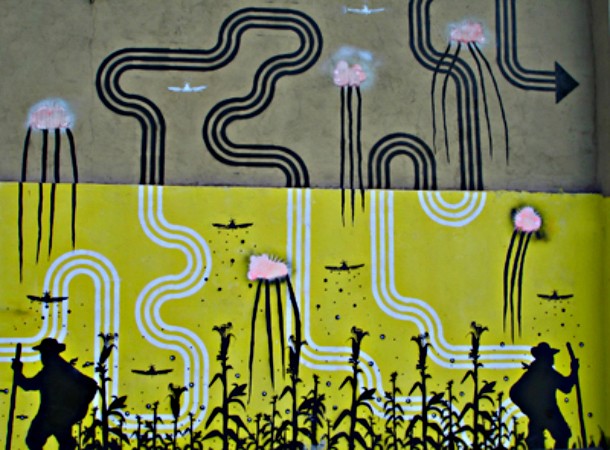
**Staff Note: There are around 5 million internally displaced people in Colombia. Please see this article for more on the displacements. Not all is due to civil conflict. Some villages are displaced by corporations seeking their resources.**
The Colombian city hosts the most citizens displaced from rural areas by the country’s ongoing civil conflict. A special program allows these domestic refugees to farm in the city.
MEDELLIN — In 2002, Aura Mosquera’s life changed forever. Civil unrest forced her from her home in a rural area of Antioquia, in northeastern Colombia. She arrived with her five children in Pinares de Oriente, a settlement in Medellin’s Comuna 8 neighborhood that was founded to host victims of forced displacement.
Like 650 others, Mosquera has been benefiting from a unique project spearheaded by the Architecture School of the Medellin branch of the Colombian National University. The project aims to use new urban agriculture techniques to partially reconstruct the rural social and cultural fabric for Medellin’s growing community of refugees from the countryside.
The new system of urban agriculture, which focuses on agricultural ecology and organic processes, has been the most important tool in the process of creating a collective “cultural memory” for more than 180 families of peasants who have been forcibly displaced from various parts of the country and settled in Medellin.

In Cali, Colombia — Photo: Neil Palmer (CIAT)
In 2012, Medellin had 37,938 residents who had been forced from their land in rural areas by armed groups — the most of any city in Colombia.
Carrying knowledge
Students, teachers and the displaced peasants work together to plant vegetable gardens, native plants and fruit trees. Building gardens and raising poultry and rabbits has both increased the communities food security and created a stronger community that has made Pinares de Oriente an oasis of peace within a sometimes dangerous part of the city, explained Guisela Quintero, a community resident.
“This project is key component in improving quality of life and environmental quality for an extremely vulnerable population,” explained professor Rafael Rueda Bedoya, the initiative leader.
For the past five years, residents in Pinares de Oriente have actively participated in workshops offered by the team from the National University. They have learned reforestation techniques, how to prepare organic fertilizer and construct sustainable habitats that contribute to repairing the environment in the area where the settlement is located.
Isela Quintero, who works with displaced peasants in Medellin’s Comuna 8, says that this project has allowed hundreds of people to reclaim their identity as farmers. Most importantly, it has given them hope that they will be able to start their lives over.
“When people are displaced, they carry knowledge with them, knowledge about how to care for and cultivate the land, and that knowledge should be preserved,” Rafael Rueda concluded.