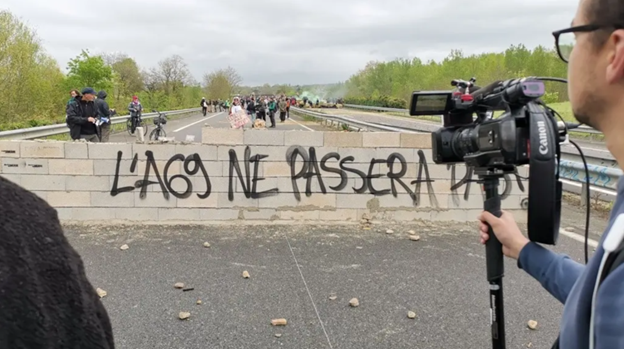
Above photo: A69 motorway protesters in France erected a resistance wall. CNV/Nadia Mejjati.
A group of nonviolent activists in France face heavy repression.
As they block the construction of an environmentally damaging new road.
In France an activist group called The Squirrels is at the center of a movement opposing the construction of a motorway extension from Toulouse to Castres — the A69. They are gravely concerned by the ecocide that this represents.
The project is highly contested due to protected species, ecological habitat and fertile agricultural land in its path, as well as a castle. Furthermore, the project’s opponents and the administrative court have deemed the A69 unnecessary and expensive. There is even a proposed, alternative plan to upgrade the existing road (the RN126) to suit the community’s needs.
The A69, if completed, would mean that those who can’t afford the toll would have to reroute, increasing traffic through local towns, which isn’t an issue with the RN126. According to local residents, problems are already beginning to occur, due to the deviations put in place for the roadworks.
Despite a problematic public enquiry, construction on the A69 began in 2023 and thereafter has been consistently characterized by a lack of compliance to environmental regulations.
The idea for the A69 — and pushback against it — began in the 1980s. Several groups, including the French Farmer’s Confederation, took action in opposition to the project. In 2021, a citizen collective, The Way is Clear (‘La Voie est Libre’ or LVEL), was created to build awareness and support a safe road development alternative to the A69 construction. The anti-A69 campaign grew rapidly from there, supported by local resident associations and environmentalist groups, like Extinction Rebellion.
In 2023, using their bodies as shields, the first Squirrels — members of France’s National Tree Monitoring Group and LVEL — began to occupy several centennial trees in the planned path, attempting to stop them from being cut down. They were joined by the ZADists — a Francophone movement, “Zone A Défendre,” or “area to be defended” from environmental harm.
Despite the urgent, worldwide need to protect and restore biodiversity, as we face a mass extinction of species, The Squirrels are regularly vilified by the authorities and have been repeatedly attacked by both the police (with tear gas) and, allegedly, guards hired by the road-construction company Atosca.
Alarmingly there were two reported incidents of arson from unidentified parties — one involving an activist’s tent and bedding being set alight and another where trees were set on fire during the night, in the garden of a local resident who had refused to vacate their home for the construction. Fortunately, no one was injured. Both incidents took place on private land and although complaints were lodged, there has been no reported follow-up.
In France, private companies build roads. The French press has noted that Atosca has financial arrangements linked to the state (being financed by funders of President Emmanuel Macron’s first presidential campaign). This raises questions regarding the aim of the project as financially benefiting a few, rather than serving the public good.
In 2024, UN Special Rapporteur on Environmental Defenders Michel Forst investigated and requested that immediate measures be taken to protect The Squirrels, highlighting that authorities had subjected them to food, water and sleep deprivation.
Despite this report, the violence continued and during a police operation to remove them last year, several activists fell from the trees, sustaining injuries.
I interviewed three of The Squirrels, hoping to learn more about what drives people to take dramatic and risky action. (I chose to respect their anonymity, refraining from asking for their names, thus here referred to as ZADist One, Two and Three.)
“We are fully aware that we are fighting against a huge monster — the state — with an immense apparatus of repression . . .” said ZADist Two.
Throughout the conversation, The Squirrels were clear that their intention is to protect Earth. Unfortunately, that noble goal can be interpreted as a crime when there is civil disobedience involved — despite their actions being a conscious alternative to the existential threat of ecological breakdown. In some instances, environmental activists in France have even been called “ecoterrorists,” which is gravely ironic considering that the state sees no issue with the transfer of weaponry into a conflict zone for financial profit, and that wars cause ecocide.
The Squirrels exemplify the growing gulf between the capitalist pursuit and the need to restore Earth. They speak to a truth many have already realized: There cannot be endless economic growth on a planet with finite resources. Instead, support for a new paradigm is taking hold — one that understands that human life on Earth exists within a delicate margin of climatic homeostasis, threatened by projects like the A69 motorway extension.
“I find that defending life in the broadest sense is something more, for me, more meaningful than my own life,” said ZADist One. “I’m ready to put it on the line to defend something bigger.”
Governmental authorities discuss environmental issues, but that is not enough. They need to support activities that protect and regenerate, while rejecting ecocidal projects that destroy the living world on which humanity depends. Until they do, groups like The Squirrels see themselves as embodying this work, which is part of our duty to care for the Earth.
Despite the violent repression they have faced, The Squirrels remain nonviolent. They walk in the footsteps of numerous historical movements for social change and are part of the worldwide climate justice movement.
Rising up against injustice and oppression, The Squirrels uphold the birth of a new model of society with more solidarity and less greed, with the evolutionary maturity of cooperation over harmful competition.
“Personally, when I defend trees and I put my life on the line, it is also against the whole system that I protest,” said ZADist One. “Because for me everything is connected, in one way or another, the violence is systemic and it feeds on itself.”
The Squirrels do not see themselves flourishing in the existing society. That tired model is collapsing on its way out, as is apparent in the harmful actions of certain governments, that demonstrate their inability to respond adequately to the needs of their citizens. Visibly, humanity is undergoing a reshuffle and reconsideration of values.
“I don’t feel depressed like I used to, when just the weight of society was too heavy and I felt helpless and I couldn’t do anything,” ZADist Two explained. “I don’t know if it is changing, but I try to tell myself that, in fact, it’s all I can do, and so I do it.”
The Squirrels are emblematic of a larger, unstoppable movement — creating a better world by laying their lives on the line to defend it. Faced with a plethora of existential threats, we know we have everything to lose. Humanity is a great risk-taker, teetering on the brink, with our trauma and fear to overcome. However, the will to survive — and indeed thrive — is also in our nature. We are the life impulse, with a co-creative capacity to evolve.
This is the hope that The Squirrels represent, as they continue the fight to stop the A69.
“To put myself in struggle and find means of collective action . . . it allows me to meet people and above all to create, to build, to do, to live in another way,” said ZADist Three. “To live and create society, differently.”