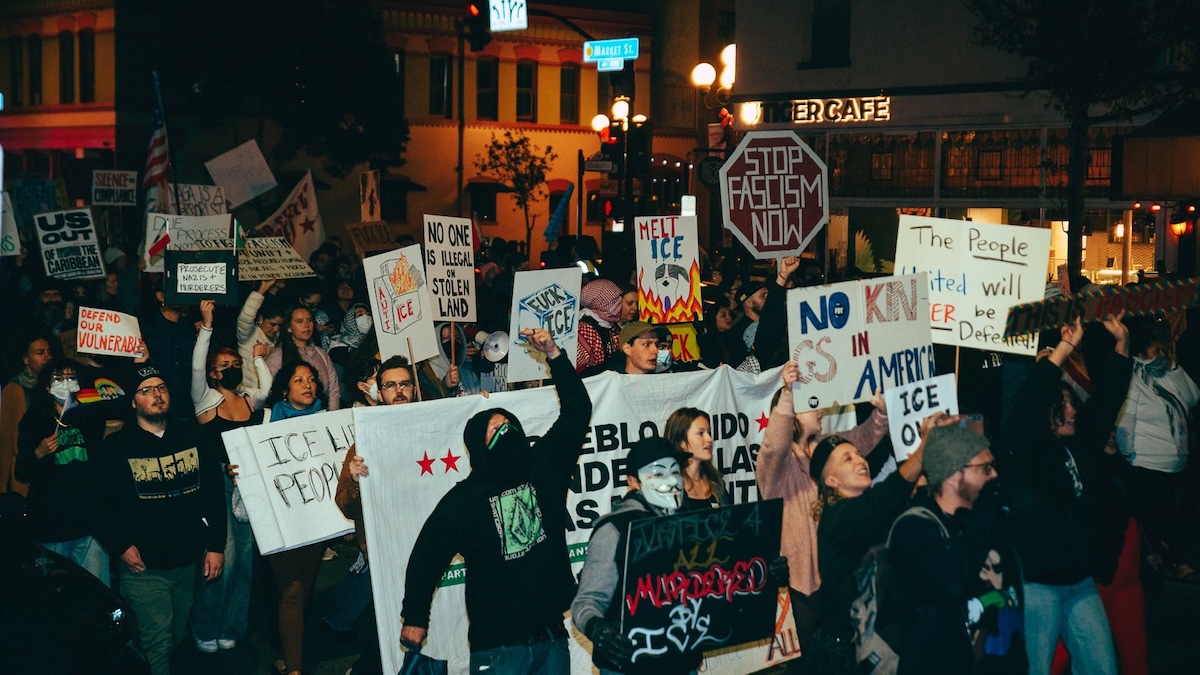
Above photo: Protest in San Diego calls for “ICE out of our communities!” Micah Fong.
In the wake of killing of Renee Good.
The ICE killing of Renee Good has sparked nationwide protests that have been met by federal force, arrests, and renewed “domestic terror” rhetoric from the Trump administration.
Protests against Immigration Customs Enforcement (ICE) are escalating across the United States. Mobilizations are calling for the arrest of Jonathan Ross, the ICE agent identified as Renee Macklin Good’s killer, and the abolition of ICE altogether.
Tens of thousands of people rallied in Minneapolis on Saturday, January 10, in the largest demonstration yet since Good’s killing.
On Friday, January 9, hundreds of protesters descended on the Hilton hotel in Minneapolis where they believe ICE and federal agents are staying. Using everything from cymbals, noisemakers, and drums to pots and pans (and even fireworks), waves of noise reverberated for several blocks and continued through the entire night.
Hundreds of riot police and state troopers were deployed to the noise protest.
Minneapolis Police Chief O’Hara had initially signaled alignment with community concerns and opposition to the federal operation. However, the noise protest highlighted the tension between federal agencies and local communities when law enforcement declared the gathering an unlawful assembly. Heavily-armed officers confronted crowds even as they demanded that those same forces arrest ICE agent Jonathan Ross and remove the federal presence from the city.
From Minneapolis to main streets nationwide, protestors mobilize
Immediately after the fatal shooting of the 37-year-old mother by an ICE agent in Minneapolis on January 7, residents began gathering at the site of the killing, demanding “ICE out of our communities!”
By that evening, thousands had flooded the residential neighborhood where Good, who had been participating in an ICE watch, was shot three times in the face in her vehicle. Makeshift memorials appeared that night, with residents placing flowers, candles, chalk tributes, and messages honoring Good.
Simultaneously with the vigils and protests in Minneapolis, cities across the United States, including New York, Los Angeles, Seattle, Philadelphia, Washington DC, Chicago, Boston, New Orleans, Phoenix, Columbus, San Antonio, Salt Lake City, San Francisco, and many others, broke out in protest demanding justice for Good and all victims of violence by ICE.
Throughout the country, waves of people marched through the streets calling for the abolition of ICE and demanding the arrest of Jonathan Ross. Speeches condemned the federal government’s attempt to label Good a “domestic terrorist”.
Ross has currently not been convicted of any crime related to the shooting, and is reportedly still an active duty officer at this time. US Vice President JD Vance even said during a press conference that the ICE agent would be immune from prosecution.
Although the protests erupted after Good’s killing, they have quickly expanded into a nationwide condemnation of militarized federal operations. Throughout 2025, ICE, Customs and Border Protection (CBP), the National Guard, and other federal forces have been deployed in various US communities resulting in multiple shootings, including the deaths of Keith Porter Jr. in Los Angeles and Silverio Villegas González in Chicago, as well as the wounding of Marimar Martinez. On Thursday, January 8, a Venezuelan couple were shot and injured by CBP agents in Portland.
This pattern of violence has galvanized communities beyond Minnesota, setting the stage for widespread resistance.
Anti-ICE protests widen into broader political resistance
”It is not enough to feel sad about what happened to Renee,” said Claudia De La Cruz, executive director of IFCO Pastors for Peace, during a speech at a rally on January 8 in Newark, NJ.
“What will make it enough is organizing, is mobilizing, is fighting, and winning!”
Many areas saw mass mobilizations, despite freezing weather, rain, and difficult conditions.
“Abolish ICE!” crowds chanted, and “Not a penny, not a dollar, we won’t pay for ICE’s slaughter!”
“We have a terrorist government that has terrorist agents, terrorizing our communities, kidnapping our people, and killing our people with impunity!” shouted Cruz to a roaring crowd.
Palestine flags and keffiyeh’s were visible at many of the protests, alongside flags from various Latin American and Caribbean countries.
Mobilizations are increasingly becoming a wider condemnation of the Trump administration. With speakers highlighting the violence of the recent US invasion of Venezuela and the kidnapping of its president, Nicolás Maduro.
“These issues are always interconnected,” said one protester at a rally in Portland. “What the United States is doing intervening abroad in Venezuela. What the United States is doing here to our people at home.”
Placards read “Hands Off Venezuela!” and “Down with US imperialism!”
This convergence of issues follows the months-long escalating US war on Venezuela, alongside intensifying militarized ICE operations in US communities. Trump’s rhetoric about the alleged threat of the Tren de Aragua gang and drug trafficking has been instrumental in justifying both campaigns in parallel.
Chants like “Healthcare and education, not war and deportation,” were part of the chorus of protests, framing the ICE killing as part of a system of “terror” by the US government both within the US and beyond its borders.
ICE intensifies violence in the wake of Good’s killing
On January 8, the day after Good’s killing, video surfaced of ICE agents firing chemical agents, pepper balls and pepper spray, at students at Roosevelt High School at dismissal time. Witnesses said the armed, masked officers came onto campus and began tackling people, dragging people on the sidewalk, and tussling with several students as bystanders shouted and blew whistles.
One school official told MPR News: “The guy, I’m telling him like, ‘Please step off the school grounds,’ and this dude comes up and bumps into me and then tells me I pushed him, and he’s trying to push me, and he knocked me down.”
“I’ve never seen people behave like this,” the official added. “They’re just animals.”
Citing “safety concerns”, Minneapolis Public Schools abruptly cancelled classes across the district for the remainder of the week.
Another video, during a demonstration in Minneapolis, shows an ICE agent pulling his gun on a protester, placing the barrel just a few inches from the person’s face.
Makeshift barricades, made of pallets, debris, and old Christmas trees, began to appear that same day on the street where Good was killed.
Law enforcement officers have reportedly met demonstrations with force, chemical agents, and arrests. At least 11 protesters were reportedly arrested on January 8 and 30 were arrested January 9 in Minneapolis.
Federal narrative clashes with local outcry
Meanwhile, the Trump administration has doubled down on its defense of the ICE killing in Minneapolis and its rhetoric that Renee Good was a “domestic terrorist”. They claim Good tried to run the agent over with her vehicle, but video footage sharply contradicts the claim. The federal government has promised to intensify deportation operations further.
Minnesota state officials have demanded to be involved with the FBI’s investigation of the killing. However, as of Friday, January 9, Hennepin County Attorney General Mary Moriarty said they still have “no access to evidence collected by the FBI.”
At the same time, the community is also rallying behind Good’s family. In a statement released to Minnesota Public Radio on Friday, Good’s wife, Becca Good, said:
“On Wednesday, January 7th, we stopped to support our neighbors. We had whistles. They had guns.”
She added, “I am now left to raise our son and to continue teaching him, as Renee believed, that there are people building a better world.”
A grassroots fundraiser has surpassed USD 1 million for Renee Good’s family, which includes three children.
Protests surge into their fourth day and beyond
Protests continued into the weekend in Minneapolis and across the country. With over 1,000 protests being organized for the coming weeks. Mobilizations broadly feature coordination between labor unions, immigrant rights groups, Palestine solidarity organizations, anti-war groups, socialist parties, anti-racist groups, and more.
As a renewed movement emerges, organizers and supporters say they view Good’s death not as an isolated tragedy but as a catalyst for sustained resistance against federal enforcement practices they see as “a reign of terror” and “a war against working class people”.
Groups are vowing to keep pressure on authorities and build momentum in the weeks ahead.