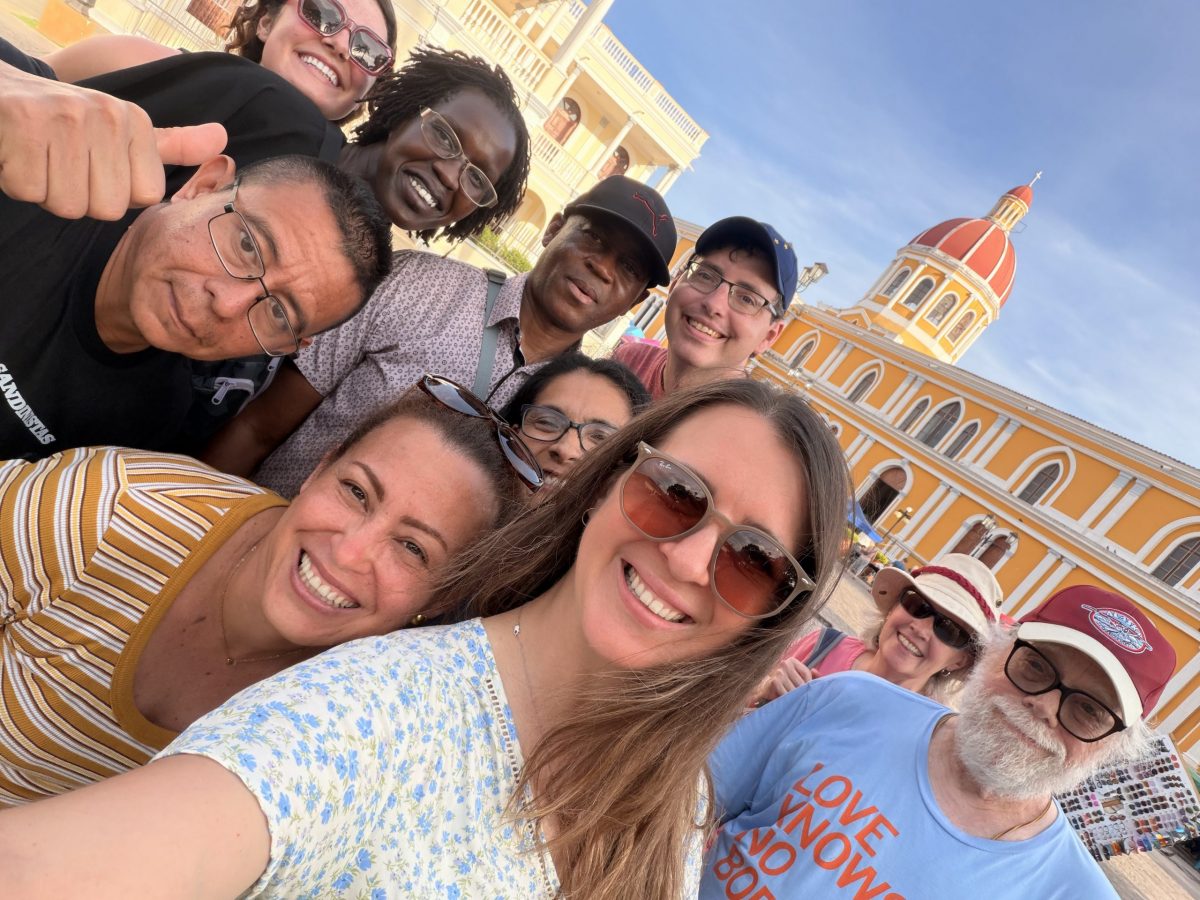
Above photo: Recent visitors to Nicaragua with Nicaraguan friend. Anastasiia Peshkova.
“Nicaragua Steals the Spotlight in Global Tourism Fairs,” read a headline in Travel and Tour World on 15 November, highlighting Nicaragua’s performance at recent industry events in the United Kingdom, China, Germany, and Canada.
“Nicaragua is rapidly becoming one of the most talked-about destinations for international tourists,” the article gushed.
Two days later on 17 November, the United States Embassy in Nicaragua announced new visa restrictions on representatives of Nicaraguan transportation companies, travel agencies, and tour operators. In a statement, the embassy claimed those affected had been “identified as knowingly facilitating illegal immigration to the United States.”
These restrictions follow a pattern of the U.S. imposing punitive measures each time Nicaragua’s tourism industry looks set to grow
In 2016-17, Nicaragua had an excellent reputation for safety, and tourism was a booming industry supporting thousands of small family businesses across the country. Following the failed coup attempt in 2018, which was led and funded by the United States, tourism has struggled to recover. One hindering factor is that since 2018, the U.S. State Department has maintained a “Level 3: Reconsider Travel” advisory on Nicaragua as part of its hybrid warfare strategy against the country.
In spite of the advisory, Nicaragua received a number of tourism accolades in early 2025: it made the top 25 places to visit by the world’s most influential travel magazine, Conde Nast Traveler. Vogue called Nicaragua an “it” destination, the country was one of the places on the top 50 list of Travel + Leisure Magazine and #14 on the New York Times List of “52 Places to Go in 2025” which called Nicaragua, “A darling of ecotourism… ready for its next renaissance.”
Apparently frustrated by Nicaragua’s resilience in the face of its attacks, the U.S. State Department held a conference warning U.S. citizens not to travel to the country.
“Despite a flurry of positive reports in the travel press, U.S. officials say Americans should avoid Nicaragua because it’s an authoritarian regime,” read a June 2025 New York Times article.
U.S. officials now claim these most recent visa restrictions on the Nicaraguan tourism industry are an attempt to slow migration to the United States.
“Investigations indicate the entities these individuals represent facilitated travel through Nicaragua, enabled by the Nicaraguan dictatorship’s permissive-by-design migration policies that destabilize the region and push illegal immigration to the United States,” the U.S. Embassy in Nicaragua said in its statement.
Nicaraguan migratory regulations allow for all visitors to enter the country upon purchasing a $10 tourist visa. Due to Nicaragua’s geographical location in the heart of the Central American isthmus, migrants traveling by land must go through Nicaragua. Rather than profiling visitors to try to stop migratory flow, Nicaragua’s policy allows equal freedom of movement for all tourists, regardless of their country of origin.
Using promoting illegal immigration as a pretext for these latest restrictions on Nicaragua, however, is particularly ridiculous in light of the fact that migration to the U.S. has now slowed to a trickle. According to U.S. Homeland Security, by June 2025, undocumented migrants apprehended at the U.S. southern border had dropped by 93% (6,072) compared to June 2024 (83,532).
In fact, with U.S. Immigration and Customs Enforcement (ICE) routinely kidnapping and disappearing people of color from the streets of the U.S., migratory flows have actually switched to north-south movement now.
So if they’re not really designed to stop migration to the U.S., what is the point of these visa restrictions?
As part of the hybrid warfare strategy, the goal is to hurt Nicaragua’s tourism industry, deal a blow to the economy, and ultimately force regime change. Attacking the tourism industry is an effective way to hurt Nicaraguan communities and families. Since the Sandinista government came back into power in 2007, Nicaragua has developed a community-based tourism model which ensures that benefits reach local people, is culturally appropriate, and minimizes the environmental impact.
This model also benefits travelers, providing an authentic experience that can be life-changing. Ken Yale, an educator and anti-imperialist activist who has travelled extensively to more than forty countries, recently visited Nicaragua for the first time on a delegation organized by Casa Ben Linder.
“As an educator, going to Nicaragua on the Women’s Empowerment Delegation was one of the most powerful experiences I’ve ever had; as an activist, one of the most inspiring; as a traveler, one of the best organized.”
Perhaps the real threat to the U.S. is not illegal immigration, but rather the danger represented by a viable tourism model that encourages people from the Global North to visit the Global South to learn about ways of being together on this earth that are not promoted within their home countries.
As Nicaraguan Tourism Minister Anasha Campbell says, “We believe…that tourism enhances that understanding between cultures and also contributes to strengthening the culture of peace in all countries.” A culture of peace in all countries certainly would be a threat to the U.S.
Becca Renk Foster is originally from Idaho, USA. For 25 years, she has lived and worked in sustainable community development in Nicaragua. She coordinates the work of Casa Benjamín Linder in Managua and serves on the coordinating committee of the Nicaragua Solidarity Coalition.