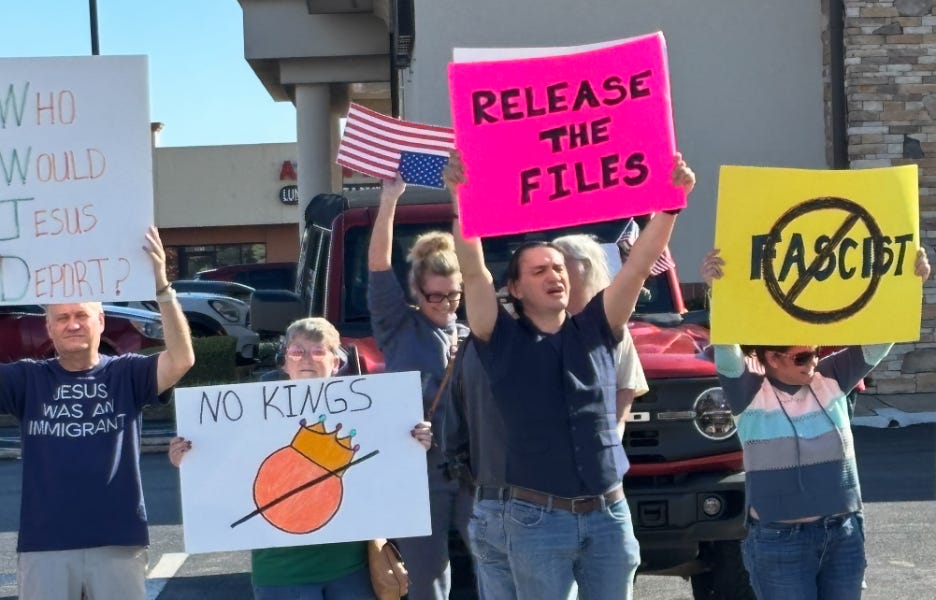
Above photo: No King’s Day rally in Tulsa, Oklahoma, October 18, 2025. Jeremy Kuzmarov.
A Color Revolution At Home?
This is the second part of a series on No King’s Day—Jeremy and Gloria.
Movements like Indivisible and No Kings brand themselves as grassroots campaigns to curb authoritarian power, rallying under slogans like “No Kings” to demand accountability.
In October 2025, No Kings staged over 2,700 protests across all 50 U.S. states, drawing millions to oppose government shutdowns, private school policies, and perceived threats from figures like Trump.
Yet, their funding reveals a stark contrast: a handful of ultra-wealthy donors, led by George Soros, bankrolls these efforts, echoing the financial tactics of color revolutions abroad—uprisings critics say prioritized Western economic and geopolitical interests over local needs.
The irony is glaring: a movement claiming to fight elite power is propped up by oligarchs, potentially destabilizing the U.S. in ways that could enrich financial speculators betting on economic collapse through short selling or other strategies. Far from empowering the masses, this setup uses relentless propaganda and social engineering to divert attention from systemic critiques of the predator class.
No Kings involves a coalition of over 200 groups, including the ACLU, MoveOn, Sierra Club, Human Rights Campaign, and Working Families Party. These partners, all funded by Soros’s Open Society Foundations (OSF) and deeply tied to the Democratic Party, amplify a network of elite-backed activism.
OSF has granted the ACLU over $347 million since 2009 for justice reform, MoveOn millions for voter drives, Sierra Club $15 million for environmental campaigns, HRC $120,000+ for LGBTQ+ advocacy, and WFP $37 million+ for labor and electoral work.
This coalition channels resources into Democratic-aligned priorities like criminal justice, climate action, and equity, steering grassroots energy away from systemic critiques of wealth concentration.
Origins and Structure
Indivisible emerged post-2016 election, launched by co-founders Ezra Levin and Leah Greenberg, alongside other former congressional staffers, to counter Trump’s agenda. Their online document, “Indivisible: A Practical Guide for Resisting the Trump Agenda,” drew from Tea Party tactics, went viral with millions of downloads, and sparked over 5,000 local chapters within months. By 2025, Indivisible drives campaigns like No Kings, coordinating with over 200 partner organizations to stage nationwide protests.
The organization operates through two entities: the Indivisible Project, a 501(c)(4) for lobbying and advocacy, and Indivisible Civics, a 501(c)(3) for education and training. Both, based in Washington, D.C., share leadership and resources. Per IRS filings, the Indivisible Project reported $7.9 million in contributions for 2023, with total revenue exceeding $12 million, reliant on large donors over grassroots support. Indivisible’s structure blends decentralized local groups with centralized tools—virtual calls, webinars, and toolkits—mimicking color revolution tactics but framed as grassroots. Critics argue this enables top-down control, channeling elite funding into curated activism that avoids critiquing wealth concentration.
Indivisible’s national team supports local chapters, ranging from small volunteer groups to well-funded urban hubs. Partnerships with Soros-funded, Democratic-aligned groups like the ACLU and MoveOn amplify reach, with No Kings events drawing 5,000-6,000 attendees in cities like Pittsburgh and Tempe. This scale, driven by elite resources, questions the “grassroots” label.
Profiles: Ezra Levin and Leah Greenberg
Ezra Levin and Leah Greenberg, Indivisible’s co-founders and co-Executive Directors, rose from obscurity as congressional staffers to fame in 2017 when their Indivisible Guide went viral post-Trump election. Media outlets like Politico, GQ, and MSNBC amplified their work, leading to a book deal for We Are Indivisible and a spot on TIME’s 100 Most Influential People list in 2019. Critics argue their rapid ascent was engineered by elite networks, particularly Soros’s OSF, which provided Indivisible $8 million+ in grants, positioning them as conduits for Democratic-aligned agendas rather than organic activists.
Levin, born ~1986 in Buda, Texas, is the son of Daniel D. Levin and Ronda Jones Levin, private citizens with no documented ties to the Democratic Party or Soros. His background—B.A. from Carleton College (2007), congressional staffer for Rep. Lloyd Doggett (D-TX), and Associate Director at Prosperity Now—reflects progressive policy work but lacks familial elite connections. His rise relied on the guide’s virality, fueled by Democratic networks and OSF funding, aligning him with party priorities like voter mobilization without direct parental links to power.
However, Greenberg, born ~1987 in Chevy Chase, Maryland, is the daughter of Mark H. Greenberg and Sara B. Anderson. Mark Greenberg served as Acting Assistant Secretary at HHS under Obama (2013-2017), overseeing poverty programs, and as a senior fellow at the Center for American Progress (CAP), a Democratic think tank funded by Soros’s OSF with over $10 million in grants since 2004. Sara Anderson worked at HHS in the Office of General Counsel. Greenberg’s childhood in Chevy Chase, a hub for D.C. insiders, and her father’s CAP and HHS roles embedded her in Democratic and Soros networks early on. Her career—B.A. from Carleton College (2008), aide to Rep. Tom Perriello (D-VA), and work at Humanity United—leveraged these ties, notably Perriello’s later role as OSF’s executive director (2018-2023). This facilitated Indivisible’s access to OSF’s $8 million+ in grants, suggesting her rise was orchestrated through elite channels. Critics see Greenberg as a sock puppet for Soros-backed agendas, her fame manufactured via CAP’s media influence and OSF’s financial backing, channeling Democratic priorities into activism.
As executives, Levin and Greenberg coordinate with the Congressional Progressive Caucus and appear on MSNBC, pushing “defending democracy” narratives. Their model—centralized communications, foundation funding, and volunteer networks—functions as social engineering, steering activists toward elite-approved issues while shielding the predator class.
Other Key Organizers and Staff
Indivisible’s team includes Angel Padilla, Policy Director, with experience at the National Immigration Law Center, and Mary Small, Legislative Director, from the SEIU and AFL-CIO. The leadership council includes regional coordinators, balancing input with centralized control. No public board is listed, suggesting executive oversight. No Kings’ coalition, backed by Soros-funded groups like the ACLU ($347 million since 2009), MoveOn (millions for voter drives), Sierra Club ($15 million for green initiatives), HRC ($120,000+ for equity), and WFP ($37 million+ for labor), mobilizes thousands, with events drawing 5,000-6,000 in cities like Pittsburgh. Chuck Schumer’s endorsements highlight Democratic ties, but critics argue these organizers use propaganda to shield elite interests.
Financial Overview
Indivisible’s 2023 Annual Report lists $14 million in contributions: foundations (41%, ~$5.8 million), major gifts (32%, ~$4.5 million), small-dollar donors (23%, ~$3.3 million), and distributed fundraising (3%, ~$0.5 million). IRS filings confirm elite sources dominate. OSF contributed nearly $8 million for No Kings, including $3 million in 2023 from the Open Society Action Fund and $3 million from the Open Society Policy Center, plus earlier grants ($1.135 million in 2022, $875,000 in 2021). Other donors include Hansjörg Wyss ($250 million+ to progressive networks) and the Tides Foundation. Coalition partners like the ACLU, MoveOn, Sierra Club, HRC, and WFP, all Soros-funded, receive millions for Democratic-aligned causes, creating a web of elite philanthropy that obscures grassroots authenticity.
Soros’s Funding and Color Revolution Parallels
OSF’s funding mirrors its role in color revolutions—Serbia (2000), Georgia (2003), Ukraine (2004), Kyrgyzstan (2005)—where it backed NGOs to drive protests aligning with U.S. goals of market access and geopolitical leverage. In Serbia, OSF-funded Otpor toppled Milošević, enabling firms like Microsoft. In Georgia, OSF-backed Kmara fueled the Rose Revolution, followed by trade deals. Ukraine’s Orange Revolution, backed by Pora, opened doors for Chevron and Cargill.
No Kings shares traits: coordinated protests, yellow banners, and elite funding. House Speaker Mike Johnson calls it a Soros-driven effort to destabilize U.S. politics, akin to a domestic color revolution targeting Trump-aligned policies. X posts allege Soros imports foreign tactics, though they lack evidence of CIA involvement. No Kings focuses on electoral influence, but its funding—Soros, Wyss, and the Sixteen Thirty Fund ($400 million+ in 2020 grants)—suggests an agenda shielding elite interests through Democratic-aligned propaganda.
Economic Instability and Short Selling Profits
Color revolutions triggered market volatility: Serbia’s dinar fell 10% post-2000; Georgia’s lari dropped 15%; Ukraine’s hryvnia lost value. Soros profited $1 billion short selling the British pound in 1992, forcing a UK devaluation. In 1997, he shorted the Thai baht and Malaysian ringgit, netting billions. In 2011, he earned $1.4 billion shorting the Japanese yen post-tsunami. Critics speculate No Kings’ protests could weaken U.S. markets—perhaps ahead of 2028 elections—creating short selling opportunities. No evidence ties OSF grants to trades, but Soros’s trading profits fuel OSF, raising suspicions.
Other strategies include shorting equity index futures, buying bonds or Treasury notes, dividend stocks, real estate, or CDs/savings accounts. No Kings’ push for green energy or wealth taxes could favor donors like Tom Steyer, amplifying volatility.
The Oligarchic Irony
No Kings rails against concentrated power, yet its reliance on Soros, Wyss, and the Sixteen Thirty Fund reveals a top-down operation. This mirrors color revolutions, serving Western market goals—like firms entering Serbia or Ukraine. The agenda is electoral, but elite funding undercuts the anti-elite narrative.
Conclusion
No Kings, backed by Soros’s millions, echoes color revolutions: coordinated protests, symbolic branding, and elite funding. It stokes division, potentially unsettling markets to benefit short selling. Soros’s exploits—1992 pound short, 1997 Asian crisis, 2011 yen trade—power OSF, fueling skepticism. OSF grants and IRS filings expose the money trail. Activists fight “kings,” but oligarchs’ cash makes them pawns in a game they didn’t even know they were playing.